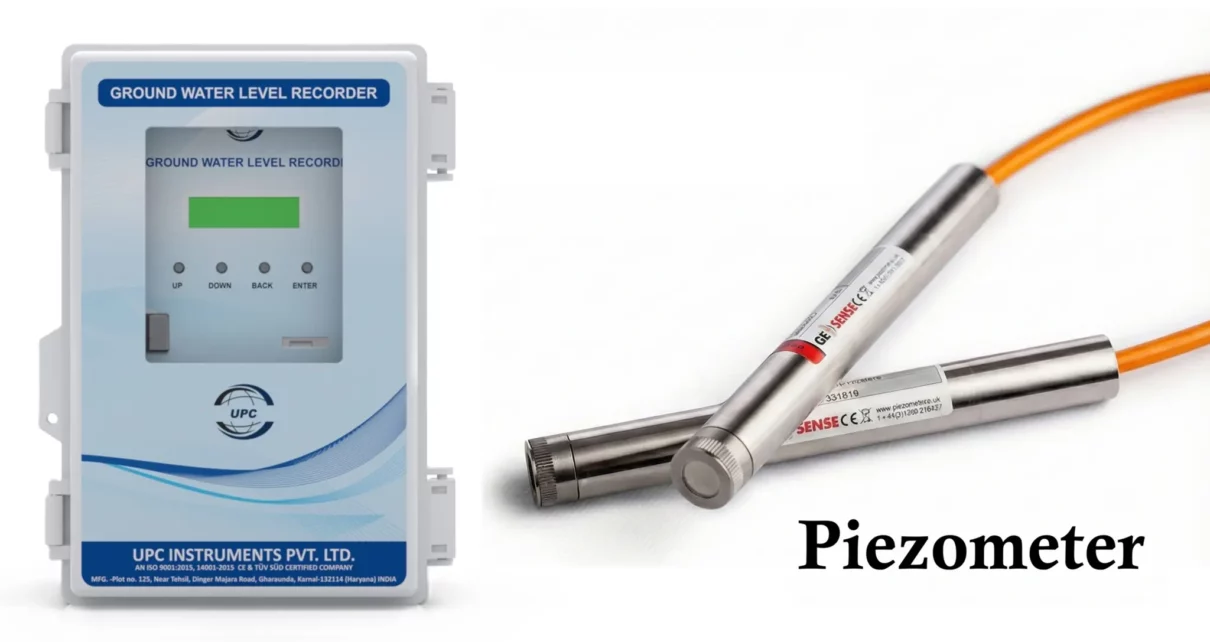
A piezometer is a geotechnical sensor that is employed for measuring porewater pressure at the ground level, which is called the piezometric level. Its main features are to measure water pressure in the earth, soil, and strong concrete designs.
Pore pressure gauges provide data for the magnitude of pore pressures and evolution. We can also determine the seepage layout, piping area, and seepage control factors. In this tutorial, we will learn about the practical working of a piezometer for finding its importance in pressure calculations and other features.
What is a Piezometer?
- A piezometer, also called a pore pressure meter, is a pressure transducer that is connected underground for measuring the below-surface level of soil and rock, which is called the piezometric level.
- By measuring pore pressures, we find features after construction and find the layout of the bad effect on the structure, foundation, and related parameters.
- It also gives details on whether any improvements are needed that make low-cost and structural designs.
- Piezometers were the first geotechnical engineering tools, also called Casagrande piezometers, that were sunk into liquid.
- The classic Casagrande design comes with a solid pipe connected to the earth for measuring and filtering, where we want to measure groundwater pressure.
- For accurate calculations, the casing of the well is sealed off with clay and concrete. That avoids water from sneaking in and throws off groundwater readings.
- Note that for the confined aquifer water level, we observe in the piezometer, not aligned to the real water level normally for vertical flow.
- For an artesian aquifer, the level of a piezometer shows the pressure of the aquifer compared to the required water level.
- There is no need for a larger diameter of a piezometer well; most are narrow standard manufacturing wells.
- piezometers connected in a strong casing and buried in the ground at the point where we measure groundwater pressure
Working of Piezometer
How a Vibrating-Wire Piezometer Works?
- Water pressure pushes on a diaphragm
Underground water pressure (pore pressure) acts on a flexible metal diaphragm inside the piezometer.
Higher water pressure → more diaphragm movement. - The diaphragm is connected to a steel wire
A strong magnetic steel wire is stretched tightly inside the sensor.- One end is fixed.
- The other end is attached to the diaphragm.
- Pressure changes → diaphragm moves → tension changes
When pore pressure increases, the diaphragm bends inward and tightens the wire.
When pressure decreases, the diaphragm relaxes and the wire becomes less tense.More water pressure = higher wire tension
Less water pressure = lower wire tension - A coil “plucks” the wire and makes it vibrate
A small electromagnetic coil briefly energizes the wire, causing it to vibrate like a guitar string. - The wire vibrates at a natural frequency
The vibration frequency depends on the tension in the wire.- Tight wire → vibrates faster → higher frequency
- Loose wire → vibrates slower → lower frequency
- The vibrating wire induces a frequency signal
The coil detects this vibration and sends the frequency to the readout or data logger. - Frequency is converted to pore-water pressure
Because wire tension directly depends on pressure, the vibration frequency tells us the water pressure acting on the diaphragm.
Frequency of Vibrating Wire Piezometer
The natural frequency f of the vibrating wire piezometer is:
f = {[(σ g) / ρ]¹ᐟ²} / (2l) Hz
What each term means:
- f = vibration frequency (Hz)
- σ = axial stress (tension) in the wire
- g = gravitational acceleration
- ρ = density of the wire material
- l = vibrating length of the wire
What the formula tells us:
- Higher stress (σ) → higher frequency f
- Lower stress (σ) → lower frequency f
- Stress is directly controlled by water pressure acting on the diaphragm.
It’s basically saying:
Wire tension ↑ → wire vibrates faster
Wire tension ↓ → wire vibrates slower
Types of Piezometers
Open Tube
- Its main function is to measure pressures below ground through the upper surface. For this purpose, a depth indicator is applied on the ground that inserts into a small hole. that helps to measure pressures accurately
Vibrating Wire
- This type measures pressures with the help of vibration frequency. This process is based on direct proportionality with vibration frequency with water pressures.
- This is performed by making pores where tools are put that are configured with rope.
- That model provides higher accuracy than other techniques due to the movement of the rope.
Standpipe Piezometers
- The standpipe piezometer is commonly used. that has a filter tip connected with a riser tube coming out from the surface. Water moves through the filter up to the point into the riser tube.
- values measured at the water level indicator.
Vibrating Wire Piezometer
- • A vibrating wire piezometer is also used, where it is connected in a borehole configured with infill and suspended over a standpipe.
- values measured through a portable readout or data logger.
Pneumatic Piezometers
- A pneumatic piezometer operated with gas pressures is connected in a borehole with a filler and connected with a larger diameter standpipe.
- Values are measured with a pneumatic indicator.
Titanium Piezometer
- A titanium piezoelectric meter, also called a 4-20 mA device, that supported industrial data loggers. used to perform drop-down testing
Pneumatic Piezometers
- This type gives indirect techniques for measuring below-surface water pressures through the use of compressed gas.
- Basic working is simple: gas is added into the piezometer tube till pressure is applied with groundwater of the surrounding soil.
- After reaching the balance point, equilibrium pressures are calculated on the surface, directly related to pore water pressures below ground.
- The piezometer is connected properly in the borehole and is typically used with larger-diameter standpipes, depending on project requirements.
- The transducer is connected to the terminal box through pneumatic tubing, which must be routed carefully and protected near the ground surface.
Difference Between Manometer and Piezometer
Manometer
A manometer is a device employed for measuring fluid pressure. According to different features, manometers have different types.
- Well-type manometer
- Inclined-tube manometer
- U-tube manometer
- Enlarged-leg manometer
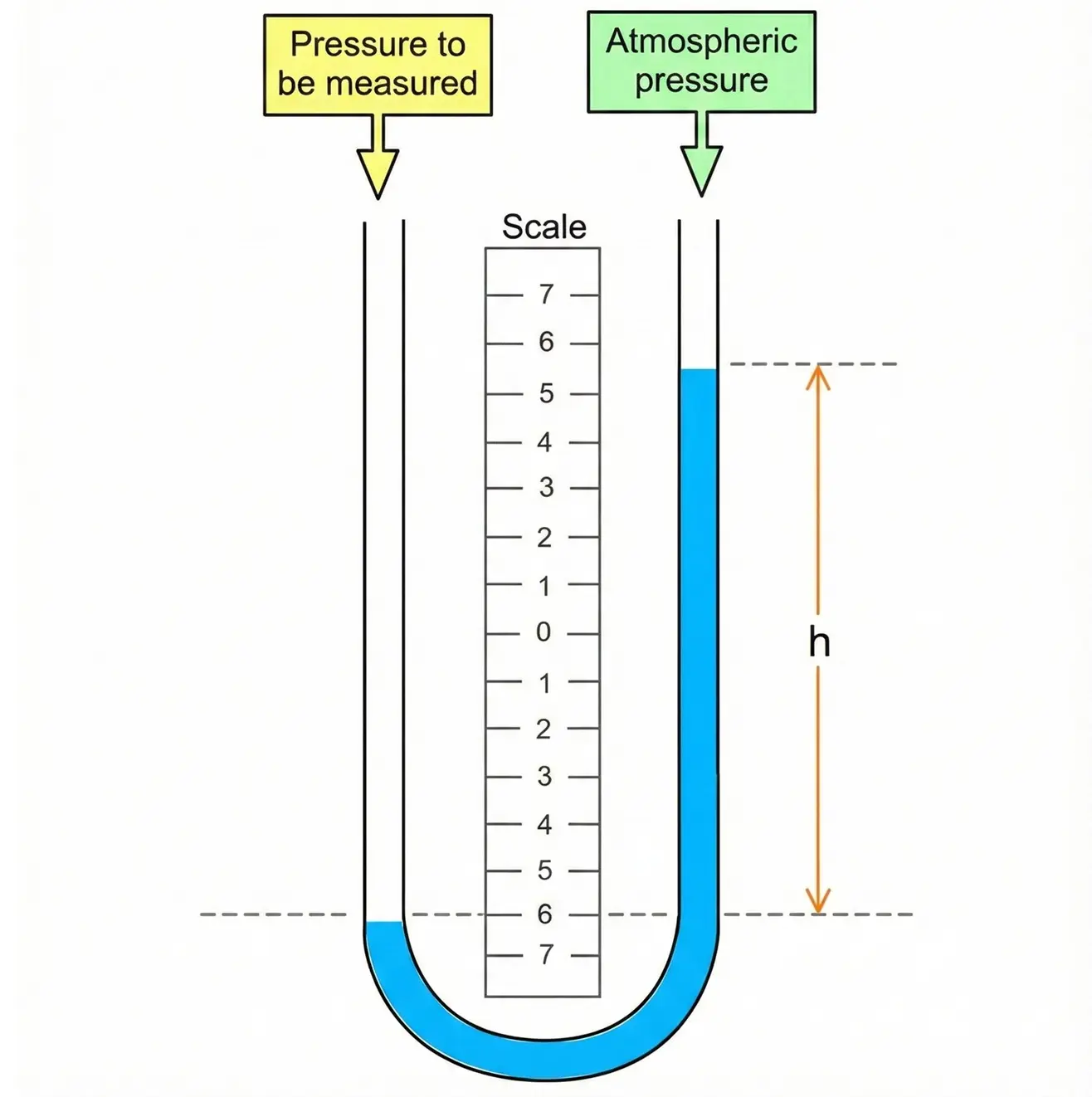
A U-tube manometer is a commonly used module. It comes with a U-shaped tube that is filled with reference fluid, like mercury, that shows the pressure level. When the column is exposed to the atmosphere, the liquid level in the column becomes equal and shows atmospheric pressure. If any column is connected with a pressure vessel, the difference in liquid levels in the limbs can be seen. That shows the pressure of fluid in the vessel.
Piezometer
A piezometer is a device used to measure underground water pressure. It converts water pressure into a frequency signal using a diaphragm and a steel vibrating wire.
When pressure acts on the diaphragm, the wire’s tension changes, causing it to vibrate at a different natural frequency. These vibrations are detected by a coil and sent to a measuring device.
Piezometers are commonly used for groundwater measurements. In open-well installations, they indicate the water level or hydraulic head within an aquifer.
They are durable instruments installed in the ground to measure groundwater pressure at specific points.
| Feature | Manometer | Piezometer |
| Measurement | gas and liquid pressure | liquid pressure or liquid head only |
| Pressure Type | measure, gauge and differential pressure | measure positive gauge pressure for static, incompressible fluids |
| uses | measures pressure differences | low-pressure measurements in pipes, wells, and for groundwater studies |
| Fluid | both compressible and incompressible fluids | static, incompressible liquids |
| Complexity | Can be more complex (e.g., U-tube, inclined) | A simple device has a single vertical tube |
How to use a manometer with a pitot tube?
The Pitot tube pressure measuring device is put into the duct with the upper part directed to the airflow. The positive part of the manometer is connected with the total pressure port, and the negative with the static pressure port. A manometer shows velocity pressure that transforms velocity.
Advantages of Piezometers
- Provide accurate and reliable measurement of pore-water pressure.
- Useful for monitoring groundwater fluctuations over time.
- Vibrating-wire types offer long-term stability and low drift.
- Can be installed at different depths for layered soil analysis.
- Suitable for harsh underground and underwater environments.
- Data can be collected manually or with automated data loggers.
- Simple open-well piezometers are low-cost and easy to maintain.
- Allow early detection of seepage, piping, and instability in soil structures.
Disadvantages of Piezometers
- Installation requires drilling or boreholes, which can be costly.
- Response time can be slow in low-permeability soils (e.g., clay).
- Can become clogged by fine sediments or mineral deposits.
- Require careful installation to avoid leakage around the casing.
- Pneumatic and vibrating-wire types need specialized reading equipment.
- Damage to cables or tubing can affect accuracy or cause failure.
- Not suitable for measuring gas pressure (especially open-tube types).
Applications of Piezometers
- Monitoring pore-water pressure in dams, embankments, and levees.
- Groundwater studies in wells, aquifers, and drainage systems.
- Stability assessment of slopes, cuttings, and retaining structures.
- Monitoring seepage in earth-filled structures and tunnels.
- Foundation engineering to evaluate settlement and structural safety.
- Environmental engineering for landfill and contamination monitoring.
- Construction monitoring to assess the effect of excavation or dewatering.
- Hydrological research for understanding soil–water interactions.
Conclusion and FAQ
Piezometers are essential instruments in geotechnical and hydrogeological engineering, providing accurate measurement of pore-water pressure in soil and rock. Their ability to detect pressure changes helps engineers ensure the safety of structures such as dams, slopes, and foundations. Although installation and maintenance require care, the reliability and long-term performance of piezometers make them valuable tools for monitoring groundwater behavior and assessing soil stability.
Is a piezometer a simple manometer?
Yes. A piezometer is a simple form of manometer used to measure gauge pressure in liquids. One end is connected to the point where pressure is to be measured, while the other end is open to the atmosphere.
Because it has an open end, a piezometer cannot be used to measure gas pressure, only liquid pressure.
What is another name for a piezometer?
A piezometer is a type of pressure sensor used to measure the pressure of liquids (especially groundwater). Pressure sensors in general may also be called transducers, pressure transmitters, pressure senders, pressure gauges, or manometers, depending on their design and application.
What is a manometer also called?
A manometer is also known as a pressure meter or pressure gauge. It is used to measure the pressure of gases or liquids, often by comparing the fluid level difference within a U-tube or similar device.
Beyond the Pixel: The Definitive Guide to the Dell Monitor Ecosystem