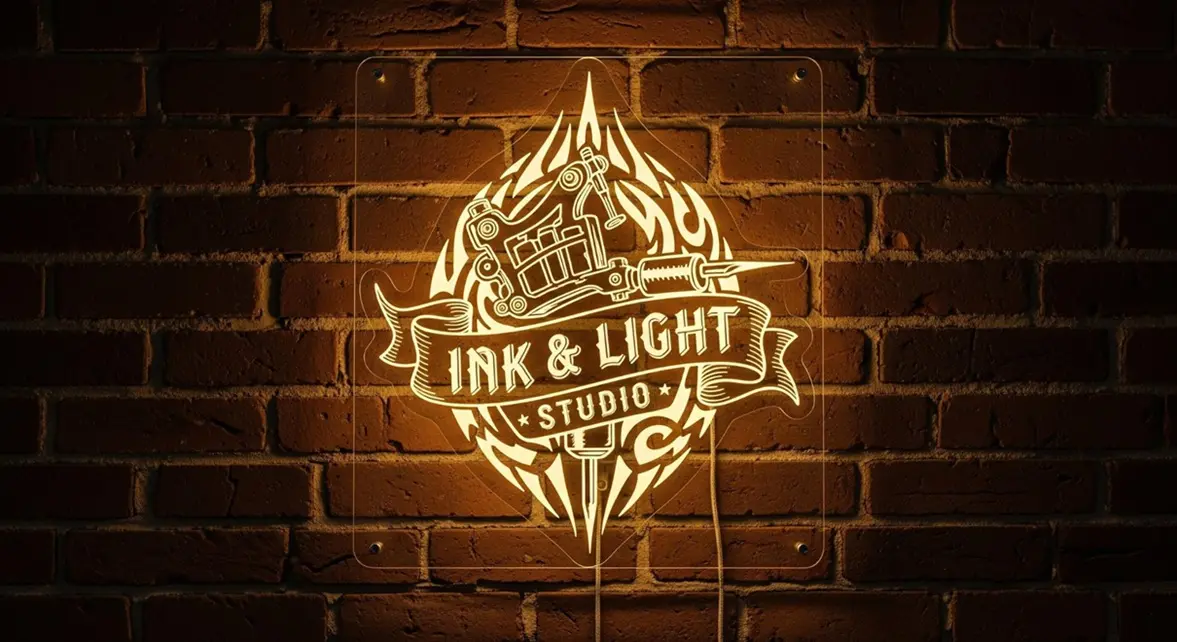
You are a tattoo artist and want your shop to be special, there is no better solution than a hand-made LED shop sign with your own logo. That complex design that you have drawn can turn out to be a shining light that attracts the customers to your door. But how do you take a tattoo logo idea and turn it into something safe and useful as an LED shop sign? Let’s walk-through the process together.
Starting With Your Design
Your tattoo logo conveys personality, boldness, and artistic flair that reflects your style. The first step is to translate the design into a format sign makers can manipulate. Start with a high-resolution scan, or provide a vector file such as SVG or AI, which allows the artwork to scale to any size without quality loss.
Most tattoo artists are now experimenting with AI in creating new tattoo designs with AI or improving on the existing ones. These are the tools that can allow you to test the options until you settle on the final one. The trick is to ensure the design converts cleanly into LED tubing. In other words, you must assess whether the line thickness, negative space, and curve shapes can be accurately reproduced with flexible LED strips.
Choosing The Right LED Technology
The traditional glass neon sign has come to the end of its road, with LED neon flex taking the leading role. LED neon flex consists of flexible silicone tubing filled with LED strips. The modern alternative is not only safer, but it also consumes less energy and requires less upkeep compared to the delicate glass tubes.
LED neon flex comes in a range of colors, brightness levels, and tube diameters. For a tattoo shop sign, you will likely want something bright enough to stand out without losing a warm, inviting feel. Most professionals recommend tube sizes between 8 mm and 15 mm, depending on the complexity of your logo. Warm colors generally create a friendlier aesthetic for a tattoo studio, but you can also achieve dramatic effects with bold blues, purples, or reds.
Working With Professional Sign Makers
As much as DIY projects sound enticing, the implementation of LED signs is electrical work, which cannot be both impressive and safe without the knowledge of an expert. Your digital design would be sent to a reputable sign maker who would make a template by bending the LED flex tubing to fit the shapes of your logo. They will attach all of it to a back board and seal everything.
Provide reference pictures, describe the mood you want to achieve, and explain how you plan to mount the sign. Indoor signs do not require the same specifications as outdoor installations, particularly regarding weatherproofing. Your sign maker should present samples or mockups so you can review the intended final product before fabrication begins.
Understanding The Electrical Requirements
The LED signs should have adequate power supply, wiring, and installation to avoid hazards. You will need a transformer to step down standard line voltage to the low voltage your sign requires, typically 12V or 24V DC for LEDs. Ensure the transformer is UL-listed and rated to handle the total wattage of your sign.
Determining the gauge of wire is a necessary precaution. A Wire Gauge Calculator is useful in calculating the proper thickness of the wire required by the amount of power your sign will require and its distance to the power source. Excessively thin, and it may drop on the voltage or overheat.
Unless you plan to hardwire the sign into your building’s electrical system, you will need to account for junction box requirements. Ensure the junction box is properly sized to accommodate all wires and connectors that will be installed in it and verify that it meets applicable electrical codes. A free electrical box fill calculator may come in handy. Overstuffed junction boxes are a common code violation and fire hazard.
Installation And Safety
The location where you install your LED sign influences the aesthetic appearance as well as the safety of that sign. The outdoor signs must have weatherproof casings or covers to avoid water penetration. Apply proper anchors that are within your range of required weight of your sign and take into consideration the accessibility of later cleaning or maintenance.
The compliance of electrical codes is no bargain. In some places, you can install signs without permission. Hiring a licensed electrician means that your sign will be quality and meet local standards and will not fail on inspection, so your business and customers will not be liable.
Maintenance And Longevity
Quality LED neon flex has a life of up to 50,000 hours or longer, this would mean that your tattoo logo would shine year after year with very little upkeep. Clean frequently- soft cloths and mild cleaners, do not spray water directly at the electrical parts.
Periodically (check every few minutes) check your sign: dimming areas, flickering or damage to the tubing. Small problems are addressed at an early stage to avoid bigger ones. The latter are LED signs that have replaceable segments, and do not require replacement of the entire unit.
Bringing Your Vision to Life
It takes imagination and skills to convert your tattoo logo into a secure LED shop sign. With the help of expert professionals, selection of good materials, and attention to electrical safety, you will make a beautiful LED sign that will be the emblem of your brand, and it will attract clients for several years.
Your logo is not a decoration, but your artistic signature and your offer to potential clients. Your logo can be shining over your door and before your customers walk through the door it tells your story. Are you willing to begin planning your custom LED shop sign? Contact sign fabricators in your locality, post your logo image and start talking about how you want to realize your dream.
Beyond the Pixel: The Definitive Guide to the Dell Monitor Ecosystem

I love how you emphasize the importance of high-resolution scans and vector files, it makes the process feel so much more manageable and professional.