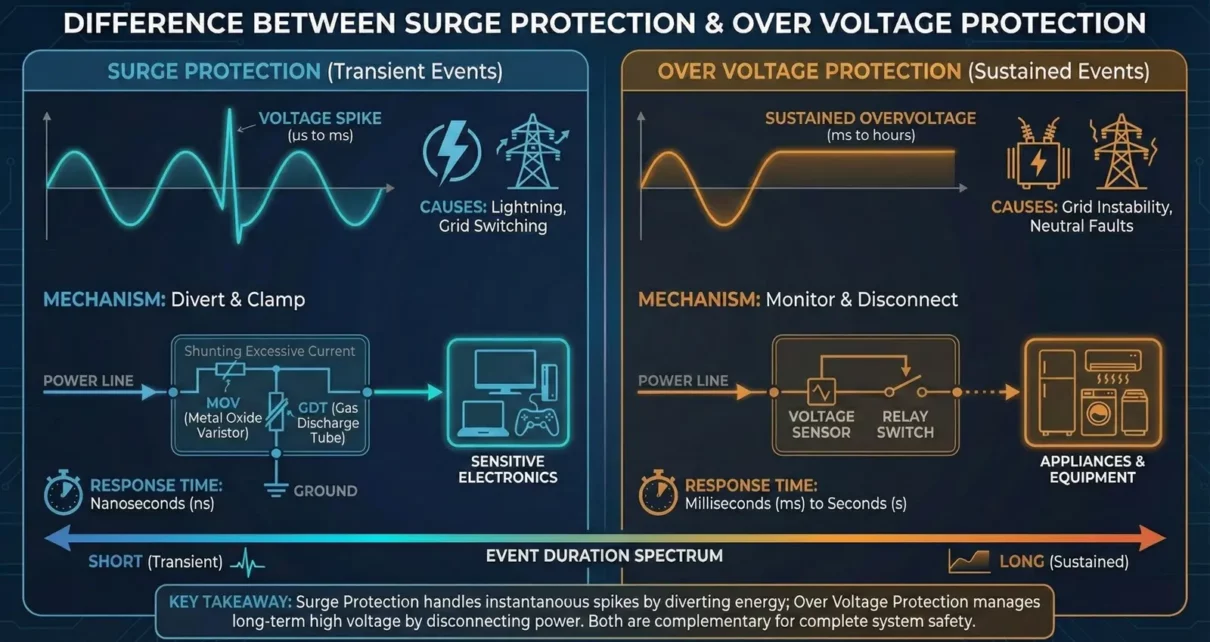
Understanding the difference between Surge Protection and Over Voltage Protection is essential for designing robust electronic systems, selecting the right protective components, and complying with safety and EMC standards.
Modern electronic and electrical systems are increasingly sensitive to abnormal voltage conditions. With the widespread use of microcontrollers, SMPS power supplies, communication modules, and semiconductor devices, even small deviations from nominal voltage levels can cause malfunction, data corruption, or permanent damage. The two important protective concepts used in power and signal integrity engineering are:
- Surge Protection
- Over Voltage Protection (OVP)
Although these terms are sometimes used interchangeably in casual discussion, they represent fundamentally different phenomena and protection strategies. Surge protection is intended to defend against very fast, high-energy transient events, while overvoltage protection handles longer-duration voltage increases beyond safe operating limits.
What is a Surge?
A surge is a sudden, short-duration spike in voltage or current, typically lasting from nanoseconds to a few milliseconds, with amplitudes that can be several times higher than the nominal system voltage.
Common causes of surges
- Lightning strikes (direct or indirect)
- Switching of large inductive loads (motors, transformers)
- Power grid faults and recovery
- Electrostatic discharge (ESD)
- Utility switching operations
Characteristics of a surge
- Duration: Nanoseconds to milliseconds
- Amplitude: Hundreds to thousands of volts
- Energy: Moderate to very high
- Occurrence: Rare but unpredictable
Surges are transient events, not steady-state conditions.
Related Articles
- Over Voltage Protection Circuit Diagram Based on Relay
- Over Current/Short Circuit Protection Using LM358 OPAMP
- Short Circuit Protection Using Relay for Batteries
What is Over Voltage?
Overvoltage is a condition where the supply voltage exceeds its rated maximum for a relatively long time — from milliseconds to minutes or even permanently.
Common causes of overvoltage
- Regulator or feedback loop failure
- Open neutral in a three-phase system
- Incorrect adapter or power supply
- Load dump in automotive systems
- Battery overcharging
- Faulty SMPS control circuitry
Characteristics of overvoltage
- Duration: Milliseconds to hours
- Amplitude: 10% to 200% above nominal
- Energy: Low to moderate per unit time, but sustained
- Occurrence: Fault-driven and persistent
Overvoltage is a steady or semi-steady abnormal condition, not a transient.
Surge Protection: Concept and Operation
Definition
Surge Protection is the process of limiting the peak voltage and diverting excess energy caused by transient surges away from sensitive equipment.
Primary objectives
- Clamp voltage spikes to safe levels
- Divert surge current to ground or neutral
- Absorb or shunt surge energy
- Prevent insulation breakdown and semiconductor damage
Common surge protection devices (SPDs)
- MOV (Metal Oxide Varistor): Voltage-dependent resistor that clamps high voltage
- TVS Diode: Fast semiconductor clamping device
- Gas Discharge Tube (GDT): Breaks down and conducts at high voltage
- Spark Gaps: Physical arc discharge path
Response behavior
- Surge protectors are Very fast (sub-nanosecond to microsecond response)
- Normally non-conductive
- Conduct only when voltage exceeds a threshold
- Return to high impedance after the surge
Over Voltage Protection: Concept and Operation
Definition
Over Voltage Protection (OVP) is a control or protection mechanism that detects and reacts to sustained overvoltage conditions, typically by shutting down, disconnecting, or crowbarring the supply.
Primary objectives
- Prevent long-term over-stress of components
- Protect against regulator or supply faults
- Ensure compliance with absolute maximum ratings
- Protect loads from thermal and electrical damage
Common OVP methods
- Crowbar circuit: Shorts the supply using an SCR when voltage exceeds the limit
- OVP ICs: Monitor voltage and disable power when a fault is detected
- Relay cutoff: Disconnects the supply when the threshold is exceeded
- Zener reference + comparator: Detects overvoltage and triggers the protection mechanism
Response behavior
- OVP systems are slower than surge protectors
- Intentionally react after verifying overvoltage
- Usually latch off or require reset
- Protect against prolonged exposure
Surge Protection vs Over Voltage Protection
| Parameter | Surge Protection | Over Voltage Protection |
|---|---|---|
| Nature of event | Transient spike | Sustained abnormal voltage |
| Duration | ns to ms | ms to hours |
| Energy | Very high, short | Moderate, long |
| Cause | Lightning, switching, ESD | Regulator failure, wrong supply |
| Response time | Extremely fast | Fast but not ultra-fast |
| Action | Clamps or diverts spike | Disconnects or shuts down |
| Typical devices | MOV, TVS, GDT | Crowbar, OVP IC, relay |
| Purpose | Absorb transient energy | Prevent long-term stress |
| System behavior after event | Continues normal operation | Often shuts down or resets |
Why Both Are Needed in Practical Systems?
In a real-world system:
- Surge protection alone cannot prevent damage from a faulty regulator that outputs 18 V instead of 12 V for minutes.
- OVP alone cannot protect against a 2 kV lightning transient that lasts 1 µs.
Therefore, robust designs often use both together:
- Surge protection at the input stage (TVS + MOV)
- OVP inside the power management stage (supervisor IC + shutdown)
This layered approach is called defense-in-depth protection.
Applications of Surge Protection
- Power distribution systems
- Substations, switchgear, and transformers
- Protection against lightning strikes and grid switching transients
- Industrial automation
- PLC inputs/outputs, motor drives, sensors, and actuators
- Prevents damage from inductive load switching and ground potential rise
- Telecommunications and data lines
- Ethernet, RS-485, CAN, telephone lines, RF feeders
- Protects sensitive transceivers from ESD and lightning-induced surges
- Consumer electronics
- TVs, computers, home appliances
- Protection from utility switching surges and nearby lightning events
- Renewable energy systems
- Solar PV strings, wind turbine controllers, inverters
- Protection against atmospheric surges and long cable runs
- Automotive and transportation
- ECU interfaces, sensors, infotainment systems
- Protects against load dump, inductive kickback, and ESD
- Medical equipment
- Patient-connected devices and monitoring equipment
- Prevents damage and ensures safety compliance
Applications of Over-Voltage Protection
- Power supplies and regulators
- SMPS, linear regulators, battery chargers
- Prevents downstream damage if regulation fails
- Battery-powered systems
- Li-ion battery packs, BMS, EV battery systems
- Prevents overcharging and thermal runaway
- Industrial control systems
- Protects PLCs, I/O modules, and control electronics from miswired or failed supplies
- Telecom and networking equipment
- Protects ICs from DC overvoltage caused by faulty adapters or PoE faults
- Consumer electronics
- Smartphones, laptops, TVs, routers
- Protects processors and ICs from adapter or charger faults
- Automotive electronics
- Protects ECUs and sensors from alternator faults and load dump conditions
- Aerospace and defense electronics
- Protects mission-critical electronics from abnormal supply conditions
Summary
Surge protection and overvoltage protection address different electrical hazards:
- Surge Protection handles short-duration, high-energy transient events.
- Over Voltage Protection handles long-duration abnormal voltage conditions.
They differ in time scale, energy profile, implementation, and system response. Treating them as the same can lead to under-protected or over-designed systems.
A properly engineered electronic system uses both, ensuring resilience against unpredictable environmental disturbances as well as internal electrical faults.
Conclusion
Understanding the difference between surge protection and overvoltage protection is essential for engineers working in power electronics, embedded systems, industrial automation, automotive electronics, and renewable energy systems. By selecting the correct protection mechanisms and placing them appropriately within the system architecture, designers can significantly improve reliability, safety, and regulatory compliance.
H Bridge Inverter Circuit using IC SG3525 and MOSFET IRFZ44N