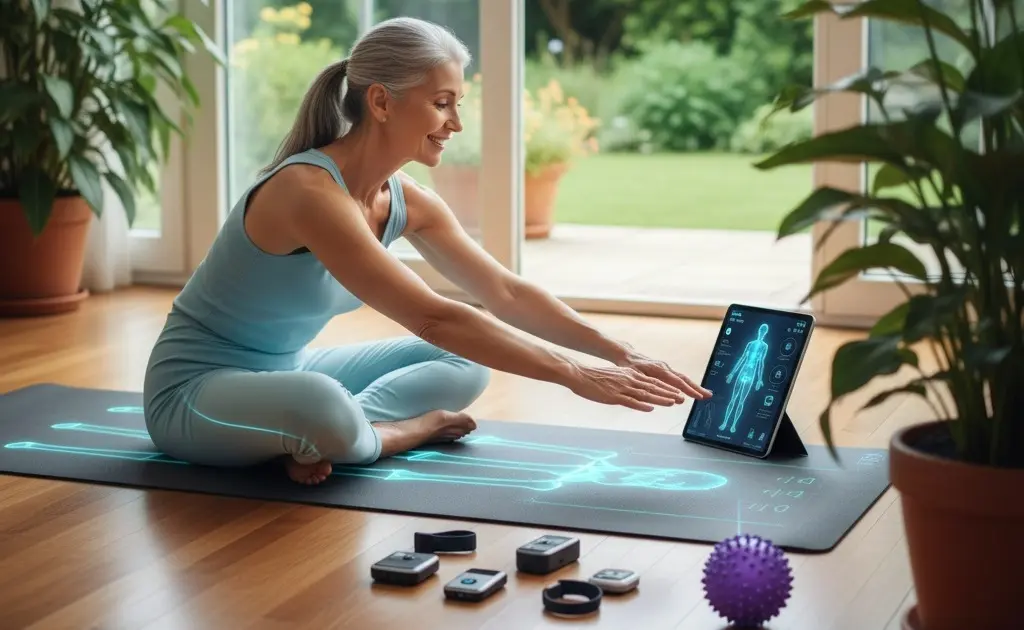
Smart yoga gear looks less like science fiction and more like everyday health support now that seniors are actively searching for gentle ways to stay limber. Whether a resident of an assisted living community unwinds in a sunlit activity room or a retired couple stretches beside the living-room sofa, sensor-rich mats and companion devices translate timeless poses into data-backed guidance.
By recognizing shaky balance, mapping breath rhythm, and coaching alignment in real time, these innovations reassure older adults that every reach, twist, and fold happens safely despite aging joints and unpredictable energy.
Sensor-Infused Surfaces Raise Body Awareness
Pressure-sensitive mats paint a living heat map of weight distribution, letting seniors see exactly where pressure gathers during mountain pose or wobbles through warrior two. When balance drifts too far forward, a cool blue ring turns amber, causing a subtle shift rather than an abrupt correction.
Conductive threads survive years of rolling, wiping, and the occasional grandchild stomp, while slim rechargeable cells disappear under cushioning that spares tender wrists. Firmware updates fine-tune sensitivity as flexibility improves, so the mat evolves alongside its owner rather than gathering dust.
Gentle Biofeedback Keeps Joints Safe
Mat readings now sync with elastic electromyography bands that listen to muscles whisper and bark. If calf fibers protest during a prolonged downward dog, a discreet vibration at the ankle suggests easing out before soreness blossoms. Infrared strips, meanwhile, notice skin temperature spikes, early hints of inflammation and propose a cooling pause.
Every algorithm was shaped with geriatric physiotherapists who value preservation over performance, so guidance errs on the side of caution. Seniors get the confidence of a watchful coach without the self-consciousness that sometimes shadows group classes.
Wearables Turn Practice into a Story of Progress
Lightweight heart-rate cuffs, gyroscopic wristbands, and posture-tracking pendants all speak the same language as the mat. Together, they assemble weekly flexibility snapshots that can be shared with physicians or curious grandchildren. If a bridge pose once lasted three seconds but now holds for eight, the trend line cheers the victory in bright green.
Should heart rate creep beyond safe zones, sequences shorten until stamina rebounds. Data may be digital, yet the resulting encouragement feels wonderfully human to seniors striving for steady improvement.
Voice and Vision Tech Remove Barriers
For seniors managing tremors or fading eyesight, a gentle voice assistant embedded in the practice hub responds to requests for slower pacing or brighter text. High-contrast displays approved by occupational therapists project oversized illustrations that remain crisp even when glasses wander off.
Subscription libraries sort routines by knee sensitivity, balance level, and recovery stage, so participants choose flows matching today’s mood rather than yesterday’s ambition. Multilingual narration opens doors for newcomers who once believed yoga belonged to someone else’s culture.
Conclusion
Smart yoga mats and their allied devices demonstrate that thoughtful engineering can honor the wisdom of aging bodies while still inviting playful exploration. By merging subtle sensors, compassionate software, and inclusive design, technology turns what might feel like a daunting exercise routine into a daily ritual of self-care.
The result is not merely flexible hamstrings; it is renewed curiosity, steadier confidence, and the satisfying realization that adventure can thrive every day long after retirement begins.
What Do You Need to Know Before Installing a Home EV Charger?
Best Driveway Lights to Enhance Your Home’s Safety and Style
Ethical AI and the Future of Emotionally Intelligent Machines