
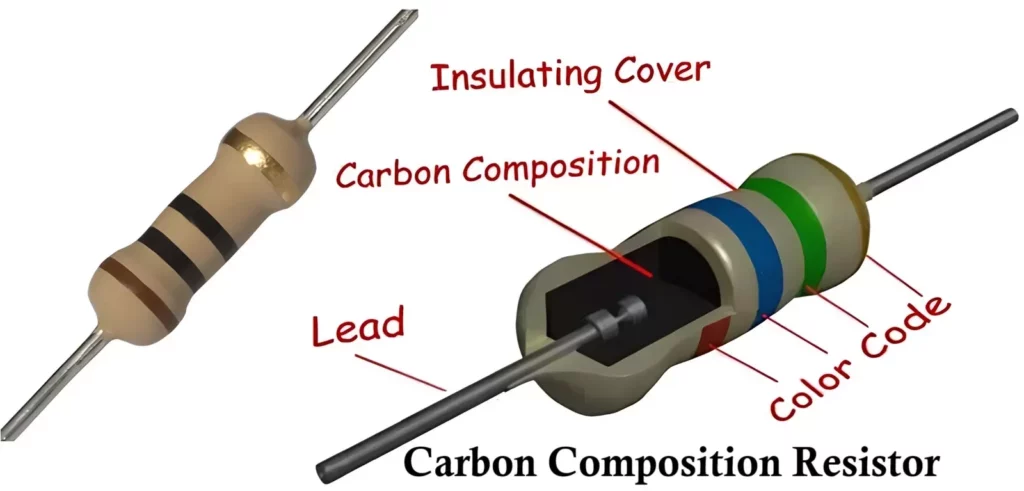
Let’s Explorer Carbon Composition Resistor symbol, construction, working, types, value reading, advantages, disadvantages, and applications explained in the clearest way.
Carbon composition resistors were once the most common type of resistors used in electronic circuits. Though largely replaced by more modern resistor types today, they still hold importance in high-energy pulse and vintage circuit applications. This article explores everything about carbon composition resistors in a detailed and simplified way.
Symbol of Carbon Composition Resistor
The symbol of a carbon composition resistor is the same as a general resistor, as circuit diagrams usually don’t differentiate between resistor types.
Circuit Symbol:
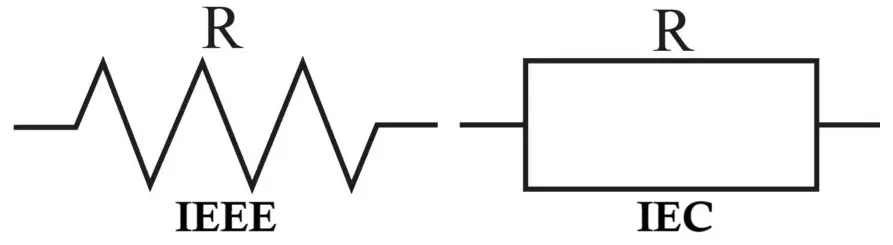
There is no separate symbol specifically for carbon composition resistors — the type is identified by the component’s body or label in the Bill of Materials (BOM).
Construction of Carbon Composition Resistor
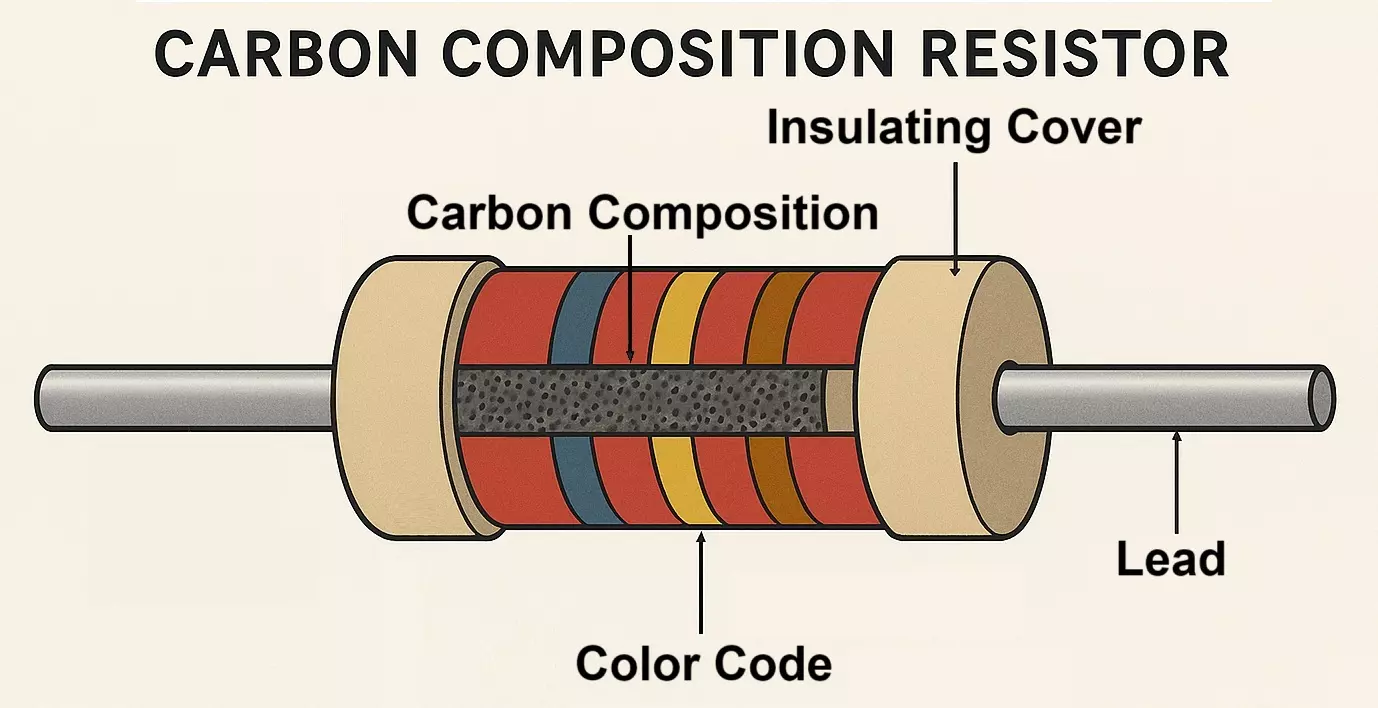
A carbon composition resistor consists of a mixture of finely ground carbon particles and insulating binder (resin), molded into a cylindrical shape. This carbon-resin core is then coated with an insulating layer and fitted with metal leads for connectivity.
Main Components:
- Carbon Powder – Provides resistance by limiting electron flow.
- Resin (Binder) – Holds the carbon particles together in a solid form.
- Metal End Caps – Ensure electrical connection to the leads.
- Axial Leads – Made of tinned copper, connected to end caps.
- Protective Coating – A layer of paint or epoxy to shield the resistor from moisture and mechanical damage.
- Color Bands – Printed around the body to indicate resistance value and tolerance.
Working Principle of Carbon Composition Resistor
Carbon composition resistors work based on Ohm’s Law, where:
V = I × R
- The carbon particles create a resistive path for the current.
- The amount of carbon vs. binder determines the resistance: more carbon = lower resistance, more binder = higher resistance.
- The electrical energy is partially converted into heat due to collisions between electrons and carbon particles.
This resistor is non-inductive, which makes it useful in high-frequency or pulse applications.
Types of Carbon Composition Resistors
Carbon composition resistors are not available in many variants like other resistor types, but they do vary by:
- Resistance Range: Typically, from 1 Ω to 22 MΩ.
- Power Rating: Commonly 1/8 W, 1/4 W, 1/2 W, 1 W, and 2 W.
- Tolerance: Typically, ±5%, ±10%, or ±20%.
Some resistors are classified based on their intended application:
- General Purpose – For typical circuits.
- High Energy Pulse – Designed to withstand short high-voltage surges.
How to Read Carbon Composition Resistor Value
Carbon composition resistors use a 4-band or 5-band color code to indicate their resistance value.
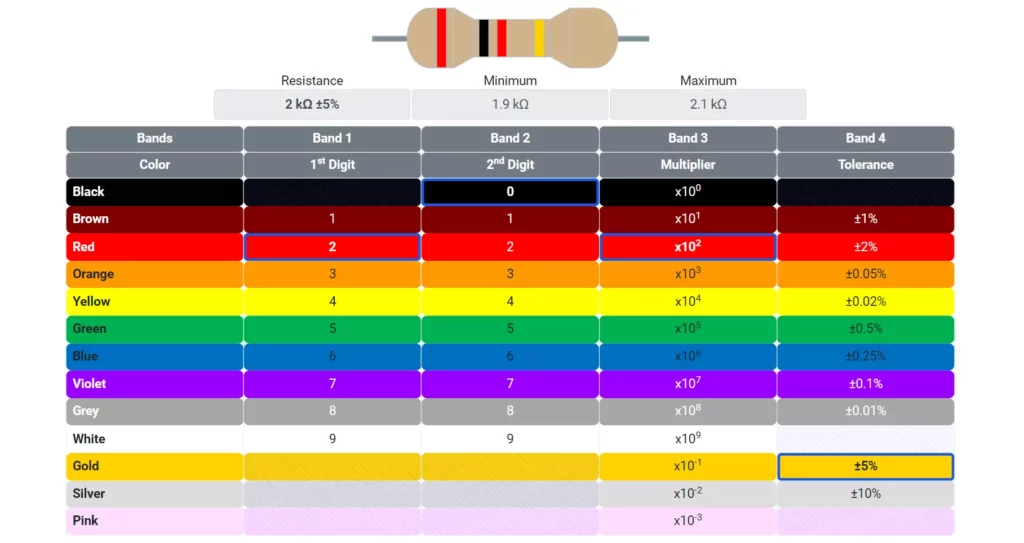
Standard 4-Band Color Code:
| Band | Meaning | Example (Brown-Black-Red-Gold) |
|---|---|---|
| 1 | First digit | Brown = 1 |
| 2 | Second digit | Black = 0 |
| 3 | Multiplier (×10ⁿ) | Red = ×100 |
| 4 | Tolerance (%) | Gold = ±5% |
Resistance = (10 × 100) = 1,000 Ω or 1 kΩ ±5%
Tolerance Colors:
- Brown = ±1%
- Red = ±2%
- Gold = ±5%
- Silver = ±10%
- No Band = ±20%
Advantages of Carbon Composition Resistors
-
- High Energy Pulse Handling – Can absorb large pulses without damage.
- Non-Inductive – Suitable for high-frequency applications.
- Simple Construction – Easy to manufacture and use.
- No Internal Coiling – Unlike wire-wound resistors, no inductance issue.
- Affordable – One of the cheapest type available.
- They have excellent overload characteristics.
- Still available for legacy and niche applications where their unique behavior is advantageous.
Disadvantages of Carbon Composition Resistors
- Poor Stability – Resistance value changes with age, humidity, and temperature.
- High Noise Generation – Due to granular carbon structure.
- Wide Tolerance – Often ±10% or ±20%, which is quite loose.
- Obsolete for Modern Use – Replaced by film and SMD resistors in most circuits.
- Limited Accuracy – Not suitable for precision electronics.
Applications of Carbon Composition Resistors
While they are not as commonly used today due to the advent of more stable and precise resistor types, they still have specific applications thanks to their unique properties.
- High Surge Applications:
- These resistors can absorb high energy pulses (surges) better than film or wire-wound resistors.
- Commonly used in surge protection circuits, snubber circuits, and arc welding machines.
- High Voltage Circuits:
- Their non-inductive nature makes them suitable for use in high-voltage applications where inductance could be problematic.
- RF (Radio Frequency) Applications:
- Used in RF circuits where parasitic inductance must be minimized, especially at high frequencies.
- Military and Aerospace Equipment (Legacy Systems):
- Some older or ruggedized systems still utilize carbon composition resistors due to their robustness and ability to tolerate extreme conditions.
- Automotive Ignition Systems (Older Models):
- Historically used in ignition systems to suppress electrical noise due to their ability to handle high peak voltages.
- Power Supplies:
- Sometimes found in power supply circuits where transient suppression is needed.
- Vintage Electronics and Restoration:
- Used in the repair and restoration of vintage radios, amplifiers, and other audio equipment to maintain historical authenticity.
They are also found in educational kits or hobby electronics, especially for demonstrating basic principles.
Summary Table
| Feature | Description |
|---|---|
| Symbol | ─────/\/\/\/───── |
| Material | Carbon powder + resin |
| Resistance Range | 1 Ω to 22 MΩ |
| Tolerance | ±5% to ±20% |
| Noise Level | High |
| Power Ratings | 1/8 W to 2 W |
| Stability | Poor |
| Cost | Low (historically) |
| Usage | Pulse circuits, vintage electronics |
Conclusion
The carbon composition resistor is a simple yet historically significant component in the evolution of electronics. While largely replaced in modern designs due to its instability and high tolerance, it still finds use in specialized applications that require pulse resistance and non-inductive performance. Understanding its construction and characteristics is important, especially for those working with vintage equipment or high-voltage pulse circuits.
Types of Resistors with Symbol, Classification and Applications
Types of Capacitors with Symbol, Classification and Applications
Light Dependent Resistor (LDR) / Photoresistor Circuit Diagram & Working