
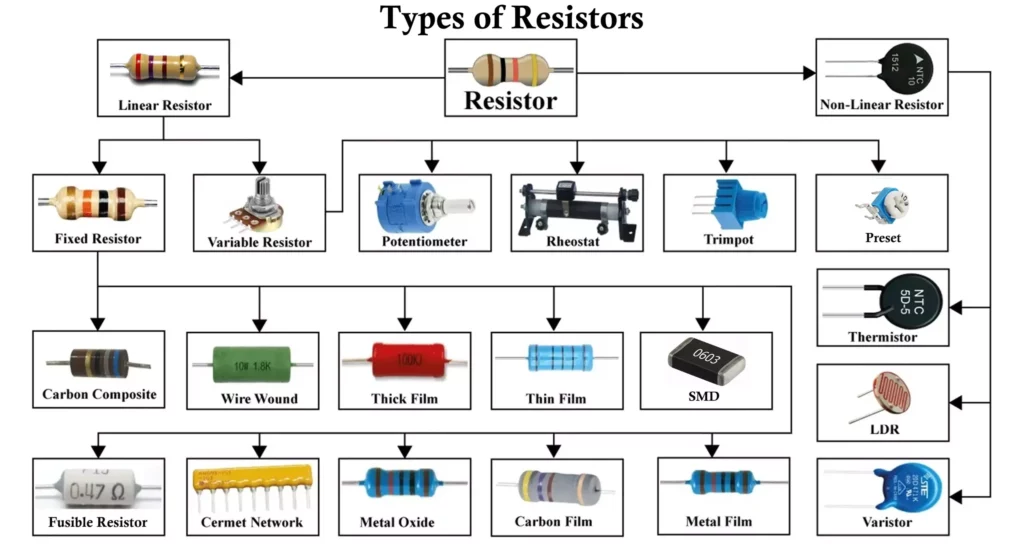
Resistors are fundamental electronic components that limit, regulate, or set the flow of electric current in a circuit. While they may appear simple, there are different types of resistors designed for specific purposes and operating environments.
Now you know the basics of resistance and its role in circuits. Let’s dive deeper into the all the types of resistors — how they’re built, how they work, and where you would choose each type. Along the way, you’ll pick up guidelines for selecting the perfect resistor for your design.
Types of Resistors – Classified
- What Is Electrical Resistance?
- Key Resistor Parameters
- Linear Resistors
- Non-Linear Resistors
- How to Choose the Right Resistor?
- Conclusion
What Is Electrical Resistance?
Electrical resistance is a material’s opposition to current flow. When electrons move through a resistor, collisions with atoms convert electrical energy into heat. Ohm’s law describes the linear relationship in many resistors:
V = I × R
where V is voltage (volts), I is current (amperes), and R is resistance (ohms, Ω).
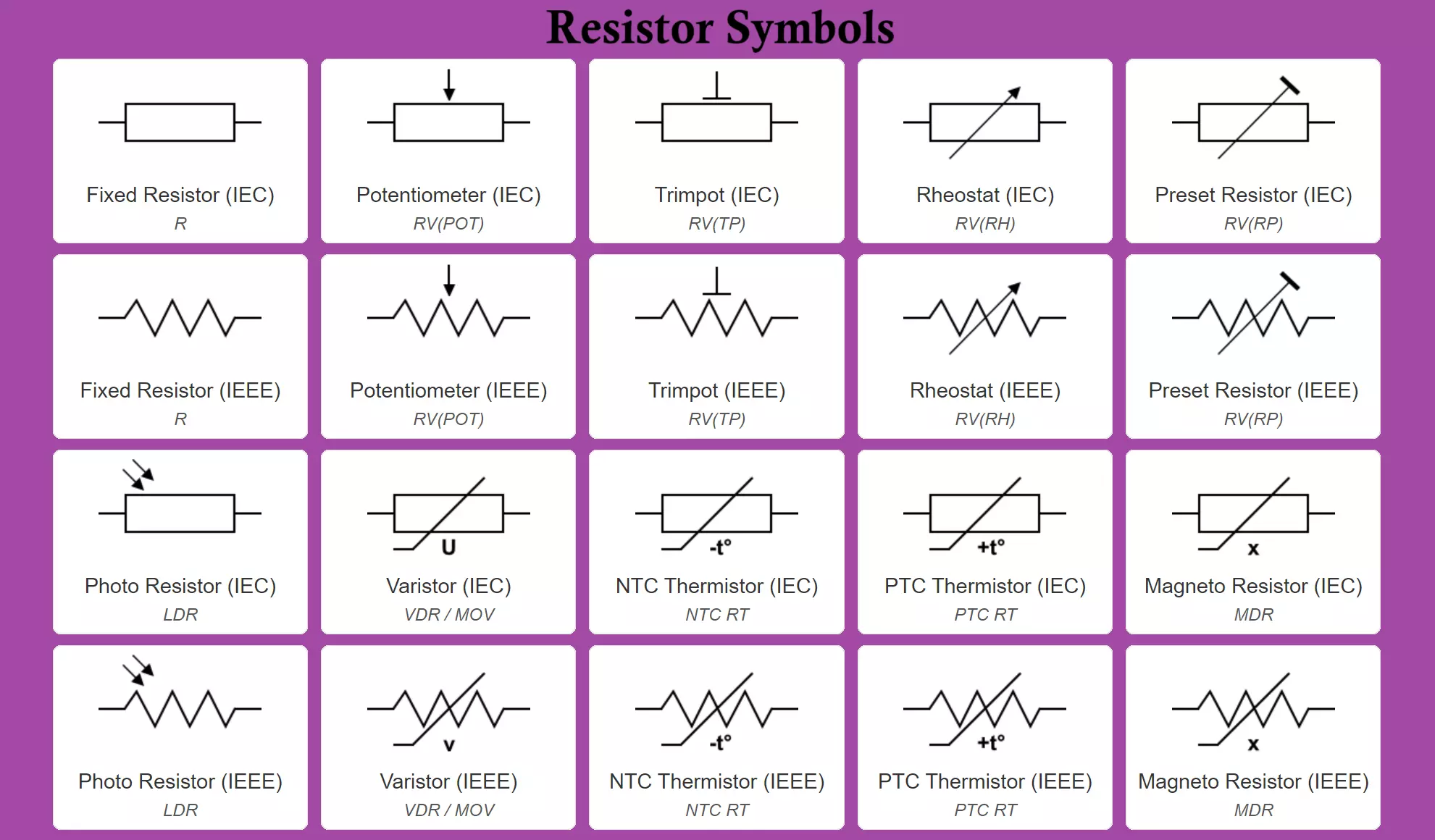
These are the symbols used in circuit diagrams to represent different types of resistors, which control the flow of electric current.
Key Resistor Parameters
Before selecting a resistor, check its datasheet for:
- Resistance value (Ω): Nominal opposition to current.
- Tolerance (%): Permissible deviation from the nominal value (e.g. ±1%, ±5%).
- Power rating (W): Maximum dissipable heat without damage.
- Temperature coefficient (ppm/°C): Change in resistance per °C.
- Maximum working voltage (V): Highest safe voltage across its terminals.
- Operating temperature range (°C): Limits for stable performance.
Linear Resistors
Linear resistors obey Ohm’s law: voltage and current change proportionally. Within this family we find fixed and variable types.
Fixed Resistors
Fixed resistors are the most commonly used type of resistor in electronic circuits. As their name suggests, these resistors have a set resistance value that does not vary with changes in voltage or current. In simpler terms, their resistance remains stable and cannot be adjusted.
That said, a slight variation in resistance may occur due to temperature changes. The standard circuit symbol for a fixed resistor is shown below.
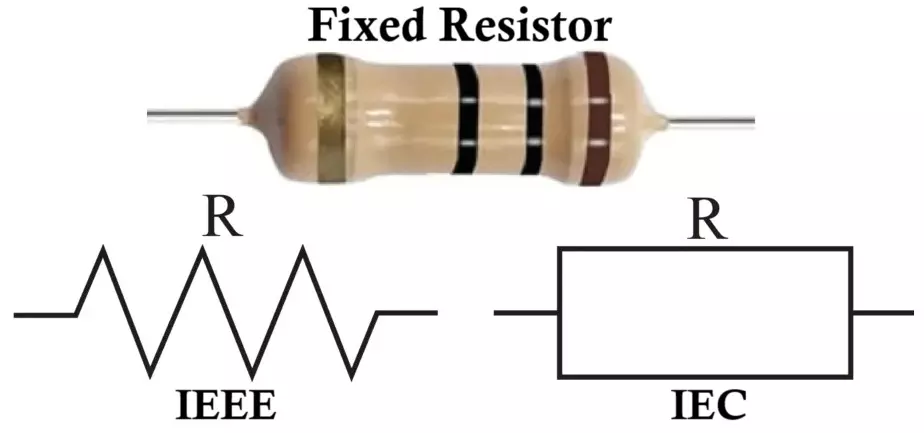
Fixed resistors can be categorized into various types depending on the materials used and the method of their construction.
| Type | Construction & Materials |
|---|---|
| Carbon Composite | Carbon powder + binder pressed into a cylinder; epoxy-coated |
| Metal-Film / Carbon-Film | Thin resistive film (metal or carbon) deposited on ceramic substrate |
| Thick-Film / Metal-Oxide | Thick resistive paste (metal oxide or cermet) screen-printed on ceramic |
| Wire-Wound | Ni-Cr or Cu-Ni wire wrapped around ceramic core, often enamel-coated |
| Fusible | Wire-wound element designed to blow like a fuse under overload |
| Surface-Mount (SMD) | Film material on ceramic chip, epoxy-encapsulated |
Here is the breakdown of each type:
Carbon-Composition Resistors
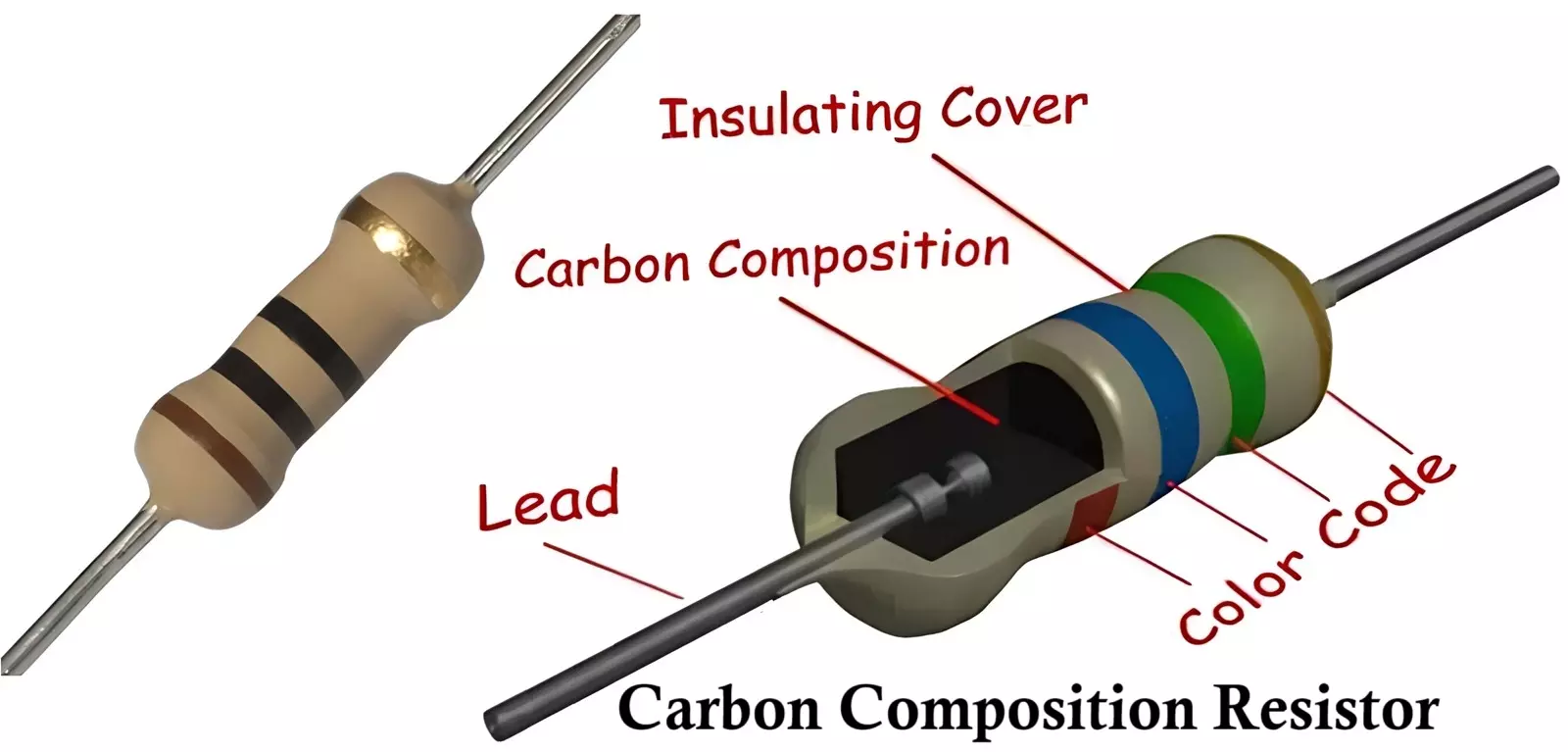
- Construction: Carbon powder mixed with binder, molded, and coated.
- Working: Uniform carbon matrix resists electron flow; heat dissipates through body.
- Advantages:
- Very low cost
- Tolerant of overload pulses
- Disadvantages:
- High noise
- Wide tolerance (±5–20%)
- Drifts with age and temperature
- Applications: Old-school electronics, pulse-snubbing networks.
Metal-Film & Carbon-Film Resistors
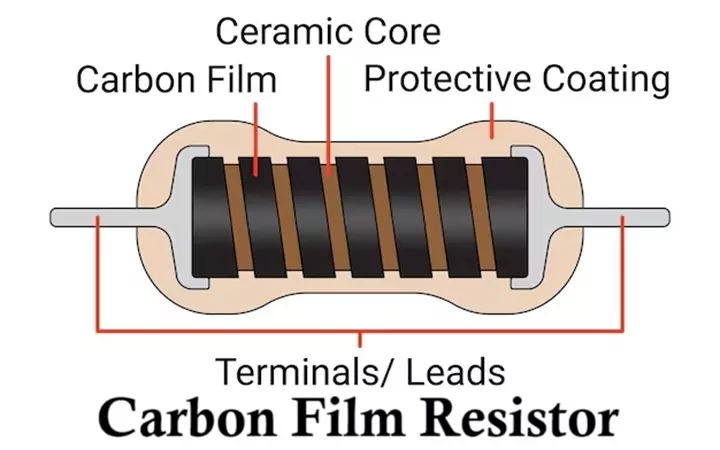
- Construction: Sputtered thin film of metal (e.g. nickel chromium NiCr) or carbon on ceramic.
- Working: Film thickness sets resistance; precise photo-etching patterns refine value.
- Advantages:
- Tight tolerances (±0.1–2%)
- Low noise
- Good temperature stability
- Disadvantages:
- Limited power (¼–1 W typical)
- Applications: Precision analog circuits, filters, RF front ends.
Thick-Film & Metal-Oxide Resistors
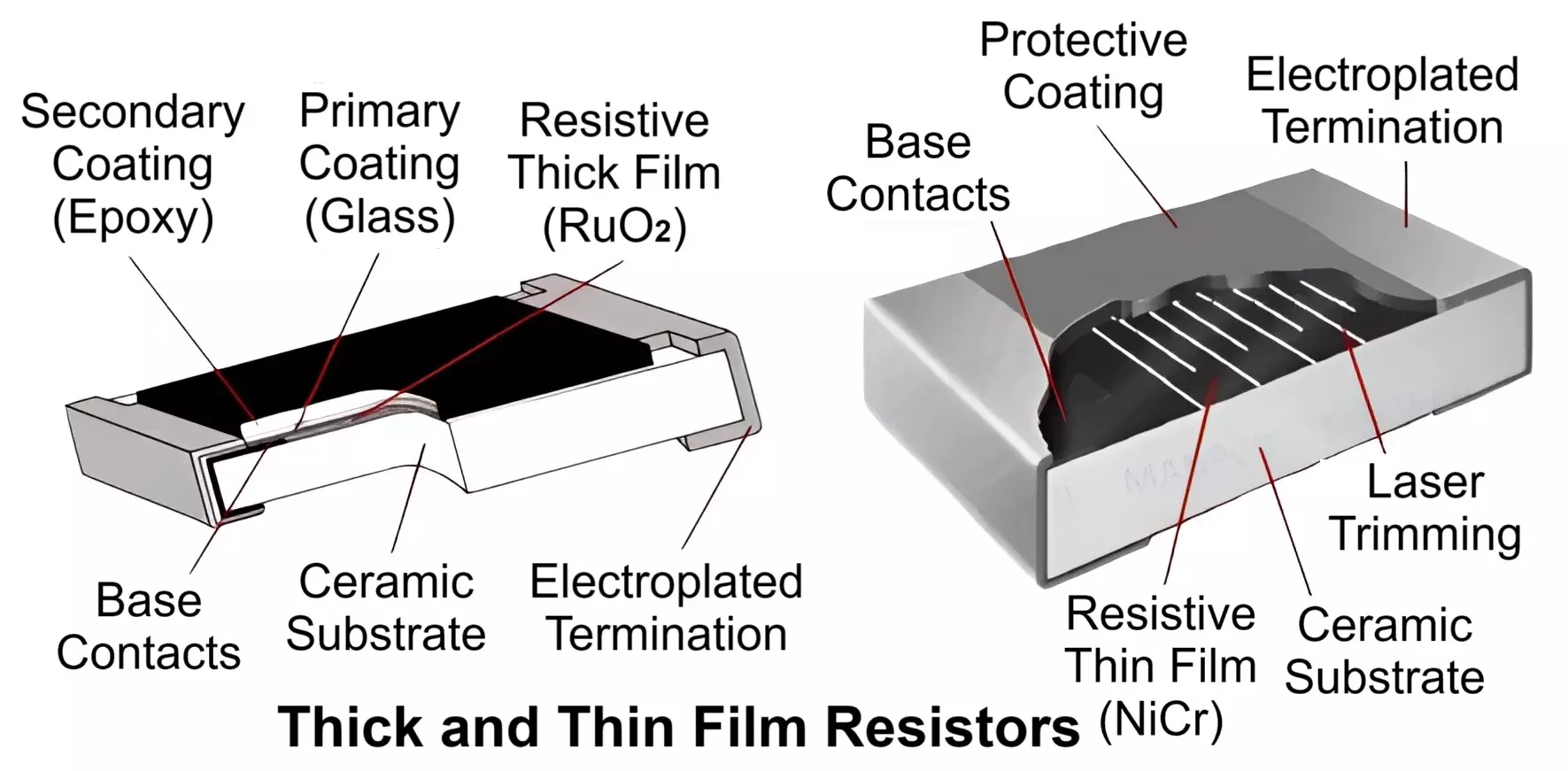
- Construction: Screen-printed paste of metal oxide (tin oxide) or cermet on ceramic.
- Working: Conduction through sintered oxide grains.
- Advantages:
- Higher power (up to a few watts)
- Rugged, flameproof options
- Better high-temperature tolerance
- Disadvantages:
- Tolerances usually looser (±1–5%)
- Applications: General-purpose power resistors, harsh-environment electronics.
Wire-Wound Resistors
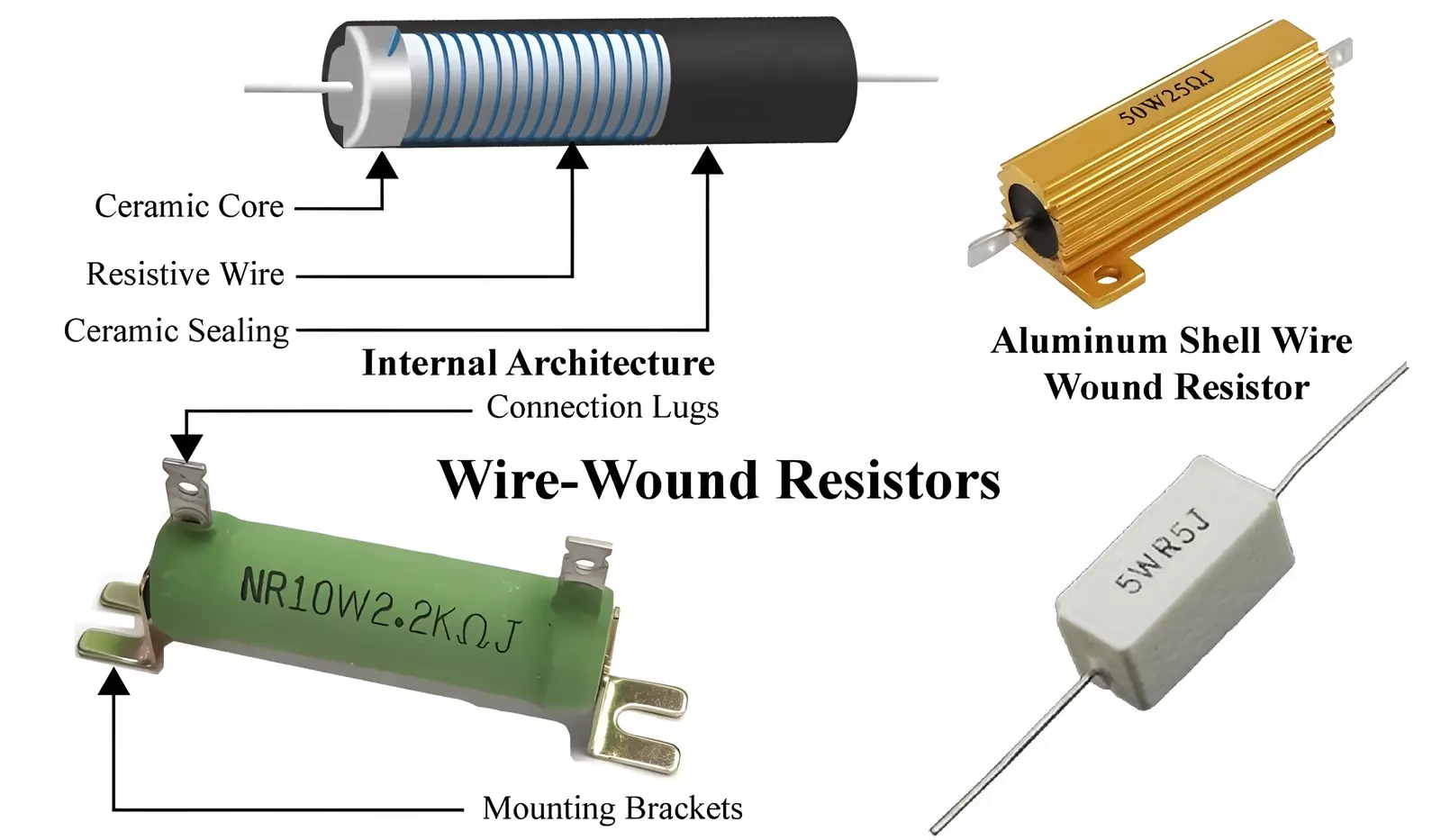
- Construction: Coil of resistive alloy wire on an insulating core; often coated or housed in ceramic.
- Working: Wire length and cross-section define resistance; heat spreads through core.
- Advantages:
- Very high power (up to hundreds of watts)
- Excellent precision and stability
- Low electrical noise
- Disadvantages:
- Inductive at high frequencies
- Bulky
- Applications: Power supplies, load banks, precision shunts.
Fusible Resistors
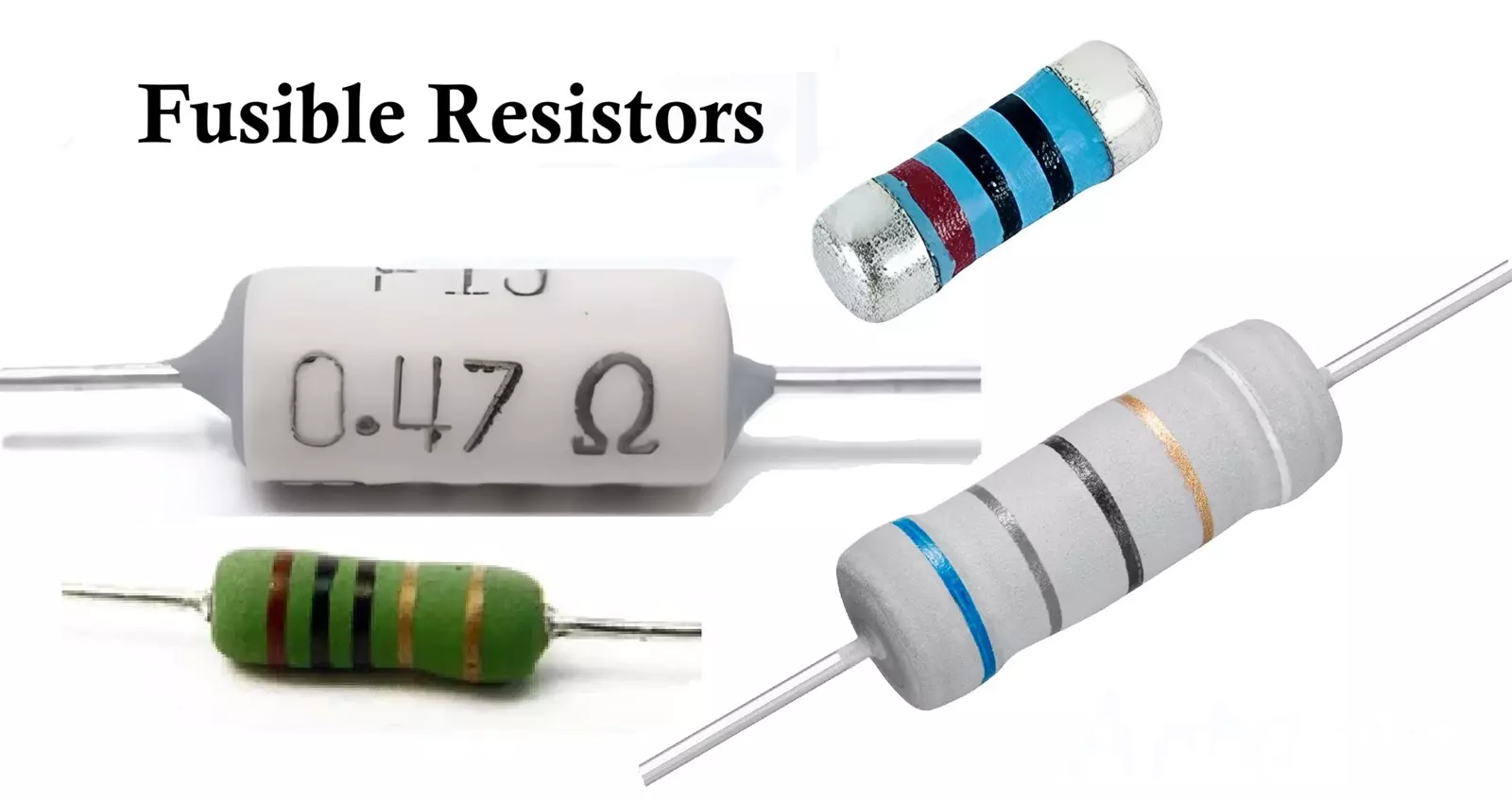
- Construction: Similar to wire-wound but engineered to open like a fuse under extreme overload.
- Working: Under sustained overcurrent, internal element melts and breaks the circuit.
- Advantages:
- Dual function: resistance + safety device
- Disadvantages:
- Single-use protection
- Applications: Power input lines, CRT monitor protection, industrial controls.
Surface-Mount (SMD) Resistors
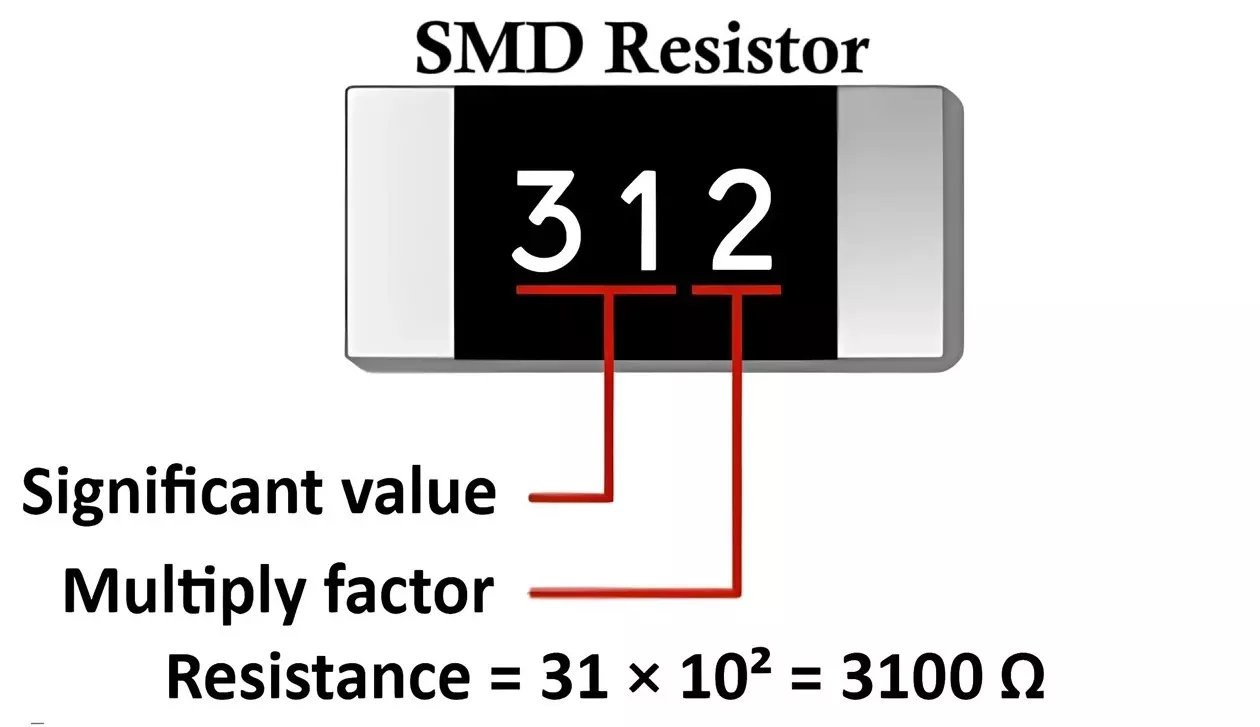
- Construction: Thin- or thick-film on rectangular ceramic chip with metalized end caps.
- Working: Identical principle to through-hole film resistors.
- Advantages:
- Extremely small footprint
- Excellent for automated assembly
- Disadvantages:
- Limited power (fractions of a watt)
- Harder to hand-solder
- Applications: Smartphones, laptops, high-density PCBs.
Variable Resistors
Variable resistors let you dial in a resistance anywhere between two limits.
| Type | Terminals | Typical Use |
|---|---|---|
| Potentiometer | 3 | Voltage divider, user control |
| Rheostat | 2 or 3 | Current regulation |
| Trimmer | 2 or 3 | One-time calibration |
Potentiometers
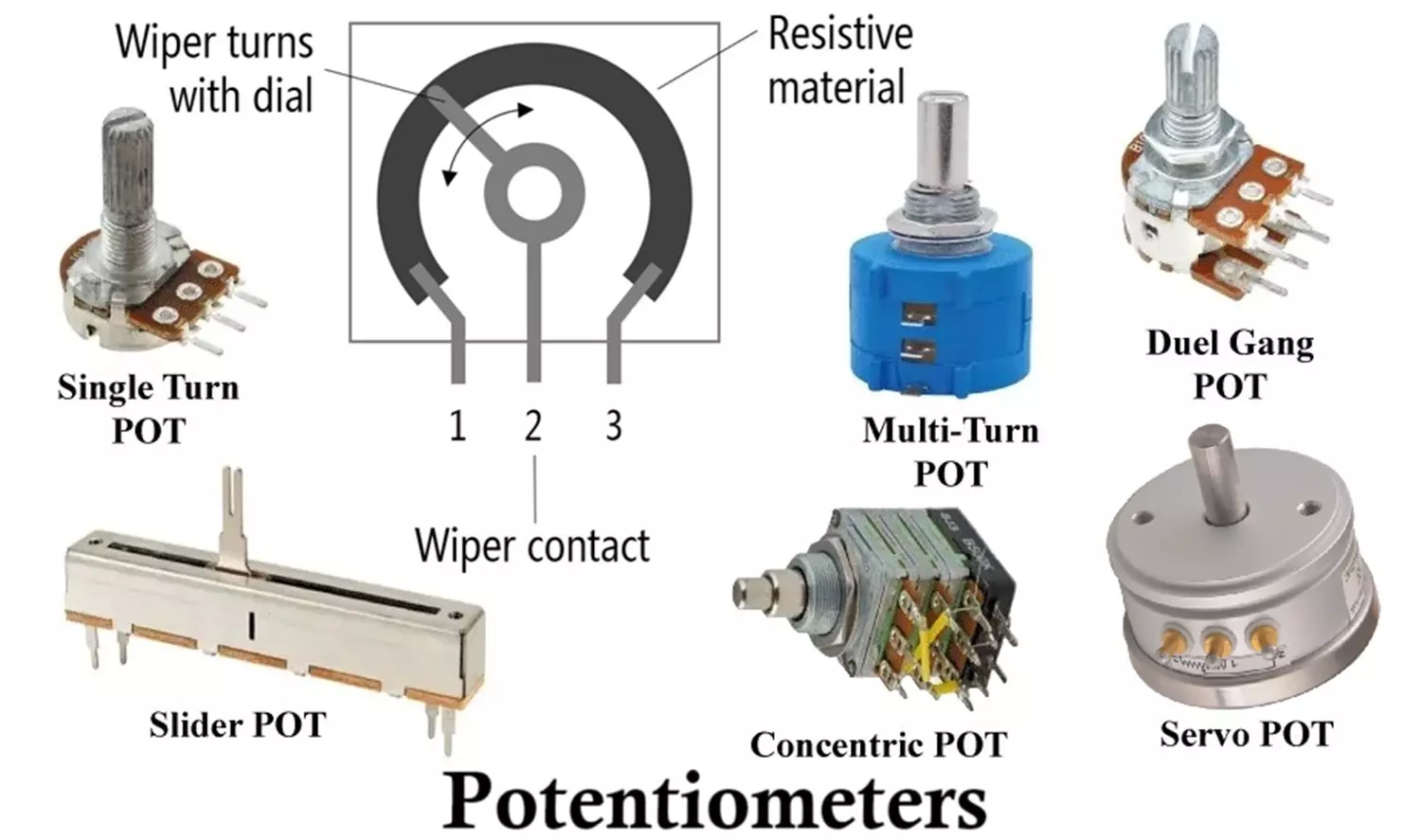
- Construction: Resistive track + sliding wiper; shaft or slider adjusts contact point.
- Working: As the wiper moves, voltage division between end terminals changes.
- Advantages:
- Continuous adjustment
- Up to ~10 MΩ available
- Disadvantages:
- Mechanical wear
- Limited power (<2 W)
- Applications: Volume knobs, adjustable attenuators, tuning controls.
Rheostats
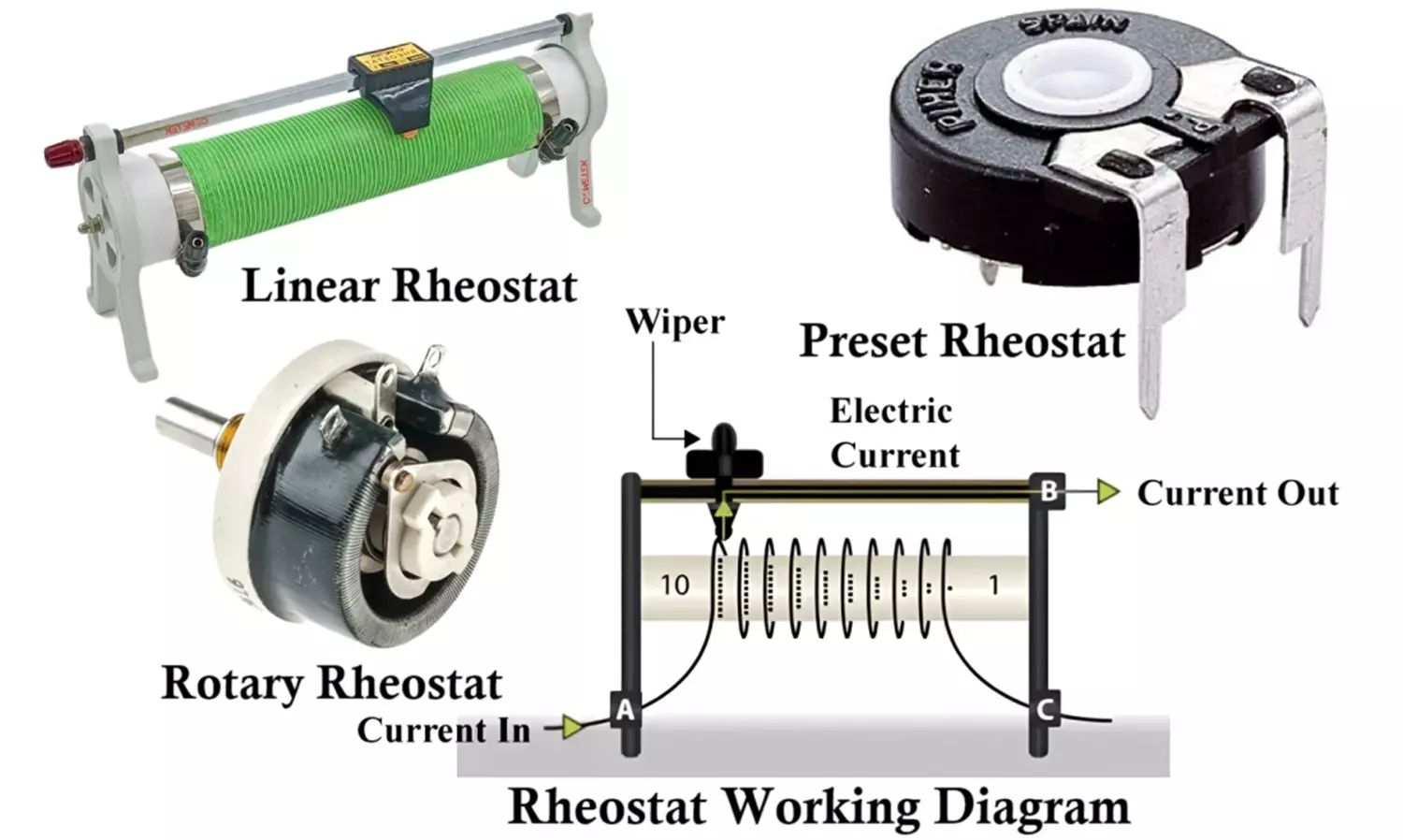
- Symbol: Similar to potentiometer but typically shown with two terminals.
- Construction: Often a wire-wound track with movable tap.
- Working: Varying the tap changes effective length of resistive coil, thus current.
- Advantages:
- Higher power capability than potentiometers
- Disadvantages:
- Bulky
- Inductive at higher frequencies
- Applications: Motor-speed controls, heater elements, laboratory loads.
Trimmers (Preset Potentiometers)
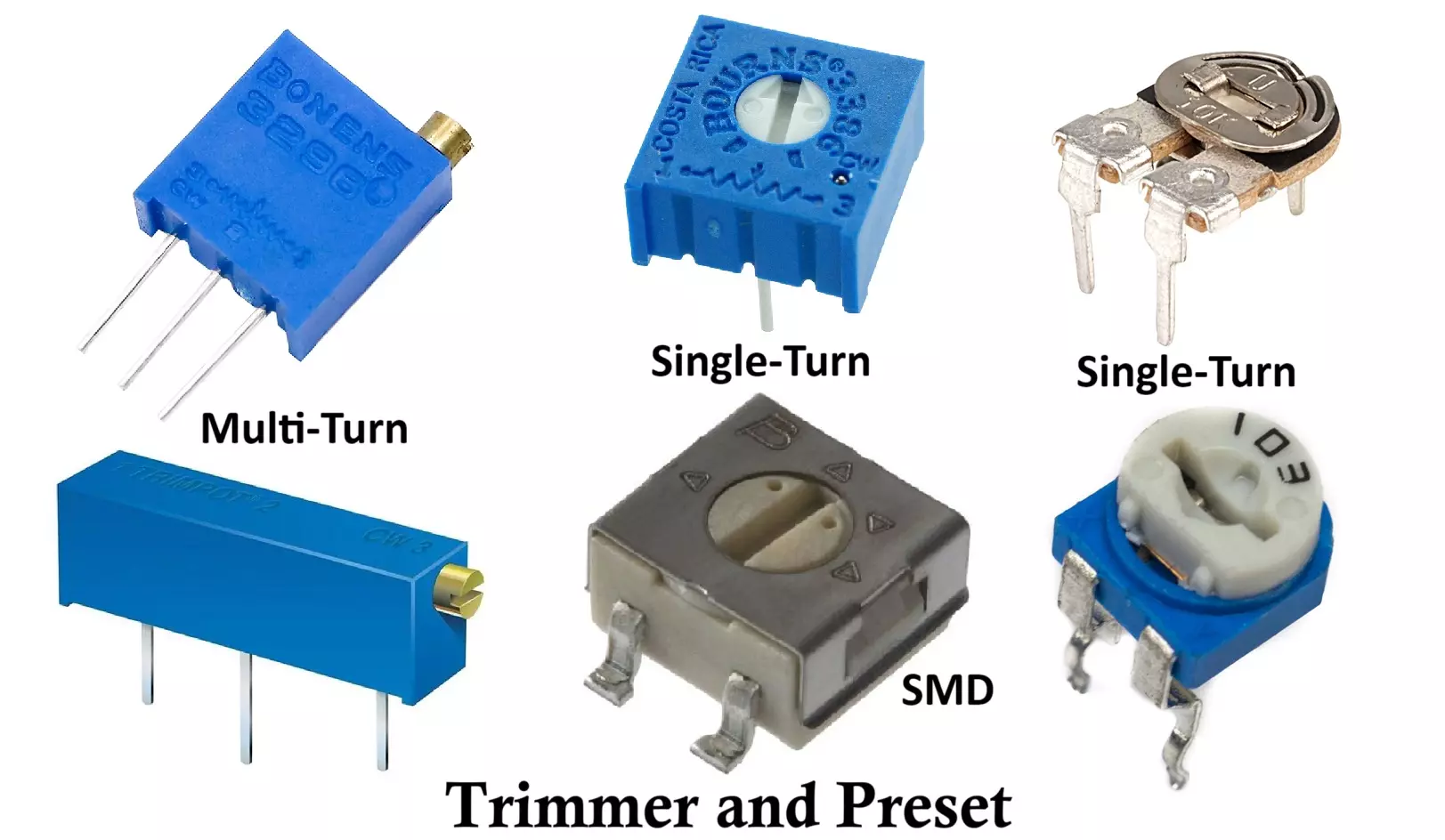
- Construction: Miniature pot set by screwdriver; single- or multi-turn options.
- Working: Used to “trim” a circuit once during calibration.
- Advantages:
- Compact
- High precision multi-turn designs
- Disadvantages:
- Not for frequent adjustments
- Applications: Offset calibration in amplifiers, precise threshold setting.
Non-Linear Resistors
Non-linear resistors do not follow Ohm’s law, their resistance shifts with voltage, temperature, or light.
Thermistors (NTC & PTC)
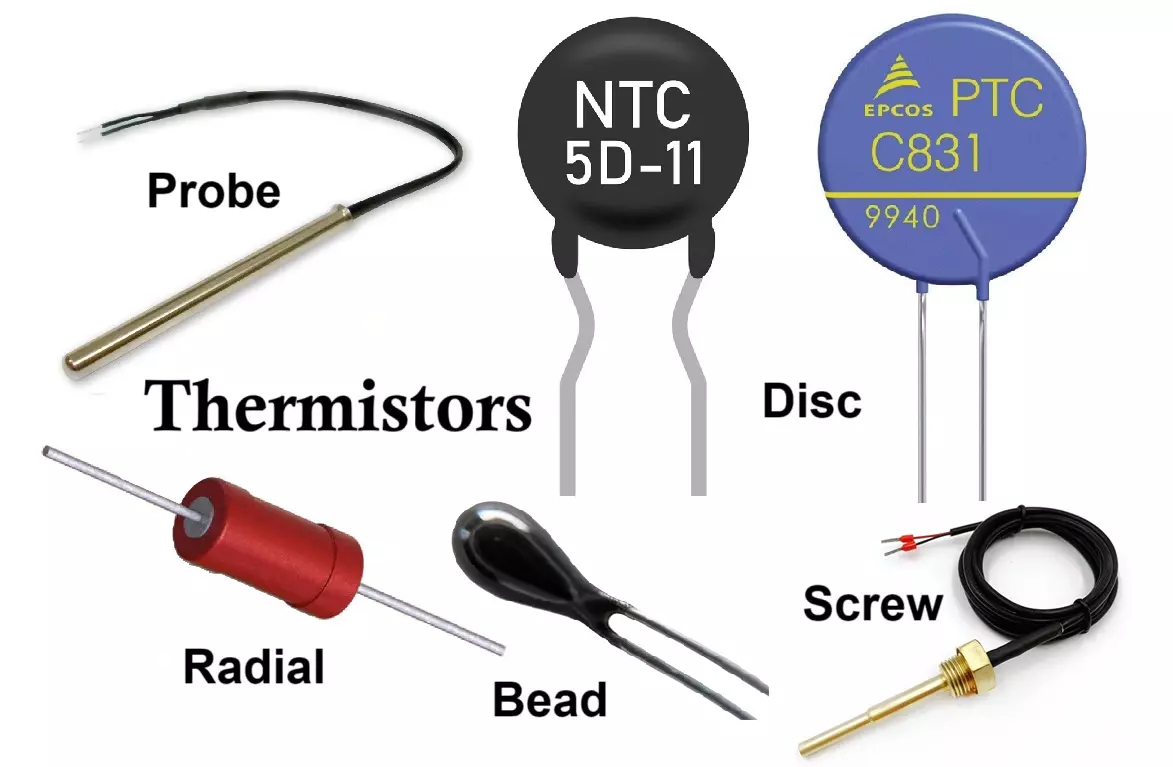
- Construction: Ceramic or polymer semiconductor pellet; leads embedded in epoxy/glass.
- Types & Working:
- NTC (Negative Temperature Coefficient): R ↓ as T ↑
- PTC (Positive Temperature Coefficient): R ↑ as T ↑
- Advantages:
- High sensitivity to temperature
- Disadvantages:
- Non-linear response
- Limited temperature range
- Applications: Temperature sensors, inrush current limiters (NTC), over-temperature cutoffs (PTC), degaussing circuits.
Varistors (VDR – Voltage Dependent Resistor)
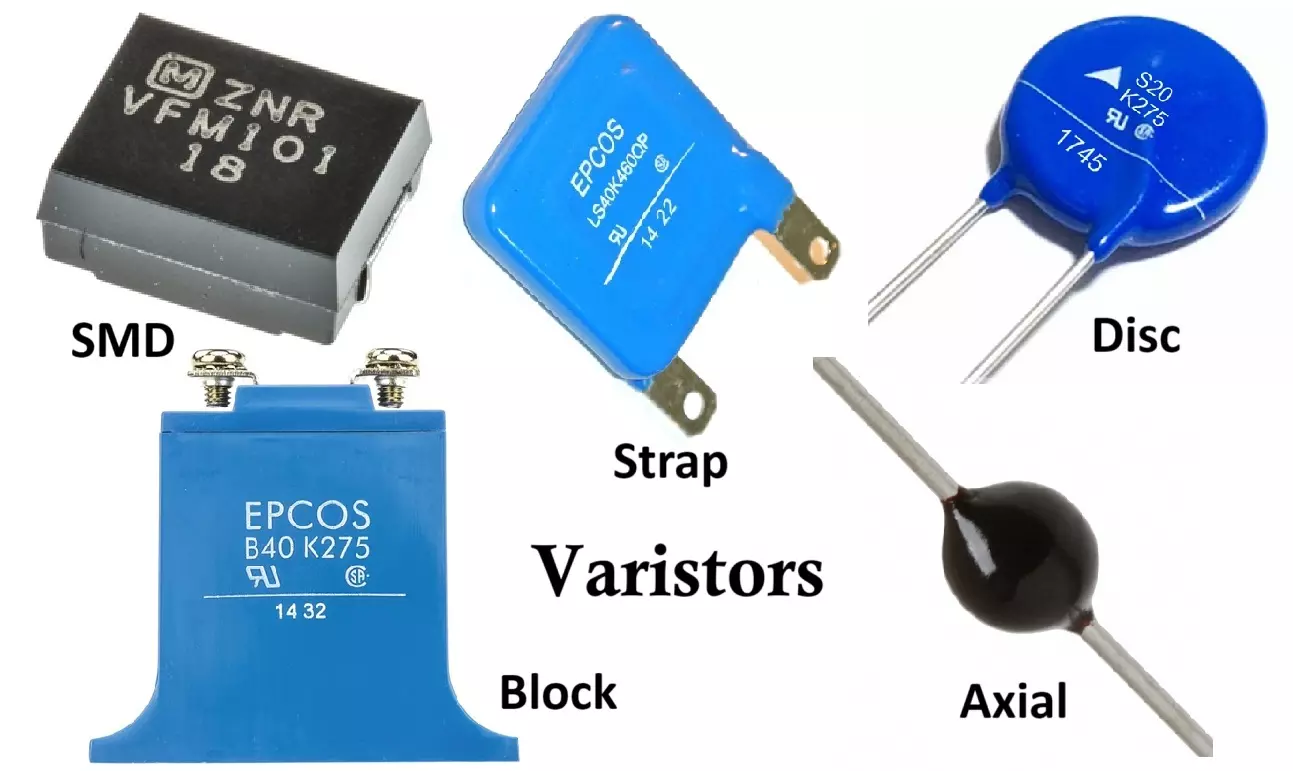
- Construction: Disc of zinc-oxide grains sintered between electrode plates.
- Working: Below threshold voltage, high resistance; above threshold, resistance collapses and clamps voltage.
- Advantages:
- Fast transient suppression
- Disadvantages:
- Gradual degradation after repeated surges
- Applications: Surge arrestors, power supply lines, lightning protection.
Photoresistors (LDR – Light Dependent Resistor)
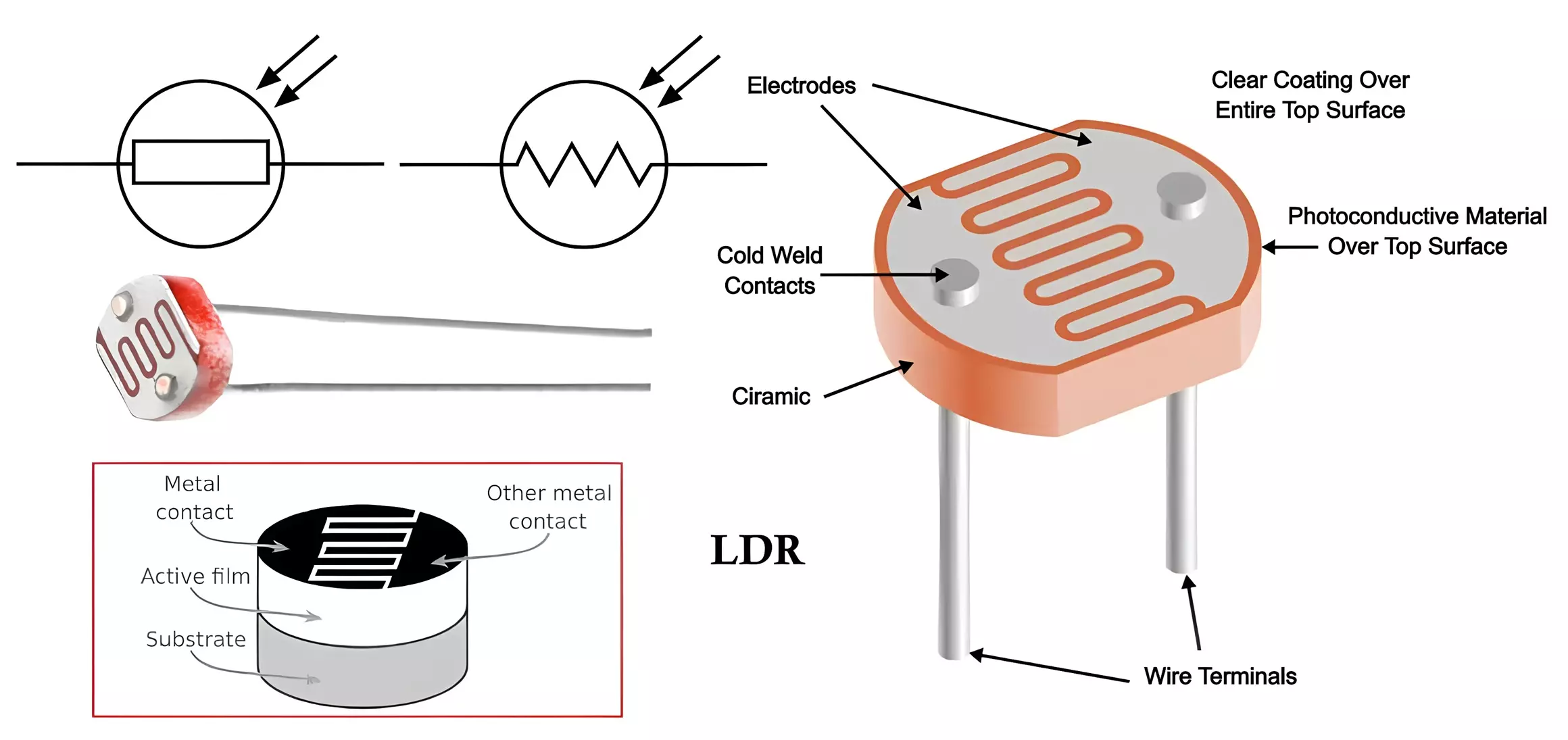
- Construction: Cadmium sulfide or lead sulfide layer between electrodes in transparent package.
- Working: Resistance ↓ as light intensity ↑.
- Advantages:
- Simple, very low cost
- Disadvantages:
- Slow response time (tens to hundreds of ms)
- Drift over time/temperature
- Applications: Light sensors, automatic lighting, camera exposure meters, solar trackers.
Magneto Resistor
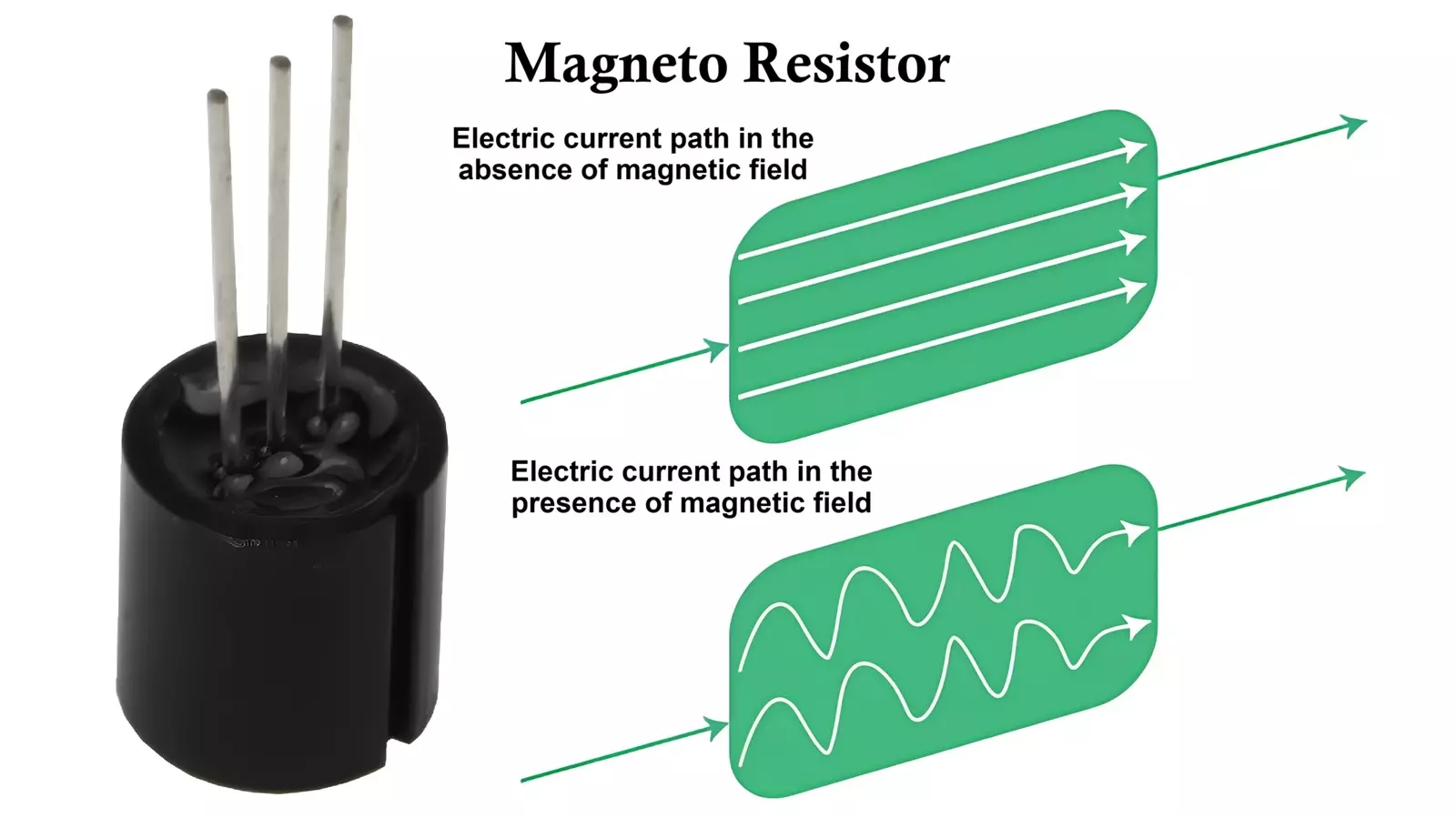
Construction:
Thin films of ferromagnetic materials (e.g., permalloy) deposited on a substrate.
Working:
Resistance changes in response to a magnetic field due to the magnetoresistive effect, which alters electron flow.
Advantages:
- High magnetic sensitivity
- Non-contact, wear-free sensing
- Fast response
Disadvantages:
- Temperature-sensitive
- More complex and costly
Applications:
Speed and position sensors, hard drive read heads, magnetic field detection.
How to Choose the Right Resistor
- Define your function
- Constant voltage drop → fixed resistor
- Adjustable voltage/current → potentiometer or rheostat
- Sensing temperature or light → thermistor or LDR
- Surge protection → varistor
- Select resistance & tolerance
- Use E-series values (E12, E24, etc.)
- Tight tolerance (≤1%) for precision; looser (5–10%) for general use
- Check power rating
- Compute P = I² × R or P = V² / R
- Add 20–50% safety margin
- Consider frequency
- Avoid wire-wound in RF/high-speed analog; pick metal-film
- Account for environment
- High heat → metal-oxide, cermet, wire-wound
- Harsh conditions → fusible or flameproof designs
- Form factor & mounting
- Space-constrained → SMD
- Prototyping / high-power → through-hole
Quick Comparison Table
| Type | Main Feature | Best Used For |
|---|---|---|
| Carbon Composition | Simple, cheap | General electronics |
| Metal Film | High precision | Instrumentation circuits |
| Wire Wound | High power | Power electronics |
| Potentiometer | Adjustable | Volume controls, tuners |
| Thermistor (NTC/PTC) | Temperature sensitive | Temperature sensing, protection |
| Photoresistor (LDR) | Light sensitive | Light detectors |
| Varistor (VDR) | Voltage sensitive | Surge protection |
| SMD Resistor | Tiny size | Compact PCBs, mobile devices |
| Fusible Resistor | Overcurrent protection | Critical safety applications |
Conclusion
Resistors span a huge spectrum—from simple carbon blocks to precision metal films, from user-tunable potentiometers to lightning-striking varistors. By matching construction, electrical behavior, and environmental robustness to your circuit’s needs, you guarantee reliable, accurate performance.
Whether you’re limiting LED current with a ¼ W metal-film resistor, tuning an audio attenuator with a pot, or shielding a power line with a varistor, a solid grasp of resistor types ensures you choose wisely and design with confidence.
Choosing the right resistor involves considering factors like:
- Resistance value
- Tolerance
- Power rating
- Temperature and environmental sensitivity
- Frequency response
Resistors are far more diverse than their simple appearance suggests. From fixed-value resistors to complex thermistors, varistors, and light-dependent resistors, each type plays a critical role in modern electronics.
Understanding the different types of resistors, their working principles, and applications ensures that circuits are designed with reliability, precision, and safety in mind.
Types of Capacitors with Symbol, Classification and Applications
Types of Diodes with Symbol, Definition, Working and Applications
Different Types of Oscillators with Working and Applications
Types of Transistors: Classification (BJT, JFET, MOSFET & IGBT)