
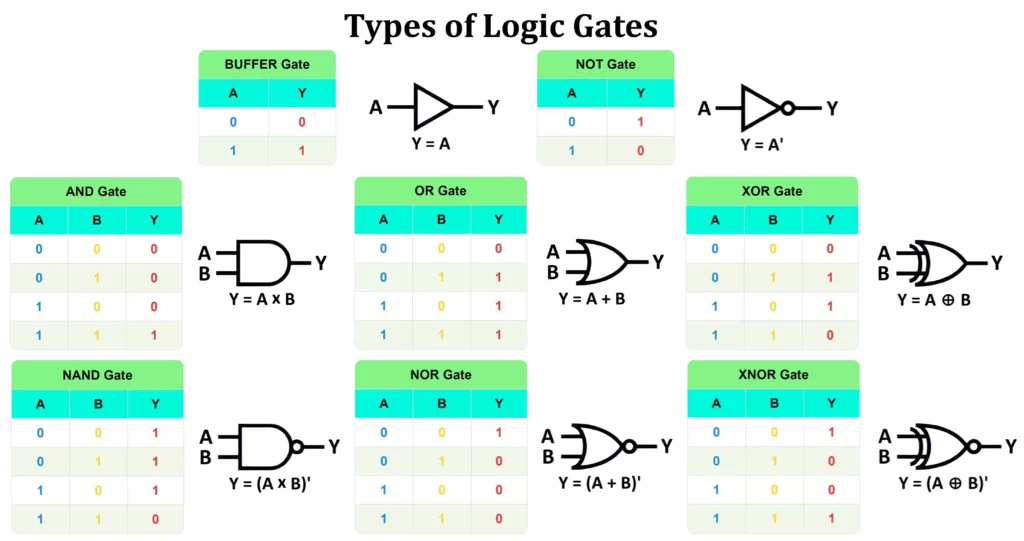
In this article, we will explore various types of logic gates with their symbol, truth table, Boolean expression, properties, IC numbers, applications, advantages, and disadvantages. Logic gates are the fundamental building blocks in digital electronics. There are basically seven main types of logic gates that are used to perform various logical operations in digital systems.
By combining different logic gates, complex operations are performed, and circuits like flip-flops, counters, and processors are designed. Logic gates are extensively used in the design and development of microprocessors, memory devices, and control systems. They play a crucial role in modern technology by enabling efficient data processing and decision-making in digital circuits.
What is a Logic Gate?
A logic gate is an electronic circuit designed using electrical components like diodes, transistors, resistors, and capacitors. It is used to perform logical operations based on the inputs provided to it and gives a logical output that can be either high (1) or low (0).
The operation of logic gates is based on Boolean algebra, which provides a mathematical foundation for binary logic. Logic gates play a critical role in digital electronics, as they are found in microcontrollers, embedded systems, and digital signal processors (DSPs). These gates are integrated into electronic devices such as smartphones, computers, tablets, and storage units, making them essential in modern-day technology.
Types of Logic Gates
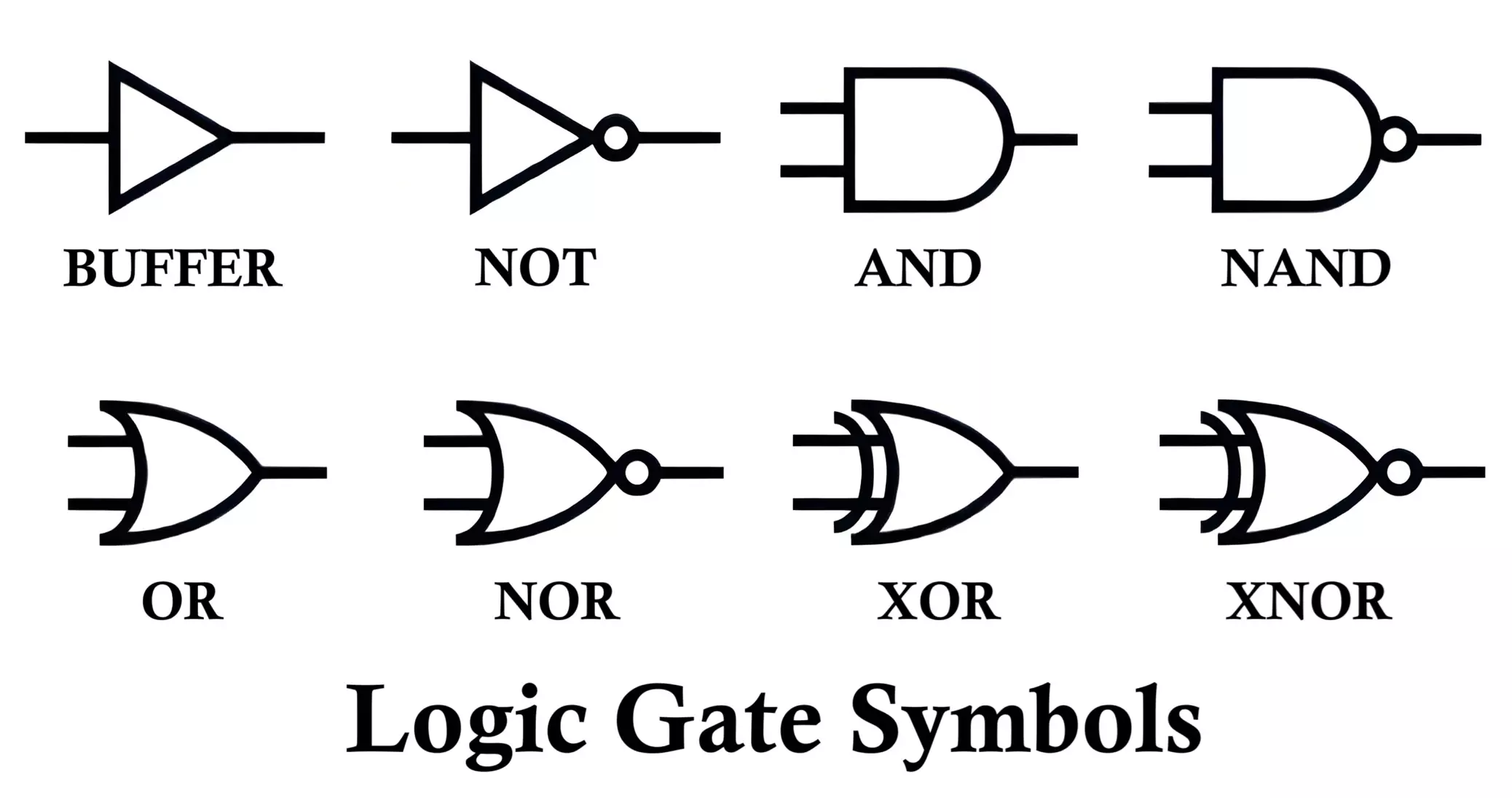
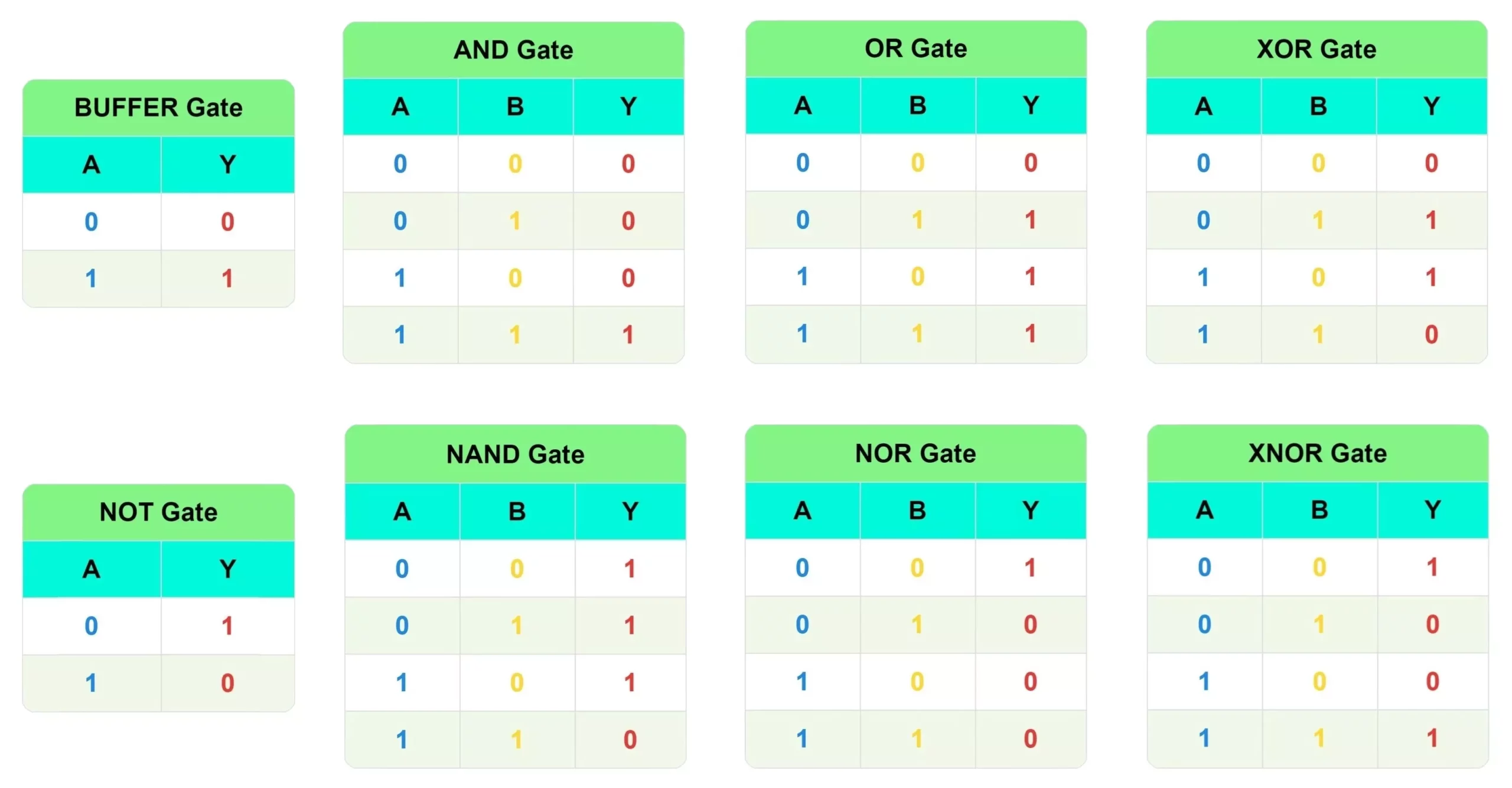
Logic gates can be broadly classified into three main categories based on their functionality: basic gates (AND, OR, NOT), universal gates (NAND, NOR), and special gates (XOR, XNOR, BUFFER). These categories help in designing complex digital circuits by combining different logic operations. Let’s see all the types of logic gates with their truth table and symbol.
1. AND Gate
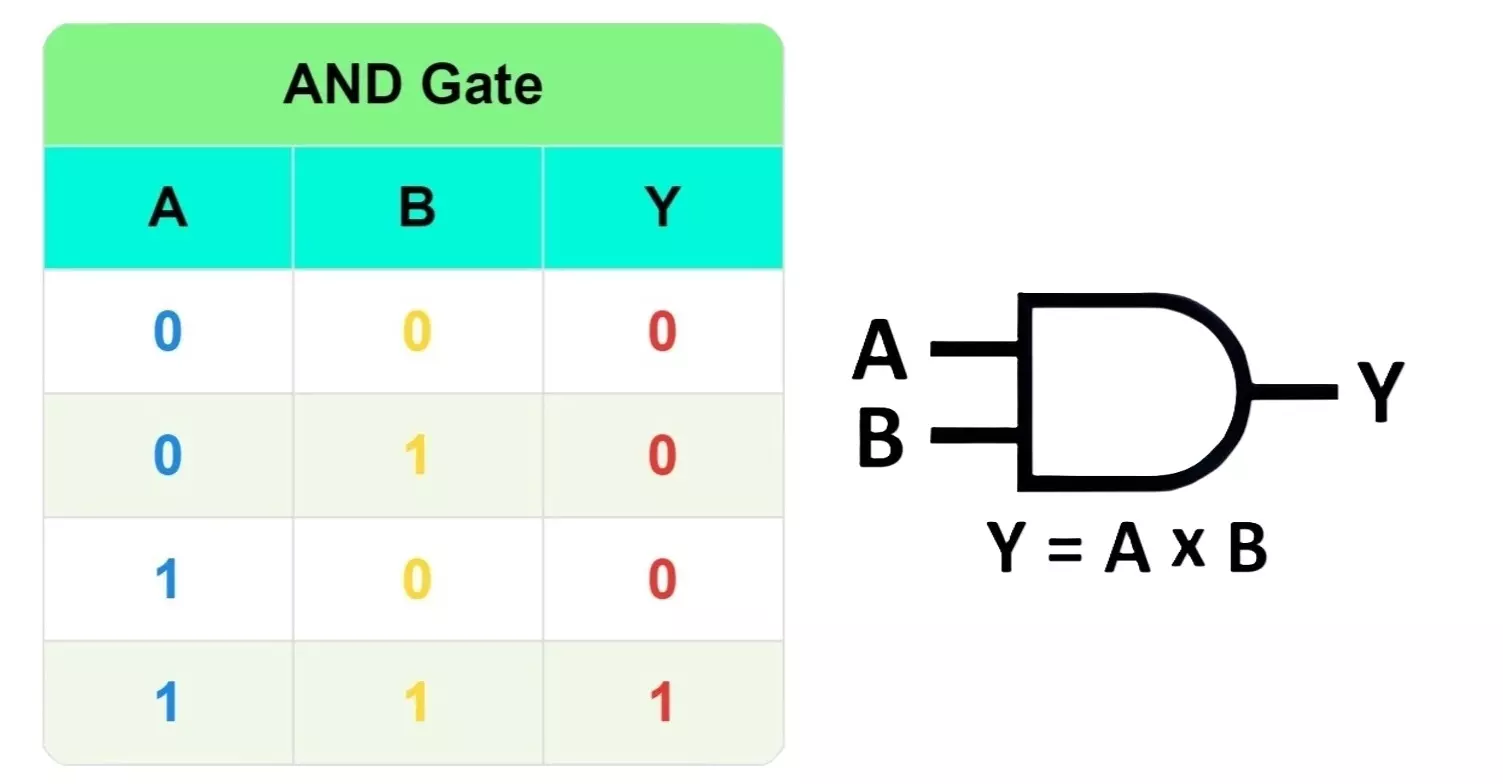
Properties:
- Accepts two or more input values.
- Output is 1 only when all inputs are 1.
- Used in security systems and logical decision-making circuits.
IC Number:
- IC 7408 – Quad 2-input AND gate
2. OR Gate
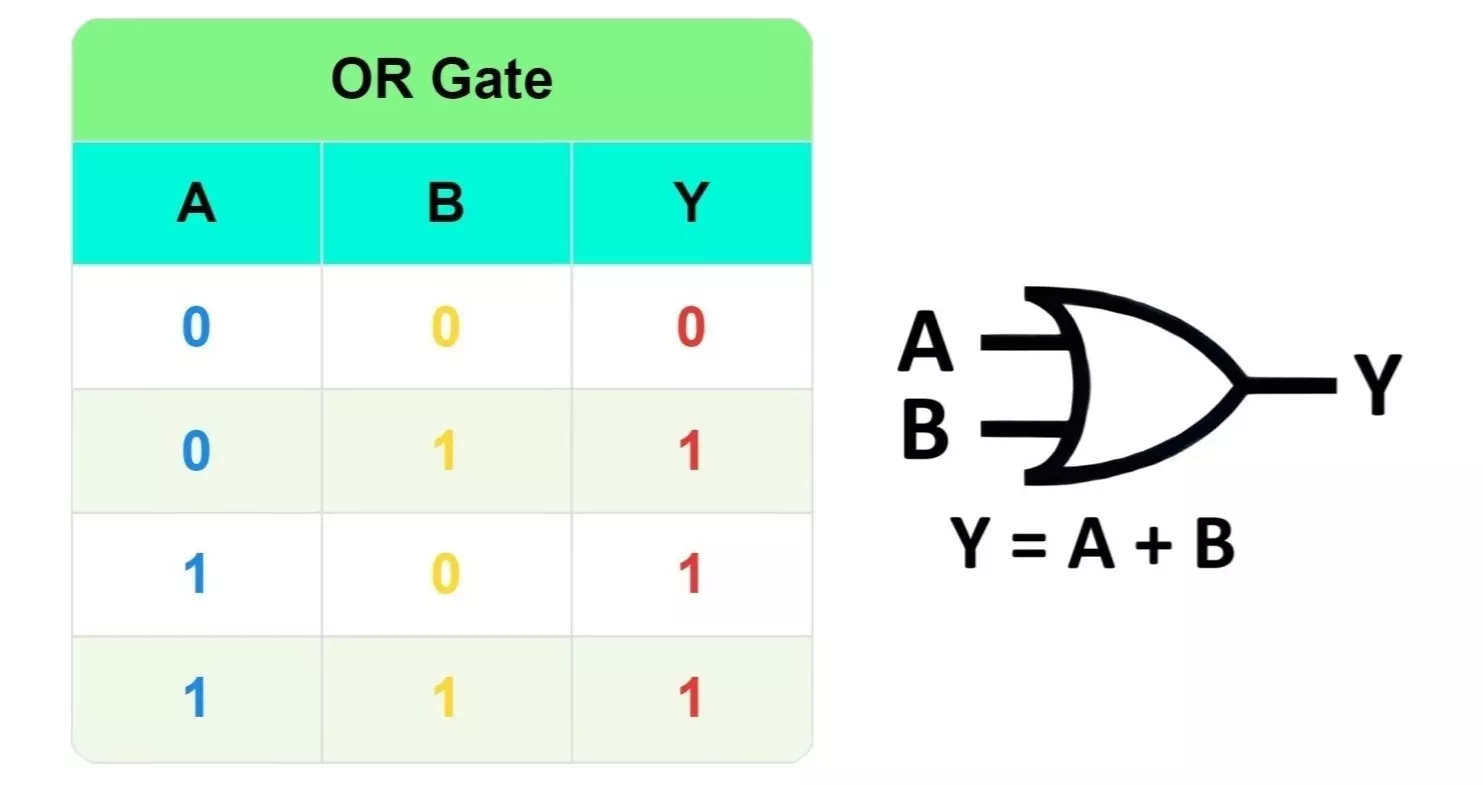
Properties:
- Can have multiple input lines.
- Output is 1 if at least one input is 1.
- Commonly used in control circuits and signal selection.
IC Number:
- IC 7432 – Quad 2-input OR gate
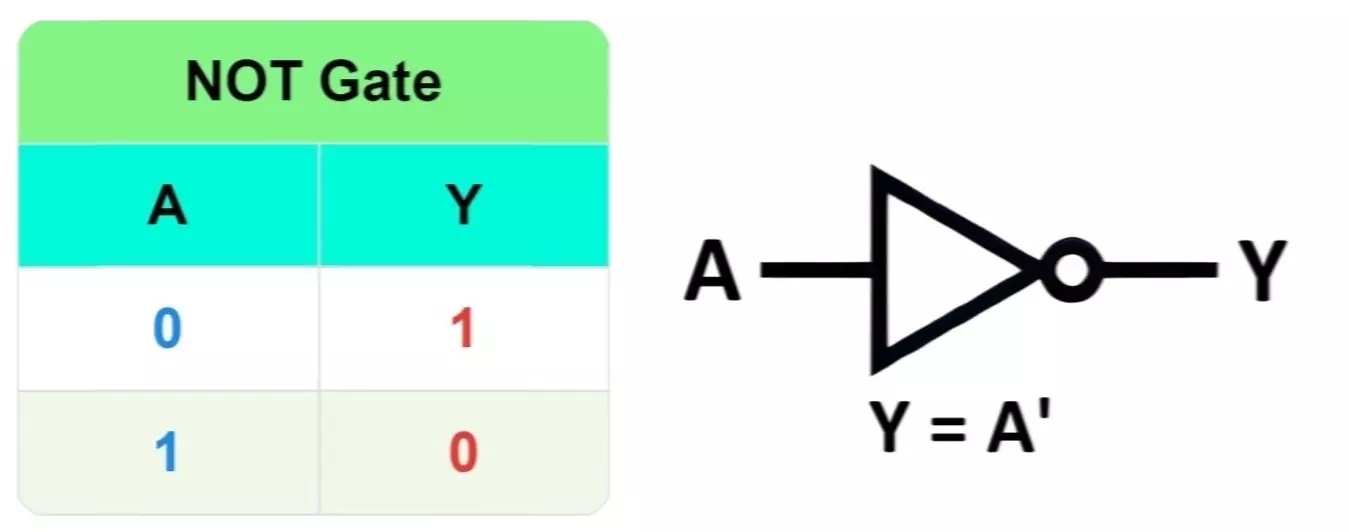
3. NOT Gate (Inverter)
Properties:
- Only one input.
- Output is always the complement of input.
- Used in memory units and control systems.
IC Number:
- IC 7404 – Hex Inverter
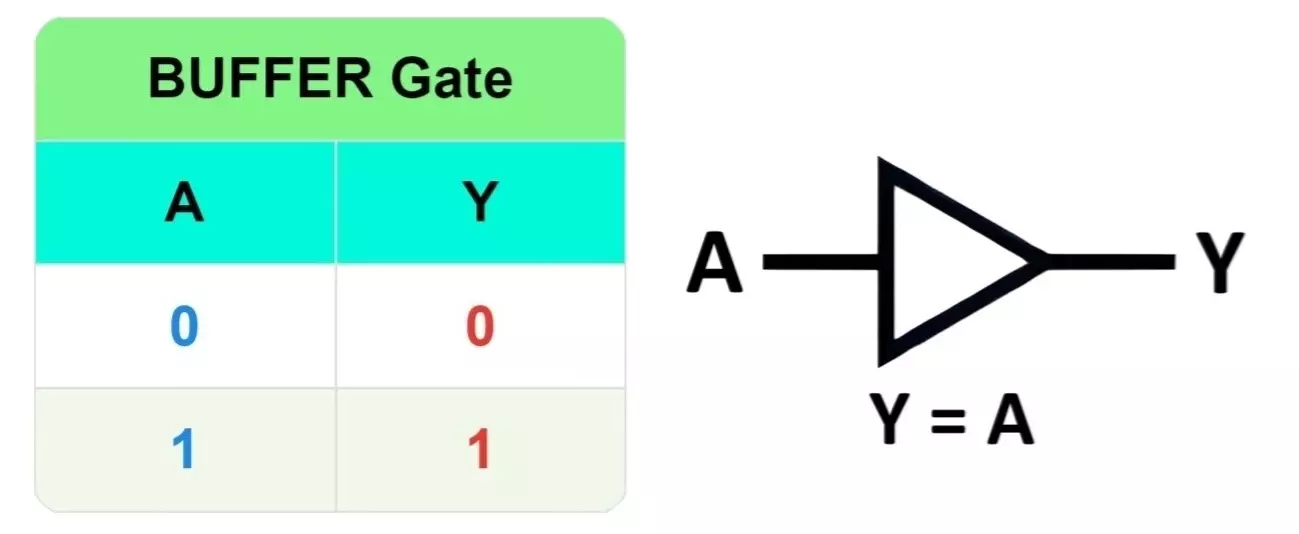
4. Buffer Gate
Properties:
- Strengthens weak signals without inverting them.
- Used in signal amplification and impedance matching.
IC Number:
-
- IC 7417 (Hex Buffer with Open Collector)
- IC 74244 (Octal Buffer/Line Driver)
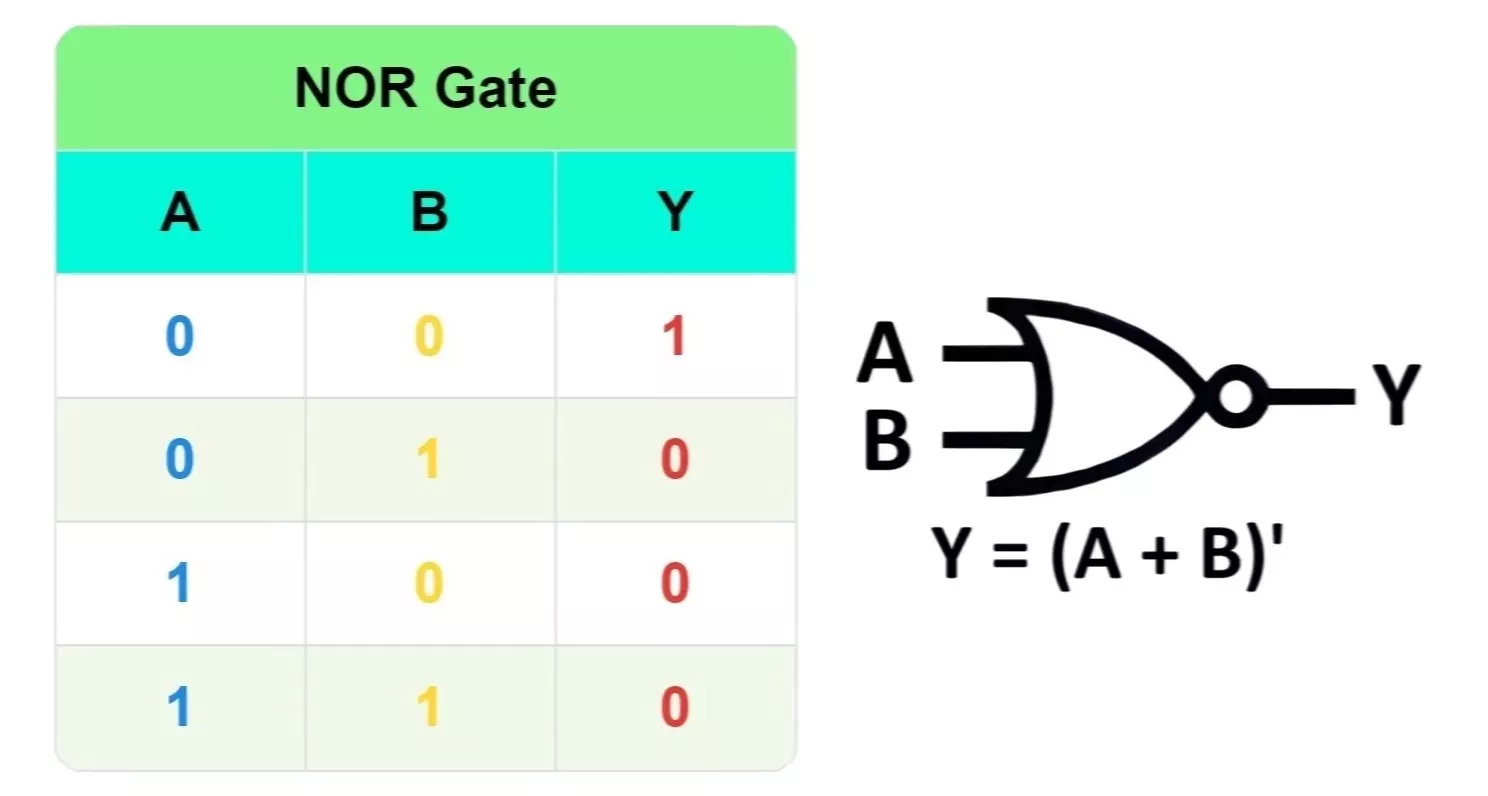
5. NOR Gate
Properties:
- Can function as a universal gate.
- Outputs 1 only when all inputs are 0.
- Used in digital storage and combinational logic circuits.
IC Number:
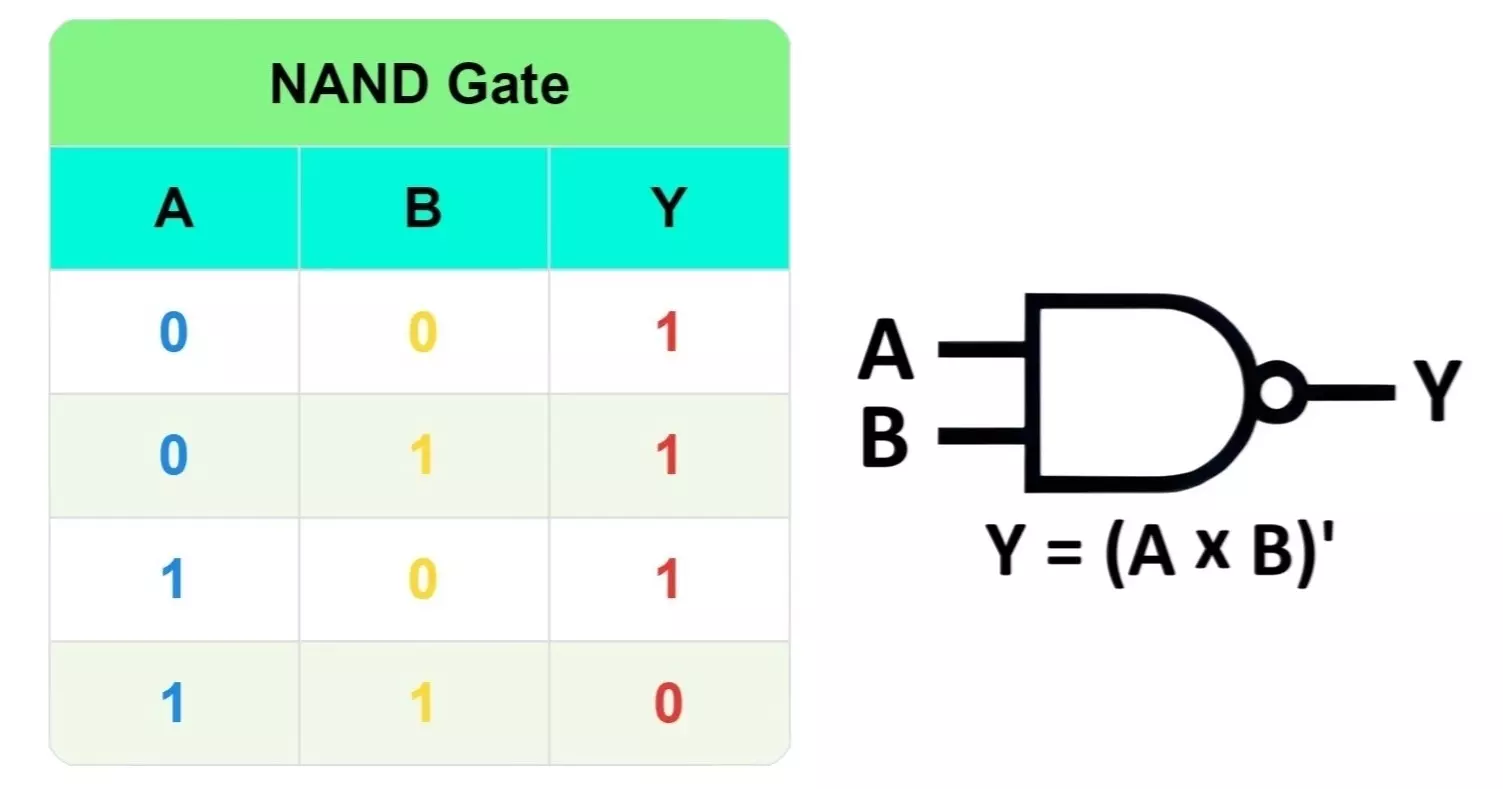
6. NAND Gate
Properties:
- Can be used to build any logic gate.
- Output is 0 only when all inputs are 1.
- Common in arithmetic circuits and microprocessors.
IC Number:
- IC 7400 – Quad 2-input NAND gate
7. XOR Gate
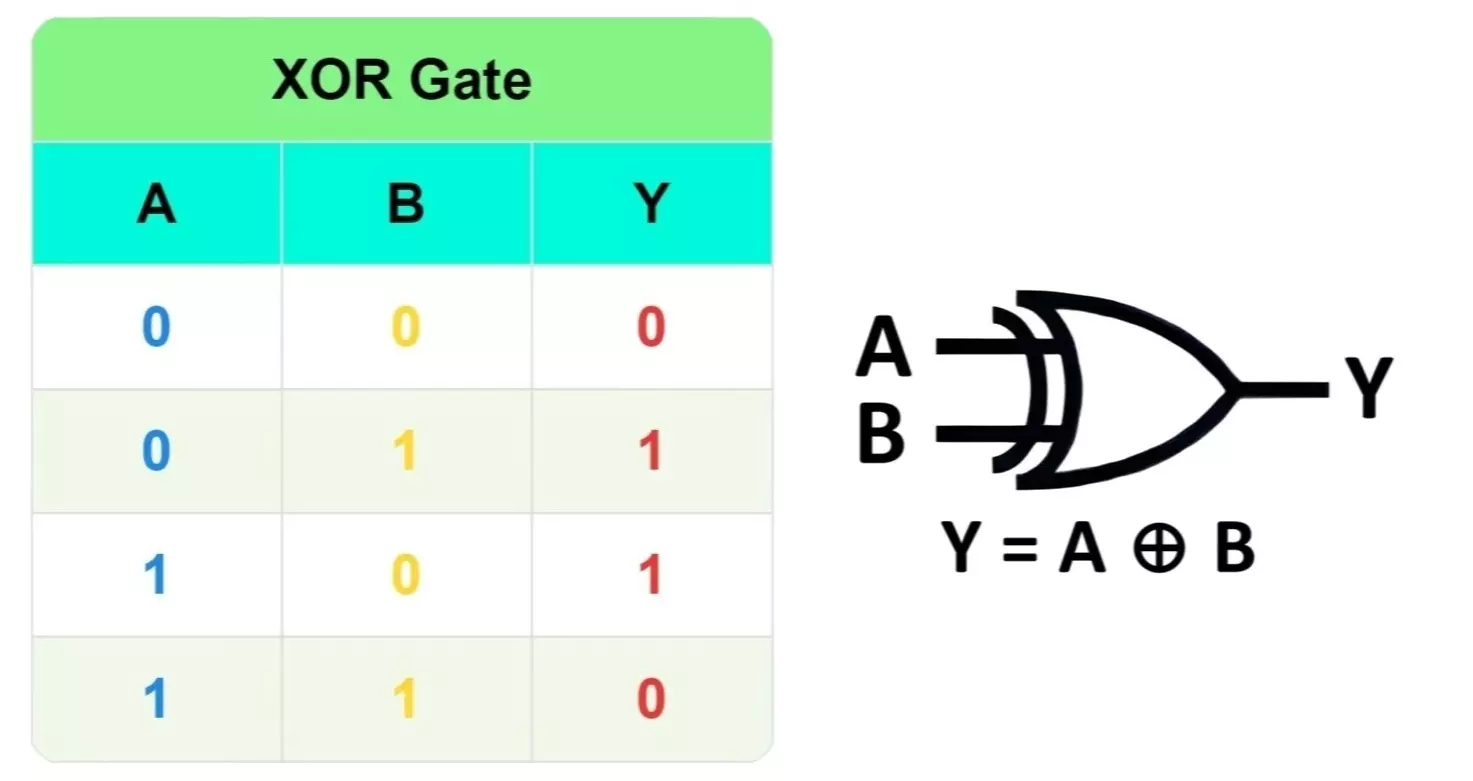
Properties:
- Output is 1 when inputs are different.
- Used in error detection and cryptographic systems.
IC Number:
- IC 7486 – Quad 2-input XOR gate
8. XNOR Gate
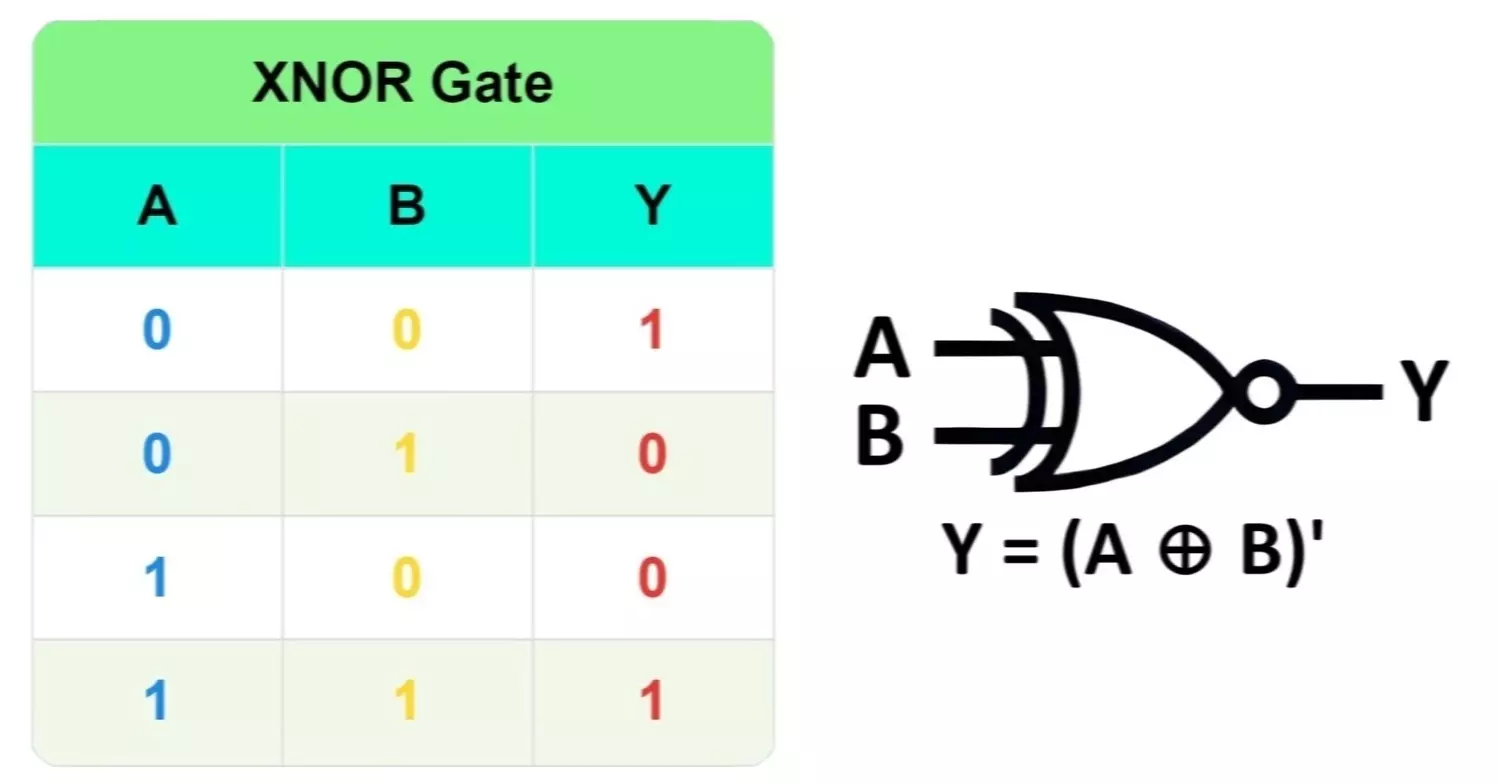
Properties:
- Output is 1 when inputs are identical.
- Used in parity checkers and digital comparators.
IC Number:
- IC 74266 – Quad 2-input XNOR gate
Logic Gates with Boolean Expression and IC Number
| Gate | Boolean Expression | IC Number |
|---|---|---|
| AND | Y = A ⋅ B | 7408 |
| OR | Y = A + B | 7432 |
| NOT | Y = A’ | 7404 |
| BUFFER | Y = A | 7417, 74244 |
| NAND | Y = (A ⋅ B)’ | 7400 |
| NOR | Y = (A + B)’ | 7402 |
| XOR | Y = A ⊕ B | 7486 |
| XNOR | Y = (A ⊕ B)’ | 74266 |
Advantages of Logic Gates
Logic gates offer several advantages that make them essential in modern digital circuits:
- High-Speed Operation: Performs calculations in nanoseconds.
- Low Power Consumption: Essential for energy-efficient designs.
- Scalability: Can be combined to create complex circuits.
- Reliability: Minimal signal degradation over time.
- Versatility: Can be used in various applications, from basic computations to advanced AI processing.
Disadvantages of Logic Gates
Despite their advantages, logic gates also have some limitations:
- Propagation Delay: Signal processing time increases in large circuits.
- Noise Sensitivity: Electrical interference can affect performance.
- Complexity in Large Circuits: Large-scale integration leads to design challenges.
- Power Dissipation: High-density circuits generate excess heat.
Applications of Logic Gates
Logic gates are widely used in various digital and electronic applications. Some key applications include:
- Computers and Microprocessors: Used in arithmetic logic units (ALUs) and control units.
- Memory Devices: Used in RAM, ROM, and storage circuits.
- Digital Clocks and Timers: Found in flip-flops and counters.
- Automation Systems: Used in industrial control circuits.
- Encryption and Security Systems: Essential for cryptographic applications.
- Communication Systems: Used in encoding, modulation, and signal processing.
- Medical Devices: Found in digital monitors and imaging systems.
Conclusion
Logic gates are the foundation of digital electronics, enabling the design of complex digital circuits. They are crucial in applications ranging from simple switching circuits to advanced computing systems. By understanding their properties, operations, and limitations, engineers can create efficient and reliable digital systems. As technology advances, logic gates will continue to play a vital role in innovations such as quantum computing and AI-driven automation.
Logic Gates FAQs
Q1: What are the basic logic gates?
> The three basic logic gates are AND, OR, and NOT gates.
Q2: Why are NAND and NOR gates called universal gates?
> Because they can be used to implement any Boolean function or any other logic gate.
Q3: What is the difference between XOR and XNOR gates?
> XOR produces a high output when inputs are different, while XNOR produces a high output when inputs are the same.
Q4: What is the importance of buffer gates?
> Buffer gates strengthen signals without inverting them and help in impedance matching.
Q5: How do logic gates impact modern technology?
> Logic gates are the foundation of digital devices, including computers, microprocessors, and smart electronics.
What is Flip Flop Circuit? Types of Flip Flops with Truth Table
Universal NOR Gate Truth Table, Logic Circuit & IC 7402 PIN Diagram
SR Flip Flop Truth Table, Circuit Diagram, Working and Applications