
Let’s explore various types of chopper circuits with their working and applications. Chopper circuit is a power electronic device that converts a fixed DC voltage into a variable DC voltage. It’s a type of DC-DC Converter which operates by turning ON and OFF a high-speed switch that connects and disconnects the load from the supply at a fast rate, thereby controlling the power delivered to the load.
In simpler terms, a chopper circuit “chops” the input DC voltage into pulses of varying duration by switching a semiconductor device (like a transistor, thyristor, or MOSFET). By adjusting the width and frequency of these pulses, the circuit controls the average output voltage. (It uses Pulse Width Modulation). The chopped pulses are then smoothed using filters, and this smoothed output provides the required DC voltage for the load.
Working Principle of Chopper Circuits:
The basic working principle of a chopper circuit revolves around switching transistors or other semiconductor devices ON and OFF to modulate the output voltage. Here’s how it works in detail:
- ON State: When the chopper switch (typically a transistor or MOSFET) is closed (ON state), the supply voltage is directly applied to the load. The current flows through the load, and the output voltage equals the input voltage.
- OFF State: When the switch is open (OFF state), the load is disconnected from the supply. During this period, no current flows through the load, and the output voltage drops to zero.
- Pulse Width Modulation (PWM): By varying the ratio of ON time to OFF time, the output voltage can be controlled. This ratio is called the duty cycle. If the ON time is longer, the average output voltage increases. If the OFF time is longer, the average output voltage decreases.
- Filtering: To smooth out the pulsed output and obtain a stable DC voltage, chopper circuits use low-pass filters like inductors and capacitors. These filters remove the high-frequency components, leaving a clean, regulated DC output.
Types of Chopper Circuits:
There are several types of chopper circuits, and they are classified based on the direction of power flow, the type of switching element, and the operation mode. The major types are as follows:
1. Step-Down Chopper (Buck Converter):
- Function: A step-down chopper reduces the input DC voltage to a lower output DC voltage.
- Operation: When the switch is ON, the load is directly connected to the source, providing full input voltage to the load. When the switch is OFF, the load voltage drops to zero. The average voltage across the load is lower than the input voltage, determined by the duty cycle.
- Applications: Step-down choppers are commonly used in DC motor speed control, power supplies for low-voltage devices, and voltage regulation circuits.
2. Step-Up Chopper (Boost Converter):
- Function: A step-up chopper increases the input DC voltage to a higher output DC voltage.
- Operation: During the ON state, energy is stored in an inductor. In the OFF state, the inductor releases the stored energy, which adds to the input voltage, resulting in a higher output voltage.
- Applications: Step-up choppers are used in renewable energy systems. They are found in solar panels, electric vehicles, and other applications where higher output voltage is required from a lower input voltage.
3. Step-Up/Step-Down Chopper (Buck-Boost Converter):
- Function: This type of chopper can either step up or step down the input voltage depending on the duty cycle.
- Operation: It combines the functionality of both step-up and step-down choppers. This circuit can produce an output voltage that is either higher or lower than the input voltage.
- Applications: Buck-boost choppers are widely used in power supplies, battery-operated devices, and voltage regulation systems where the input voltage can vary, but a constant output voltage is needed.
4. Bidirectional Chopper:
- Function: A bidirectional chopper allows power to flow in both directions. This means it can transfer power from the source to the load and from the load back to the source.
- Operation: Bidirectional choppers have switches that allow current to flow in both forward and reverse directions. This is useful in regenerative braking systems and other energy recovery systems.
- Applications: Bidirectional choppers are used in electric vehicles, regenerative braking in DC motor drives, and other energy recovery systems.
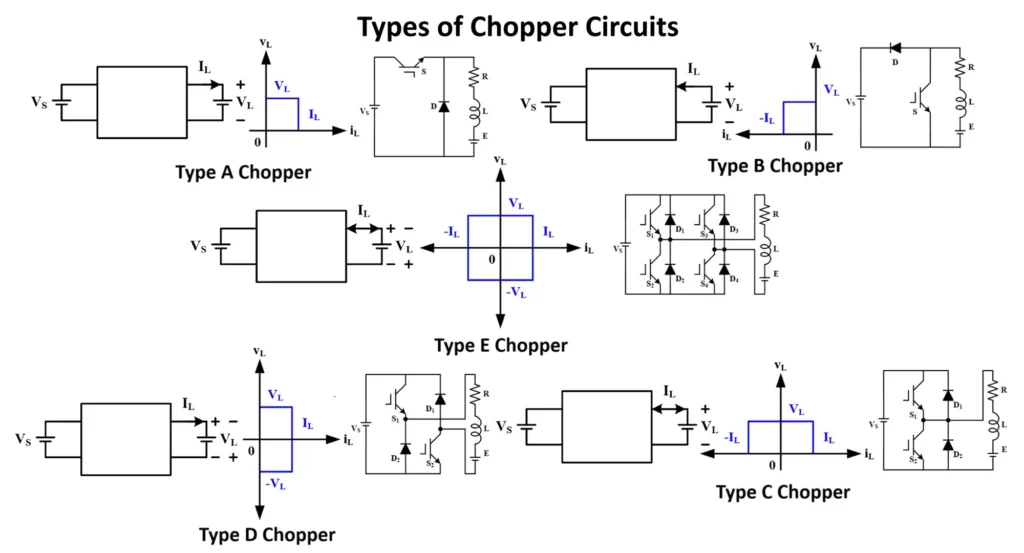
A, B, C, D, and E Types of Chopper Circuits:
Chopper circuits are classified into different types based on their operation and application. These include A, B, C, D, and E types, which are also referred to as Class A, B, C, D, and E choppers. Each class operates in a different quadrant of the voltage-current plane, providing different forms of control.
Type-A Chopper (First Quadrant Chopper):
- Operation: This type operates in the first quadrant of the voltage-current plane, meaning both voltage and current are positive.
- Working: The chopper allows current to flow in one direction. When the chopper switch is on, the voltage across the load is equal to the supply voltage, and current flows through the load. When the switch is off, a freewheeling diode maintains the current in the load.
- Application: Type A choppers are used in DC motor control, where only forward motoring is needed.


Type-B Chopper (Second Quadrant Chopper):
- Operation: This chopper operates in the second quadrant, meaning the current is negative while the voltage is positive.
- Working: It allows for regenerative braking of motors. When the chopper switch is off, current flows back to the supply due to the energy stored in inductive loads, allowing the load to regenerate power back to the supply.
- Application: Used in regenerative braking of DC motors.

Type-C Chopper (Two-Quadrant Type A Chopper):
- Operation: This type operates in both the first and second quadrants of the voltage-current plane.
- Working: It combines both Type A and Type B choppers. In the first quadrant, the load receives power from the source, and in the second quadrant, the load sends power back to the source (regenerative braking). This chopper can be used for forward motoring and regenerative braking.
- Application: DC motor control where both forward motoring and regenerative braking are required.

Type-D Chopper (Two-Quadrant Type B Chopper):
- Operation: This chopper operates in the first and fourth quadrants, meaning the voltage is always positive, but the current can be either positive or negative.
- Working: In the first quadrant, the chopper provides positive current and voltage (forward motoring), and in the fourth quadrant, the current becomes negative, allowing for reverse motoring.
- Application: Used in situations where both forward and reverse motoring are needed.

Type-E Chopper (Four-Quadrant Chopper):
- Operation: This type operates in all four quadrants of the voltage-current plane. It can provide both positive and negative voltage and current.
- Working: The chopper can control forward motoring, reverse motoring, and regenerative braking in both forward and reverse directions.
- Application: Used in sophisticated motor control systems where complete control over motoring and braking in both directions is needed, such as in electric vehicle drive systems.

Types of Choppers – Operation Summary by Quadrant:

| Chopper Type | Voltage | Current | Quadrant | Applications |
|---|---|---|---|---|
| A | Positive | Positive | 1st | DC motor speed control (forward motoring) |
| B | Positive | Negative | 2nd | Regenerative braking (motor control) |
| C | Positive | Positive/Negative | 1st and 2nd | Forward motoring and regenerative braking |
| D | Positive/Negative | Positive/Negative | 1st and 4th | Forward and reverse motoring |
| E | Positive/Negative | Positive/Negative | All four | Full control in motor drive systems, including reverse motoring and braking |
Chopper circuits are an essential part of modern power electronics, providing efficient control over DC voltage and current, widely used in industrial applications and motor drive systems.
Applications of Chopper Circuits:
Chopper circuits are extensively used in various industries due to their efficiency, flexibility, and ability to control DC power. Some of the common applications include:
1. DC Motor Control
Chopper circuits are widely used in controlling the speed of DC motors in applications such as electric trains, conveyor belts, and industrial machinery. By varying the duty cycle, the motor’s speed can be adjusted precisely, resulting in efficient operation and power savings.
2. Electric Vehicles (EVs)
In electric vehicles, chopper circuits are used to manage battery power, control the speed of DC motors, and enable regenerative braking. The bidirectional flow of power facilitated by chopper circuits helps in recovering energy during braking and recharging the battery.
3. Power Supplies and Voltage Regulators
Choppers are employed in DC power supplies to regulate the voltage delivered to electronic devices. They provide efficient voltage conversion with minimal power loss, making them ideal for use in modern power electronics.
4. Renewable Energy Systems
Chopper circuits are essential in renewable energy systems like solar power and wind turbines. Step-up choppers are used to boost the voltage from solar panels, making it suitable for charging batteries or feeding into the grid.
5. Battery Chargers
Choppers are used in battery charging circuits to regulate the charging voltage and current. This ensures efficient and safe charging of batteries, especially in portable electronics and electric vehicles.
6. Regenerative Braking
In applications like electric trains and electric vehicles, chopper circuits enable regenerative braking. During braking, the kinetic energy of the vehicle is converted into electrical energy and fed back into the power source, improving overall efficiency.
7. Traction Systems
Chopper circuits are widely used in traction systems, such as electric locomotives and subway trains. They help in controlling the speed and torque of the traction motors, ensuring smooth and efficient operation.

Advantages of Chopper Circuits:
- High Efficiency: Chopper circuits typically have very high efficiency because switching devices like MOSFETs or IGBTs operate in saturation mode, exhibiting very low power losses.
- Compact and Lightweight: Chopper circuits use solid-state devices, making them compact and lightweight. Due to high switching frequency, chopper circuits require smaller components, leading to compact designs.
- Fast Response: Chopper circuits can quickly adjust output voltage or current by varying the duty cycle of the switching signal, providing rapid control of power delivery.
- Smooth Control: They provide smooth control over output voltage or current, which is essential for sensitive applications like electric vehicles, motor drives, and power regulation.
- Regenerative Operation: Certain configurations allow bidirectional power flow, enabling regenerative braking or energy recovery in motor control applications.
- Versatility: Chopper circuits can be used for various applications such as buck (step-down), boost (step-up), buck-boost (step-up/step-down), and inverters.
- Reduced Power Dissipation: Since switching devices operate in ON-OFF modes, they dissipate less power compared to linear regulators, resulting in lower heat generation and reduced cooling needs.
- Precision Control: By controlling the duty cycle, chopper circuits allow accurate voltage or current regulation, useful in power supplies and renewable energy systems.
Disadvantages of Chopper Circuits:
- Electromagnetic Interference (EMI): Rapid switching generates high-frequency electromagnetic interference, which can affect nearby electronic systems. Proper filtering and shielding are required.
- Complex Control Circuitry: Chopper circuits require complex control circuitry, including PWM controllers, feedback loops, and sensors for monitoring current and voltage.
- Harmonics and Noise: High-frequency switching introduces harmonics into the output waveform, leading to electrical noise, which may require additional filtering.
- Switching Losses at High Frequency: At very high frequencies, switching losses due to device capacitances and inductances can become significant, reducing maximum efficiency.
- Voltage Spikes: Rapid switching of inductive loads can cause voltage spikes or surges, potentially damaging components if not properly suppressed.
- Complex Heat Management: Effective heat dissipation techniques are needed, especially in high-power applications, despite the overall lower heat generation compared to linear regulators.
- Component Stress: Rapid switching stresses the switching devices and passive components, potentially reducing their lifespan or requiring high-reliability components.
- Cost: The need for high-quality components, advanced control systems, and noise suppression techniques can make chopper circuits more expensive to design and implement.
Conclusion:
Chopper circuits are crucial components in modern power electronics, providing efficient DC voltage conversion and control. Their ability to step up, step down, or regulate DC power makes them ideal for applications in motor control, electric vehicles, power supplies, renewable energy systems, and more. The rapid switching action of choppers, coupled with advancements in semiconductor technology, has made them indispensable in industries where energy efficiency and precise control are paramount.