
A metal oxide resistor is a type of fixed resistor that uses a metal oxide film, most commonly tin oxide (SnO₂), as its resistive element, deposited on a ceramic substrate. Designers widely use these resistors in electronic circuits that require high temperature stability, high voltage endurance, and strong surge resistance.
Metal oxide resistors were developed as an improvement over carbon film resistors. They offer better long-term stability, lower noise, higher operating temperature, and greater resistance to voltage surges, making them suitable for power electronics, industrial equipment, and protection circuits.
Symbol of Metal Oxide Resistor
In circuit diagrams, a metal oxide resistor uses the same standard symbol as other fixed resistors. The symbol does not differentiate the resistor material; the type is specified in the bill of materials (BOM) or component list.
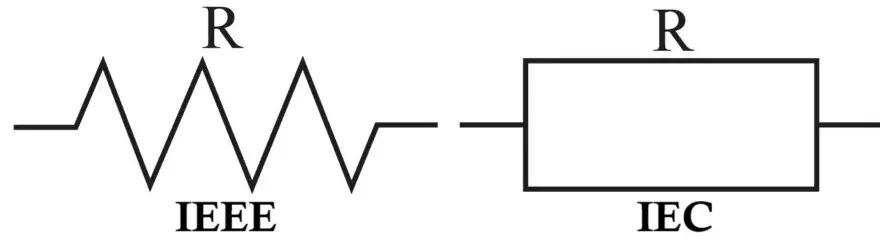
- Zigzag symbol – ANSI standard (commonly used in American schematics)
- Rectangular symbol – IEC standard (commonly used in European and Indian schematics)
Related Articles:
- Carbon Composition Resistor Construction, Working & Applications
- Carbon Film Resistor Construction, Working, Types & Applications
- Metal Film Resistor Construction, Working, Types and Applications
- Types of Resistors with Symbol, Classification and Applications
Construction of Metal Oxide Resistor
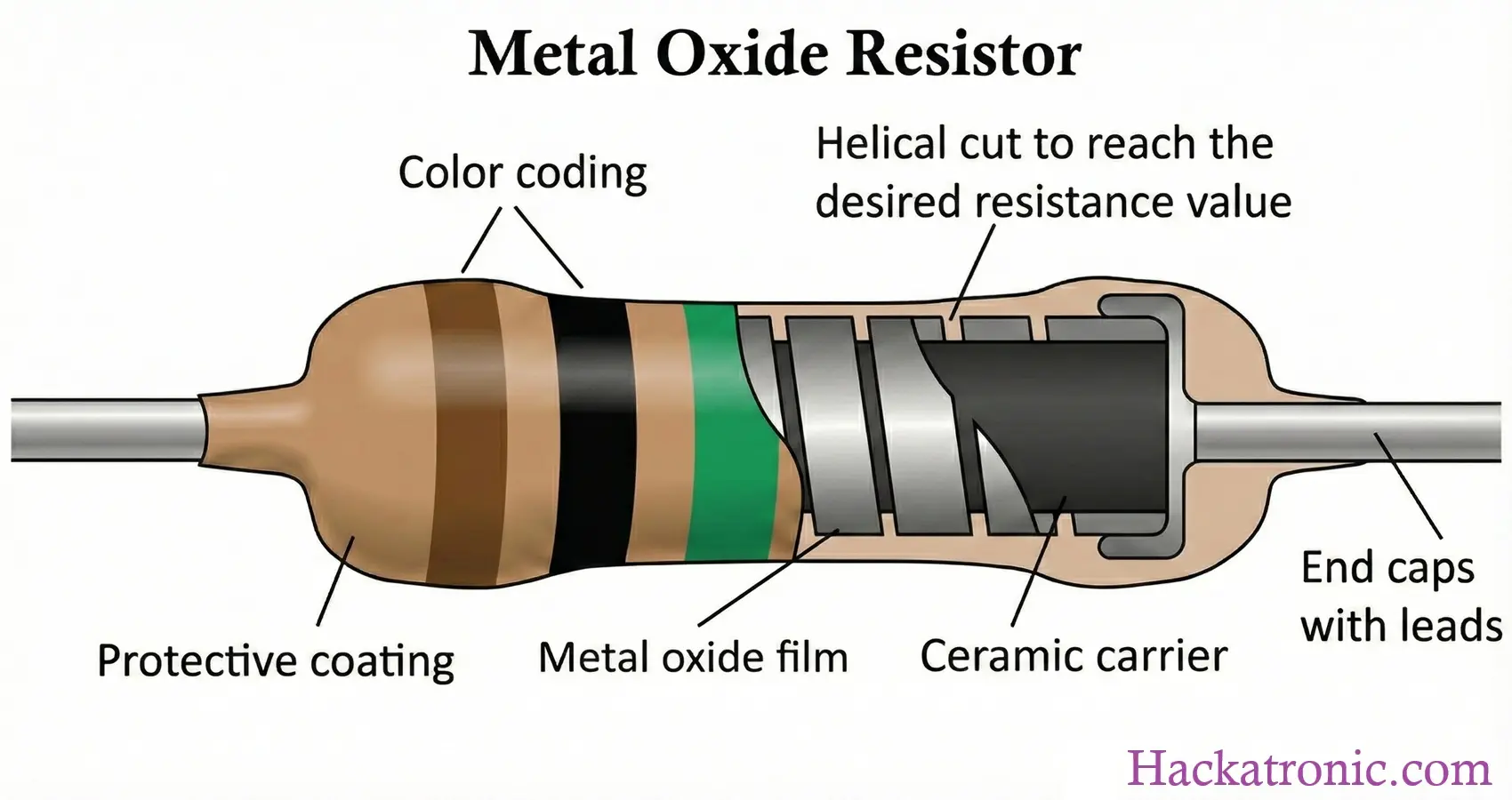
The construction of a metal oxide resistor is carefully engineered to ensure mechanical strength, electrical stability, and thermal endurance.
- Ceramic Core
- A high-purity ceramic rod (usually aluminum oxide) forms the mechanical base.
- Provides excellent insulation, thermal stability, and heat dissipation.
- Metal Oxide Film
- A thin layer of tin oxide (SnO₂) is deposited on the ceramic core using high-temperature oxidation or sputtering techniques.
- Tin oxide is chosen because it:
- Remains stable at high temperatures
- Has excellent resistance to oxidation
- Withstands high electric fields
- Resistance Trimming
- The desired resistance value is obtained by laser cutting or spiral grooving the metal oxide layer.
- Increasing the spiral length increases resistance.
- End Caps and Leads
- Metal end caps are attached to both ends of the ceramic rod.
- Copper or tinned copper leads are welded to the caps for PCB mounting.
- Protective Coating
- An outer silicone resin or epoxy coating protects the resistor from: Moisture, dust, mechanical damage and chemical exposure.
Working of Metal Oxide Resistor
The operation of a metal oxide resistor is based on Ohm’s Law:
V = I × R
- When a voltage is applied across the resistor, current flows through the metal oxide film.
- The metal oxide layer provides controlled opposition to electron flow.
- Electrical energy is converted into heat, which is safely dissipated through the ceramic body.
Key working features:
- Resistance remains stable even at high temperatures
- Minimal resistance drift with time
- Maintains performance under high voltage stress
Characteristics of Metal Oxide Resistor
- Resistance Range
- Typically, available from 1 Ω to 1 MΩ
- High-value resistors are stable compared to carbon film types
- Power Rating
- Common ratings: 0.25 W, 0.5 W, 1 W, 2 W, 3 W, 5 W
- Special high-power versions available for industrial use
- Temperature Coefficient (TCR)
- Low temperature coefficient: ±300 ppm/°C to ±100 ppm/°C
- Ensures resistance stability over temperature changes
- Noise Performance
- Lower noise than carbon composition resistors
- Suitable for analog and signal-conditioning circuits
- Voltage Handling
- Excellent high voltage withstand capability
- Suitable for circuits above 500 V
- Surge Resistance
- Can tolerate short-duration current and voltage surges
- Often used in surge suppression paths
How to Read Metal Oxide Resistor Value
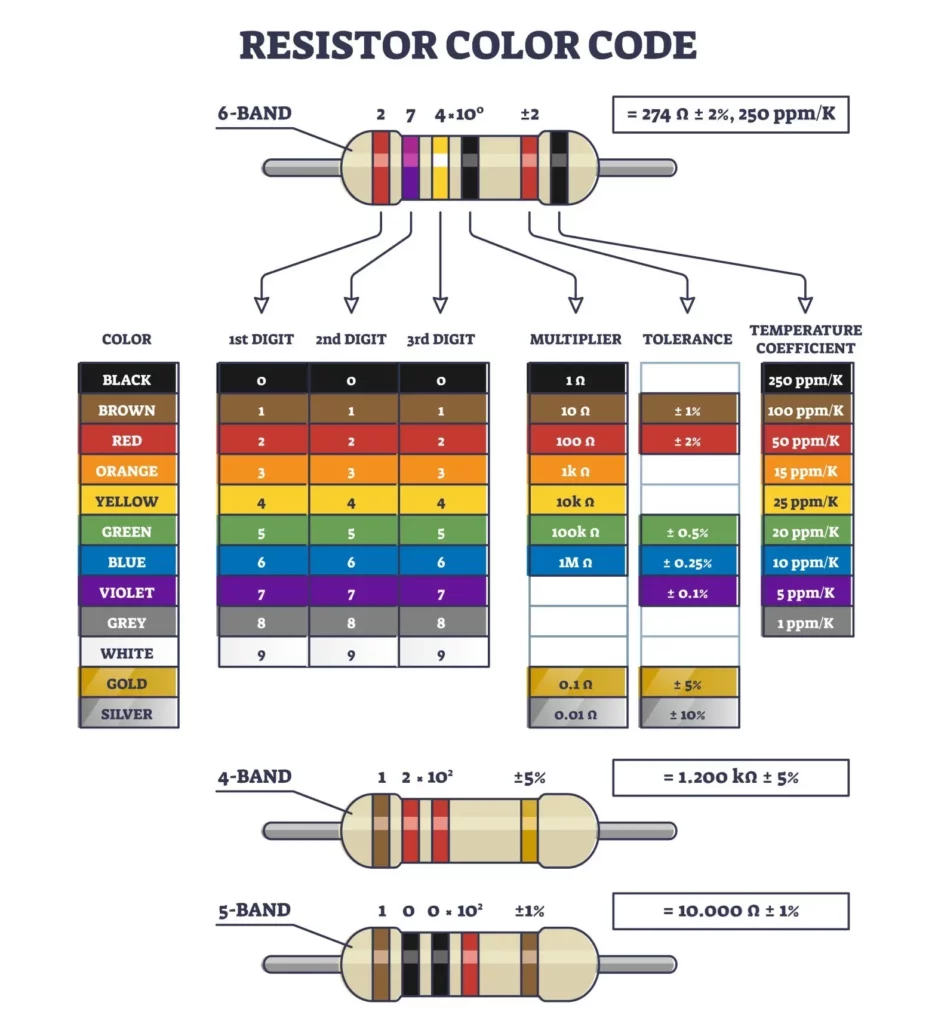
Metal oxide resistors usually follow the standard resistor color code system.
Four-Band Color Code
| Band | Meaning | Example (Brown-Black-Red-Gold) |
|---|---|---|
| 1 | First digit | Brown = 1 |
| 2 | Second digit | Red = 2 |
| 3 | Multiplier (×10ⁿ) | Red = ×100 |
| 4 | Tolerance (%) | Gold = ±5% |
Resistance = (12 × 100) = 1,200 Ω or 1.2 kΩ ±5%
Five-Band Color Code
| Band | Meaning | Example (Brown-Black-Black-Red-Brown) |
|---|---|---|
| 1 | First digit | Brown = 1 |
| 2 | Second digit | Black = 0 |
| 3 | Third digit | Black = 0 |
| 4 | Multiplier (×10ⁿ) | Red = ×100 |
| 5 | Tolerance (%) | Gold = ±5% |
Resistance = (100 × 100) = 10,000 Ω or 10 kΩ ±5%
Types of Metal Oxide Resistors
- Axial Leaded Metal Oxide Resistors
- Most common type
- Used in through-hole PCBs
- Flameproof Metal Oxide Resistors
- Designed to fail safely without catching fire
- Used in power supplies and safety-critical circuits
- High-Voltage Metal Oxide Resistors
- Designed for kilovolt-level operation
- Used in CRT circuits, SMPS, and industrial equipment
- Metal Oxide Power Resistors
- Higher wattage versions (5 W and above)
- Used in load banks and current limiting
Selection Criteria for Metal Oxide Resistor
When selecting a metal oxide resistor, consider the following parameters carefully:
- Resistance value (Ω)
- Power rating (with at least 50% safety margin)
- Operating voltage
- Tolerance (±1%, ±2%, ±5%)
- Temperature coefficient
- Surge and pulse handling requirement
- Flameproof requirement
- Physical size and lead spacing
Advantages of Metal Oxide Resistor
- High temperature stability
- Excellent voltage withstand capability
- Low noise compared to carbon resistors
- Better long-term reliability
- Good surge and overload tolerance
- Flameproof options available
- Suitable for harsh environments
Disadvantages of Metal Oxide Resistor
- More expensive than carbon film resistors
- Lower precision compared to metal film resistors
- Larger size for the same resistance value
- Limited availability in very tight tolerance ranges
Applications of Metal Oxide Resistor
Metal oxide resistors are widely used in:
- Switch-mode power supplies (SMPS)
- High-voltage power circuits
- Snubber networks
- Surge protection circuits
- Audio amplifiers (power sections)
- Industrial control systems
- LED driver circuits
- Inrush current limiting
- Voltage dividers in high-voltage measurement
Comparison with Other Resistors
- Metal oxide resistors offer better stability and higher voltage rating compared to carbon film resistors
- Metal oxide resistors have much lower noise and drift compared to carbon composition resistors
- Metal oxide resistors are slightly less precise but far more rugged compared to metal film resistors
Summary Table
| Parameter | Metal Oxide Resistor |
|---|---|
| Resistive Material | Tin Oxide (SnO₂) |
| Resistance Range | 1 Ω to 1 MΩ |
| Power Rating | 0.25 W to 5 W+ |
| Tolerance | ±1% to ±5% |
| Temperature Coefficient | ±100 to ±300 ppm/°C |
| Noise Level | Low |
| Voltage Rating | High |
| Surge Handling | Excellent |
| Flameproof Options | Available |
| Typical Applications | Power, HV, Industrial |
Conclusion
Metal oxide resistors occupy an important position in modern electronics due to their robust construction, thermal endurance, and high-voltage capability. While they may not offer the extreme precision of metal film resistors, their ruggedness and safety performance make them indispensable in power electronics, industrial systems, and protection circuits. Proper selection and derating ensure long service life and reliable operation in demanding environments.
Types of Resistors with Symbol, Classification and Applications
Metal Film Resistor Construction, Working, Types and Applications
Carbon Composition Resistor Construction, Working & Applications
Carbon Film Resistor Construction, Working, Types and Applications