
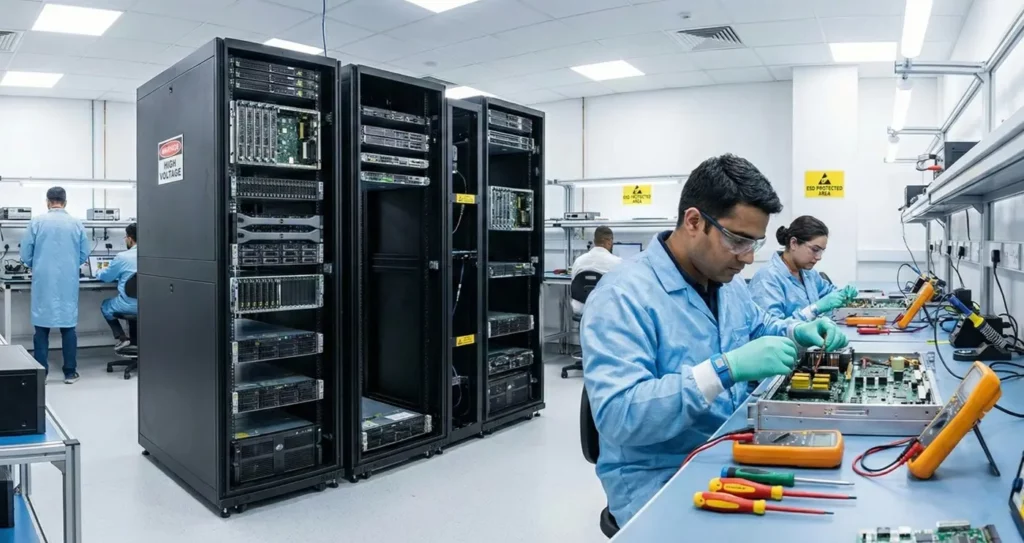
Electronics work may appear calm and controlled, but anyone who has spent meaningful time in a lab or workshop understands that it involves a complex interaction between heat, voltage, chemicals, sharp tools, and sensitive components. Every experienced technician has a few stories that begin with “I almost…”. Tools and systems that seem harmless can injure users, ignite fires, or destroy expensive hardware in seconds.
This extended guide explores the categories of hazard-prone equipment and provides actionable safety protocols designed for professionals, educators, and serious hobbyists.
High-Risk Electronics Equipment
1. Soldering Irons, Hot Air Stations, and Reflow Devices
Thermal equipment is responsible for a high percentage of lab injuries and component failures. Heat burns flesh, delaminates PCBs, releases toxic fumes, and damages nearby components.
Safety Protocols:
- Ensure your work surface is fire-resistant before beginning.
- Use heat mats when reworking large assemblies to prevent surface damage.
- Always return the iron to its stand—never lay it on the bench “just for a second.”
- Use temperature-controlled systems rather than fixed-output irons to minimize overheating risks.
- Keep fire extinguishers rated for electrical fires within arm’s reach.
Additional Consideration:
- Long soldering sessions can lead to repetitive strain injuries; periodic breaks reduce risk and improve precision.
2. High-Voltage Units, Capacitors, and Converter Modules
Electric shock, arc flash, and unexpected capacitor discharge are among the most serious hazards in electronics work.
Safety Protocols:
- Use lockout/tagout practices when maintaining shared lab power supplies.
- Install bleeder resistors across large capacitors to ensure automatic discharge.
- Keep one hand behind your back when adjusting live circuits—this reduces the chance of current crossing your chest.
- Maintain dry hands and non-conductive footwear during any HV task.
- Use insulated mats where high-voltage equipment is routinely operated.
Additional Consideration:
- High-power switching supplies generate electromagnetic fields that can interfere with medical devices; post clear signage where applicable.
For field repairs or outdoor electronics work, stable footing is essential. Uneven or soft ground increases the risk of equipment tipping or cables pulling loose. Using
composite ground protection mats create a level, non-conductive surface that helps maintain a safe and controlled workspace.
3. Diagnostic Equipment on Live Circuits
Diagnostic instruments are safe if used correctly but extremely vulnerable when used carelessly. Incorrect grounding or inappropriate probe selection can result in blown equipment—or worse.
Safety Protocols:
- Never float an oscilloscope by defeating the earth ground. Use proper differential probes instead.
- Inspect probes for cracks, worn insulation, or exposed metal.
- Avoid resting metal tools near energized circuits; accidental contact during probing is common.
- Use cable management techniques to avoid pulling instruments off the bench.
Additional Consideration:
- New technicians often underestimate probe-loading effects; incorrect setups can distort waveforms or push circuits into unsafe conditions.
4. Rotary Tools, PCB Routers, Cutters, and Precision Drills
Beyond electrical hazards, electronics work frequently involves cutting or machining tasks. These tools present mechanical, particulate, and noise-related risks.
Safety Protocols:
- Wear a particle-rated mask; cutting fiberglass boards produces hazardous airborne dust.
- Use ear protection when operating high-speed rotary tools.
- Apply gentle pressure; forcing a drill bit increases slip risk.
- Use magnification when performing micro-drilling or cutting tasks to maintain precise control.
Additional Consideration:
- Dust buildup on PCBs can create conductive paths or corrosion; vacuum work areas after machining operations.
5. Batteries, Chargers, and Energy Storage Systems
Energy storage systems pose some of the most unpredictable hazards in electronics. A failure can escalate instantly.
Safety Protocols:
- Conduct charge/discharge experiments inside protective enclosures.
- Never short terminals—even momentary contact can produce molten metal.
- Allow batteries to acclimate to indoor temperature before use, especially in cold climates.
- Store cells at partial charge in long-term storage to reduce degradation and risk.
Additional Consideration:
- Battery chemistry matters. NiMH, lead-acid, and lithium-ion all have distinct failure modes—never apply a one-size-fits-all approach to handling or charging.
Additional High-Risk Things Often Overlooked
6. Chemical Agents (Fluxes, Cleaners, Solvents, Epoxies)
Many labs underestimate chemical hazards. Flux fumes irritate lungs, IPA dries skin, and some adhesives release volatile compounds.
Safety Protocols:
- Use chemical-resistant gloves when handling epoxies or solvents.
- Keep flammable liquids away from soldering stations and hot equipment.
- Store chemicals in labeled, sealed containers and maintain MSDS documentation.
- Avoid mixing cleaning agents—some combinations release toxic gas.
Proper personal protective equipment (PPE) remains one of the simplest and most effective ways to reduce injuries when working with high-risk electronic tools. Items such as safety glasses, gloves, and respirators should be standard practice for tasks involving heat, chemicals, or electrical exposure.
7. ESD-Sensitive Components and Equipment
While not dangerous to humans, static discharge can silently destroy sensitive electronics.
Safety Protocols:
- Always ground yourself using wrist straps or heel straps.
- Use antistatic mats and humidity control systems.
- Store ICs in conductive bags, not plastic containers.
- Keep plastics, fabrics, and other charge-generating materials away from critical assemblies.
8. Lab Infrastructure and Environmental Hazards
Safety issues often arise not from tools, but from the workspace itself.
Examples and Protocols:
- Ensure proper lighting to avoid misreading components or touching exposed conductors.
- Prevent cable clutter that can catch on equipment or create tripping hazards.
- Keep liquid beverages out of electronics zones.
- Maintain adequate ventilation for thermal and chemical safety.
Safety Strategies for Professional Environments
Risk Assessment Before Each Task
- Identify voltage levels, stored energy, thermal exposure, and mechanical risks.
- Confirm that you have the correct PPE for each risk category.
Redundancy in Safety
- Use multiple safeguards: insulated tools, PPE, and ground fault protection.
- Never rely on a single safety measure.
Incident Response Preparedness
- Maintain fire extinguishers rated for electrical fires.
- Train all staff in first aid for burns and electric shock scenarios.
- Keep emergency shutdown switches clearly marked.
Documentation and Standard Procedures
- Establish written SOPs for high-voltage testing, battery handling, soldering, and rework.
- Require signoff on training before technicians handle advanced equipment.
Professional Mindset: Safety Discipline
Mastery in electronics is not defined solely by building clever circuits or debugging complex systems; it includes maintaining rigorous control over every hazard—from heat to voltage, chemicals to rotating tools, batteries to sharp edges. Professionals avoid accidents not by luck, but through discipline, planning, and respect for the equipment they operate.
A safe lab is a productive lab. The best outcomes are the innovative products, stable prototypes, and elegant solutions built in an environment where safety is not an afterthought but an integrated technical skill.
7 Tips for Building Compact and Efficient Electronic Circuits
Choosing the Right Materials for Reliable Electrical Performance
Best Ways to Create Product Photos for Electronic Components