
Field Programmable Gate Array (FPGAs) stand out as versatile and powerful devices that offer unique advantages in terms of flexibility, speed, and customization. Unlike traditional processors and microcontrollers, FPGA board enables user to create and implement their digital circuits, providing a canvas for innovation across a wide range of applications. This article is about fascinating world of FPGAs, exploring their architecture, applications, and the impact they have on modern technology.
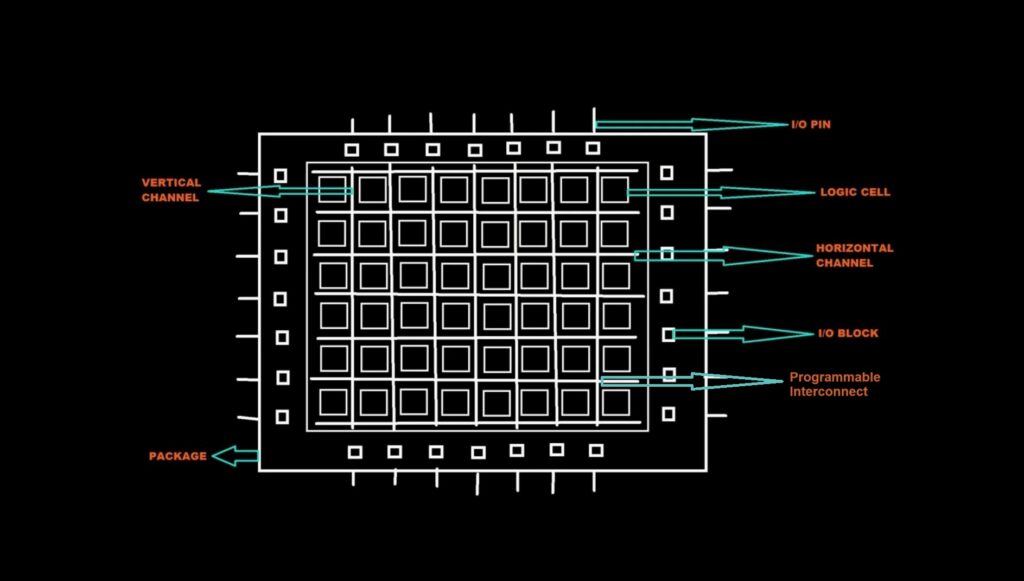
The architecture of a Field Programmable Gate Array (FPGA) is a key aspect that defines its functionality and versatility. FPGAs are unique in that they allow users to configure the hardware of the device to implement specific digital circuits. Below is an overview of the typical architecture of an FPGA:
Field Programmable Gate Array Architecture:
The Integrated circuit of FPGA includes various components all of them are listed below.
- Configurable Logic Blocks (CLBs): CLBs are the fundamental building blocks of an FPGA. They consist of Look-Up Tables (LUTs) for implementing combinational logic functions and flip-flops for sequential logic. LUTs are programmable and can be configured to implement any Boolean logic function.
- Interconnects: Interconnects form a mesh-like network that facilitates communication between different CLBs. Configurable switches enable users to define the connections between CLBs and other elements within the FPGA.
- Input/Output Blocks (IOBs): IOBs serve as interfaces between the internal logic of the FPGA and external signals. They include programmable I/O pads that can be configured to support various standards such as LVCMOS, LVDS, and differential signaling.
- Clock Distribution: Dedicated resources for clock management include Global Clock Distribution Networks. Clock resources enable the distribution of clock signals throughout the FPGA, ensuring synchronous operation.
- Routing Resources: Routing resources connect different CLBs and other components within the FPGA. Programmable switches allow users to configure the routing paths to meet specific design requirements.
- Block RAM (BRAM): FPGAs often include on-chip Block RAM for fast, dedicated memory storage. BRAM can be used for data storage, buffering, and other memory-intensive tasks.
- Digital Signal Processing (DSP) Blocks: DSP blocks are specialized resources designed to accelerate digital signal processing tasks. They often include dedicated multipliers, adders, and accumulator units.
- Configuration Memory: Configuration memory holds the bitstream that defines the logic configuration of the FPGA. The bitstream is loaded into the FPGA during initialization and configures the CLBs, interconnects, and other components.
- Configurability and Programming: FPGAs derive their name from their field-programmable nature. The process of configuring an FPGA involves programming the device with a bitstream that defines the logic functions and interconnections. This bitstream is typically generated from a Hardware Description Language (HDL) like Verilog or VHDL using synthesis tools. The configurability of FPGAs allows users to create custom digital circuits, making them highly versatile for a broad range of applications.
Advanced Features in Modern FPGAs:
- Hard Intellectual Property (IP) Blocks: Some FPGAs include pre-designed, dedicated blocks for common functions, such as processors (ARM cores), Ethernet controllers, or PCIe interfaces.
- High-Speed Serial Transceivers: FPGAs often feature high-speed serial transceivers for data communication over protocols like PCIe, SATA, or Ethernet.
- Analog Mixed-Signal Components: Advanced FPGAs may include integrated analog components, such as analog-to-digital converters (ADCs) or digital-to-analog converters (DACs).
- Partial Reconfiguration: Some FPGAs support partial reconfiguration, allowing specific regions of the device to be reprogrammed without affecting the entire configuration.
Development Tools:
To harness the power of FPGAs, designers use development tools provided by FPGA vendors. These tools include:
- Design Entry Tools: Tools for creating and entering the hardware description of the digital circuit.
- Synthesis Tools: Convert the high-level hardware description into a netlist, mapping it to FPGA resources.
- Place and Route Tools: Determine the physical locations of each logical element and define the routing resources.
- Configuration Tools: Generate the bitstream and configure the FPGA.
FPGA architecture is a dynamic and evolving field, with advancements continually expanding the capabilities of these devices. Their ability to be reconfigured for different tasks makes FPGAs invaluable in applications ranging from digital signal processing and communications to embedded systems and prototyping. As technology progresses, the architecture of FPGAs will likely continue to incorporate more features and become increasingly integrated with other technologies, fostering innovation in the world of digital design.
Application of FPGA in various domains:
- Digital Signal Processing (DSP): FPGAs excel in DSP applications, where real-time processing of signals is essential. They can be programmed to implement filters, modulators, and other signal processing algorithms.
- Communications and Networking: FPGAs are used in communication systems to implement protocols, codecs, and data processing tasks. They are also employed in networking equipment for tasks like packet processing and routing.
- Image and Video Processing: FPGAs are ideal for image and video processing applications, such as image recognition, video compression, and computer vision.
- Aerospace and Defense: FPGAs are widely used in aerospace and defense systems for tasks like radar signal processing, communication systems, and cryptography.
- Prototyping and Emulation: FPGAs serve as effective tools for prototyping and emulating hardware designs before they are implemented in ASICs. This speeds up the design and verification process.
Advantages of FPGA and why they are so useful:
Field Programmable Gate Array (FPGAs) serve a critical role in the world of digital design and electronic systems. Their unique features and capabilities address specific needs that make them indispensable in various applications. Here are some key reasons for the need of FPGAs:
Flexibility and Reconfigurability:
Tailored Hardware Acceleration: FPGAs allow designers to create customized hardware accelerators for specific algorithms or tasks. This level of customization can lead to significant improvements in performance compared to software running on a general-purpose processor.
Adaptability to Changing Standards: In industries where standards evolve rapidly, such as communications and networking, FPGAs provide a solution. They can be reprogrammed to support new protocols, standards, or features without requiring a complete hardware redesign.
Prototyping and Rapid Development:
Quick Prototyping: FPGAs are invaluable for hardware prototyping and testing. Designers can quickly implement and test new ideas without waiting for custom Application-Specific Integrated Circuits (ASICs) to be manufactured.
Short Time-to-Market: The ability to rapidly prototype and iterate designs with FPGAs can significantly reduce time-to-market for new products.
Digital Signal Processing (DSP):
Real-Time Signal Processing: FPGAs excel in applications that require real-time processing of signals, such as audio and video processing, radar systems, and communication systems.
Customized DSP Functions: Designers can implement custom digital signal processing functions tailored to specific application requirements.
Low-Volume Production:
Cost-Effective for Low Volumes: FPGAs are cost-effective for low-volume production or niche markets where the cost of ASIC development may not be justified.
Customization for Small Batches: Small batches of electronic devices can benefit from the configurability of FPGAs, allowing customization without the need for expensive custom chip manufacturing.
Parallel Processing:
Parallelism for High Performance: FPGAs can exploit parallelism in data processing, making them suitable for applications demanding high-throughput and low-latency performance.
Parallel Data Processing: In applications like image processing or simulations, FPGAs can process multiple data streams simultaneously.
Educational and Research Purposes:
Teaching Digital Design: FPGAs are widely used in educational settings to teach digital design, enabling students to gain hands-on experience with real hardware.
Research and Prototyping: Researchers can use FPGAs to prototype and test novel algorithms or designs before committing to a more permanent implementation.
Mixed-Signal Integration:
Integration of Analog and Digital Functions: Advanced FPGAs may integrate analog components, such as analog-to-digital converters (ADCs) and digital-to-analog converters (DACs), offering a mix of digital and analog functionalities in a single device.
System-on-Chip (SoC) Integration: Some FPGAs include processors, memory, and other components, providing a platform for developing complete embedded systems.
High-Speed Serial Communication:
High-Speed Transceivers: FPGAs often come equipped with high-speed serial transceivers, enabling communication over high-speed serial protocols like PCIe, SATA, and Ethernet.
Energy Efficiency: In certain scenarios, FPGAs can offer energy-efficient solutions compared to traditional processors, especially when tailored for specific tasks.
In summary, the need for FPGAs arises from their unparalleled flexibility, reconfigurability, and ability to address specific design challenges across a spectrum of applications. Whether for rapid prototyping, real-time signal processing, or educational purposes, FPGAs offer a dynamic platform for innovation in the field of digital design.
Challenges and Future Directions
While FPGAs offer significant advantages, they also come with challenges, such as a steeper learning curve, higher costs, and limited resources compared to ASICs. However, ongoing advancements in FPGA technology aim to address these challenges. The future of FPGAs may see improvements in tooling, accessibility, and integration with other technologies, making them more mainstream in various industries.
Conclusion
Field Programmable Gate Array represent a powerful shift in digital design, empowering engineers and developers to create custom digital circuits tailored to their specific needs. As technology continues to evolve, FPGAs will play an increasingly crucial role in fostering innovation across diverse industries, providing a dynamic platform for the realization of creative and efficient digital solutions. The world of FPGAs is one of endless possibilities, where the boundaries of digital design are defined by the imagination and expertise of those who harness their potential.
How is a Microprocessor Different from an Integrated Circuit?