
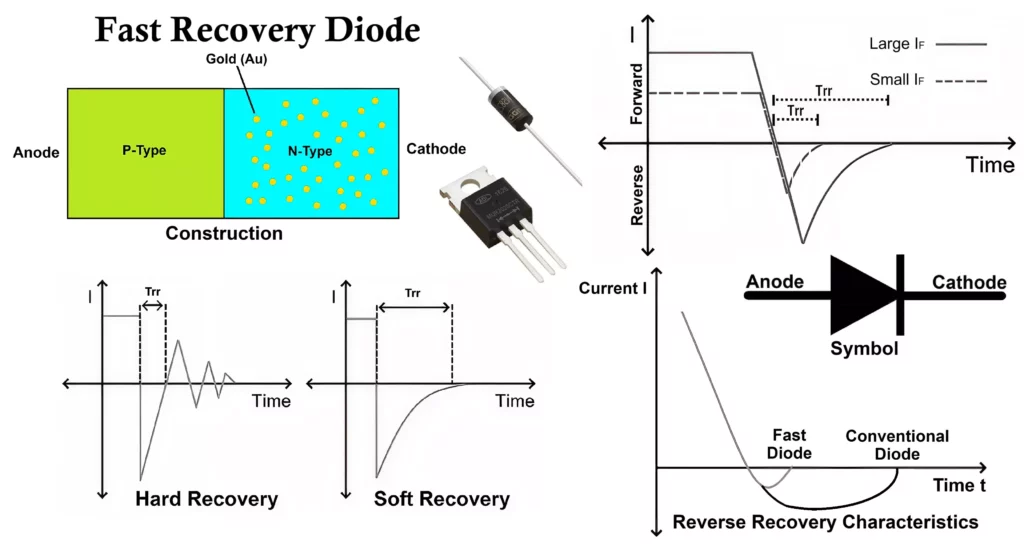
Diodes are semiconductor devices that allow current to flow in only one direction. They are widely used in modern circuits for applications such as switching, rectification, and protection. Among the various types of diodes, the fast recovery diode (FRD) is specifically applicable in high-frequency applications due to its fast reverse recovery time.
When a diode switches from forward conduction to reverse blocking mode, it takes a small amount of time to remove the stored charge carriers. This time is called reverse recovery time (T_rr). Conventional diodes have a high T_rr, making them unsuitable for high-frequency rectification. Fast recovery diodes, however, minimize this recovery time, making them ideal for high-speed rectification and switching applications.
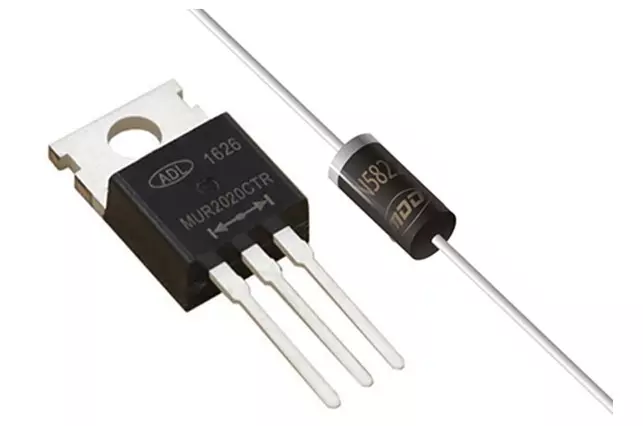
Fast Recovery Diode Symbol
The symbol of a fast recovery diode is the same as a conventional diode since both operate similarly, except for the difference in switching speed. The symbol consists of:
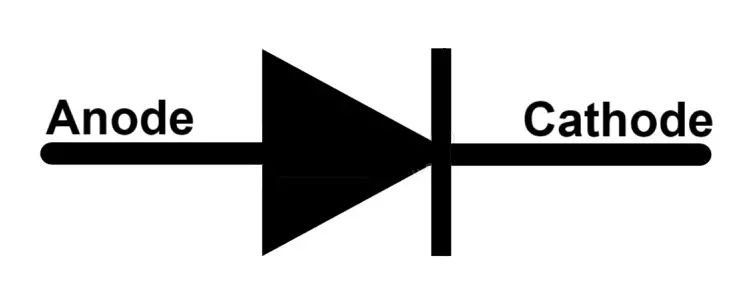
- Anode (A) and Cathode (K) terminals.
- A directional arrow showing conventional current flow.
In circuit diagrams, fast recovery diodes are marked with labels such as FR-106, FR-107, etc., to differentiate them from regular diodes.
Construction of Fast Recovery Diode
Fast recovery diodes are constructed using silicon semiconductor materials with modified doping profiles to achieve minimal charge storage and fast switching. The key construction elements include:
Key Construction Elements:
- PN Junction: The diode consists of a standard P-N junction.
- Recombination Centers: Gold (Au) doping is introduced into the semiconductor material to create recombination centers, which help in faster removal of stored charge carriers.
- Epitaxial Layer: Some FRDs use an additional epitaxial layer to optimize switching speed.
- Material Composition: Fast recovery diodes are typically made from silicon (Si), but some high-speed versions use gallium arsenide (GaAs) for even faster switching performance.
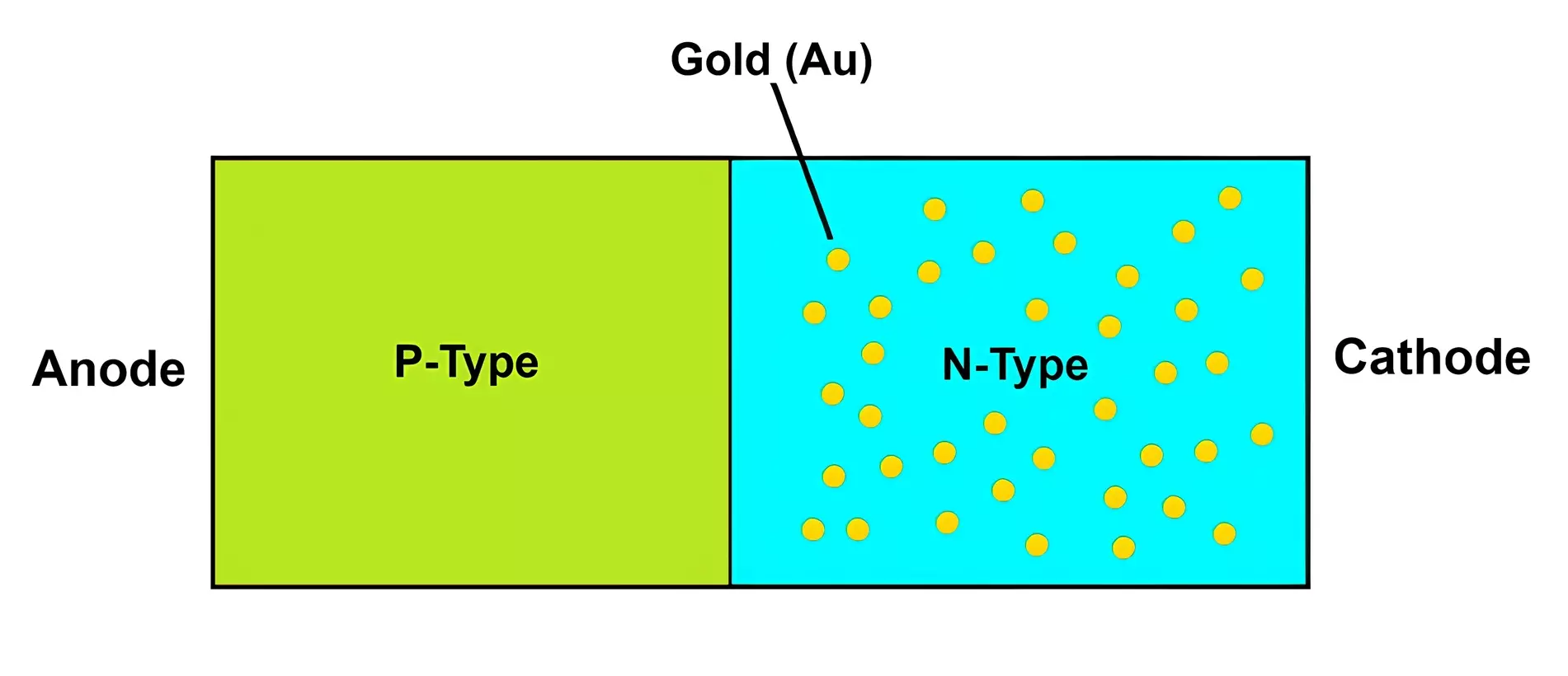
The recombination centers ensure that charge carriers recombine quickly, reducing the reverse recovery time significantly. However, excessive recombination centers may increase reverse leakage current, so an optimal balance is maintained during manufacturing.
Working of Fast Recovery Diode
Fast recovery diodes operate like regular diodes, but with a much smaller reverse recovery time. They allow current to flow in the forward direction and blocking it in the reverse direction. However, during switching, the diode must transition from conducting to non-conducting state. The reverse recovery process occurs in two stages:
- Forward Bias: In forward bias, the diode allows current to flow from anode to cathode.
- Charge Storage Phase: When the diode is forward biased, charge carriers accumulate in the depletion region.
- Reverse Bias Switching: When the voltage is suddenly reversed, the stored charge carriers continue to conduct for a very short time before recombination occurs.
- Charge Recombination & Removal: When the bias is reversed, the diode does not immediately block current; residual charge must be removed, which occurs rapidly in FRDs.
- Reverse Recovery Phase: The recombination centers (gold doping) accelerate the removal of charge carriers, allowing the diode to quickly switch to a blocking state.
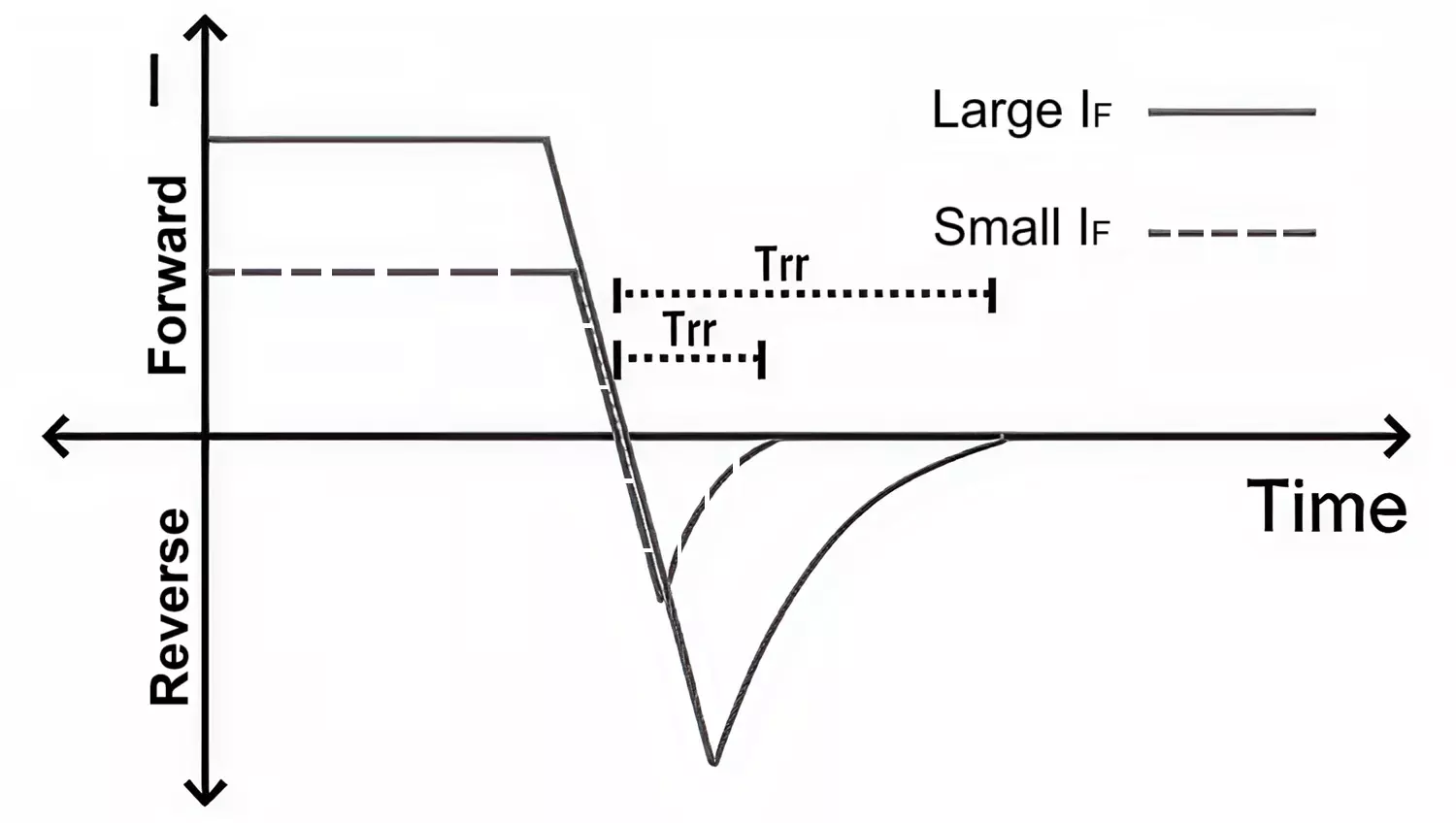
The diode is designed to minimize the reverse recovery time (T_rr), which is the time required for residual charge carriers to recombine, making it highly suitable for high-speed switching applications.
Why is Fast Recovery Needed?
- Conventional diodes have a large reverse recovery time, causing unwanted conduction during the reverse cycle in high-frequency applications.
- Fast recovery diodes solve this problem by minimizing the recovery time (T_rr), making them ideal for frequencies up to 100 kHz and beyond.
Types of Reverse Recovery in Fast Recovery Diodes
Fast recovery diodes exhibit two types of reverse recovery behavior:
1. Hard Recovery
- Reverse current drops abruptly, causing oscillations and electrical noise.
- Power loss is higher due to sudden current changes.
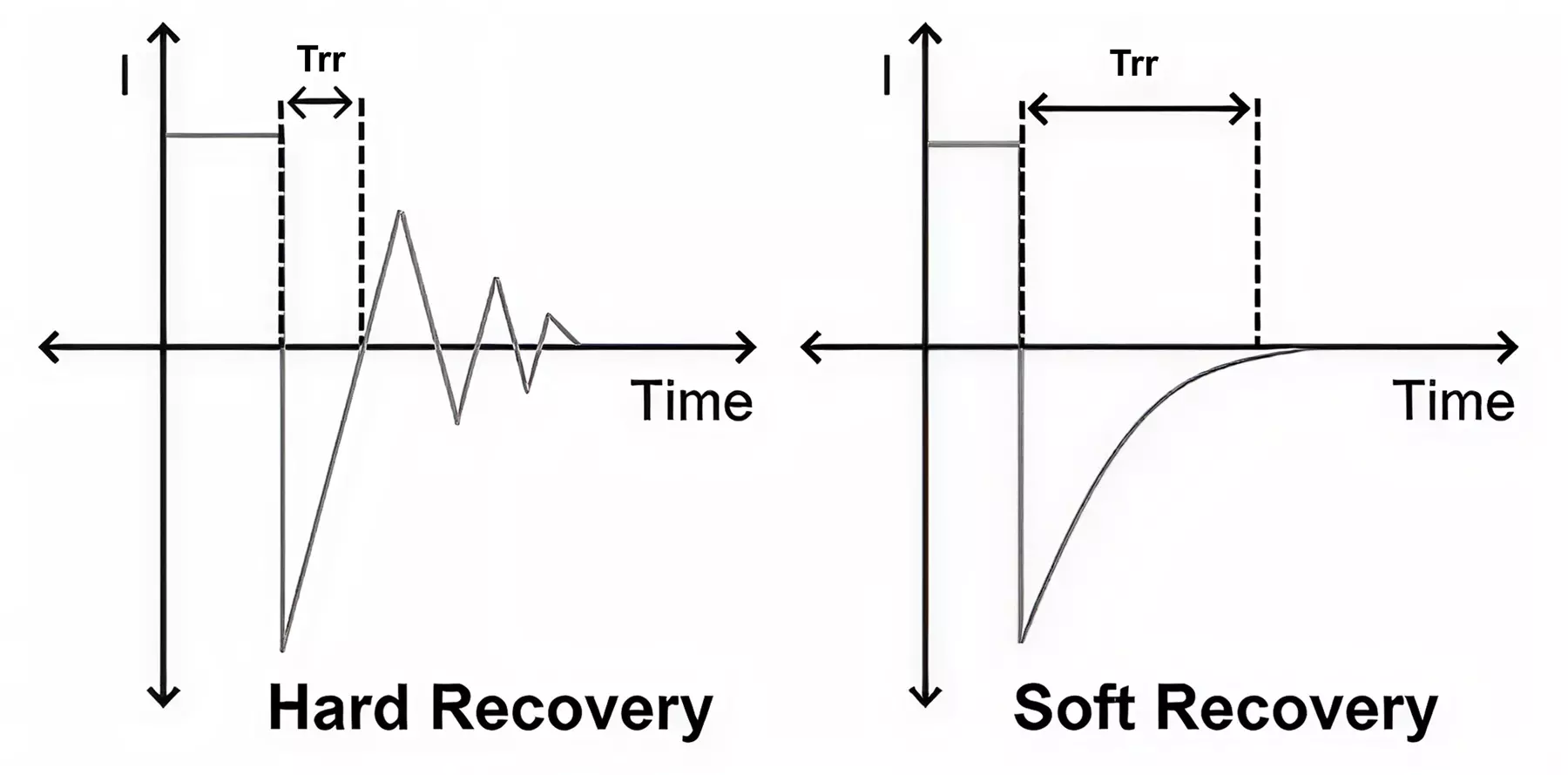
2. Soft Recovery
- Reverse current decreases gradually, reducing noise and improving system stability.
- Used in circuits requiring smooth operation with minimal EMI (Electromagnetic Interference).
Soft recovery diodes are preferred in high-frequency power electronics and inverter circuits.
Characteristics of Fast Recovery Diode
- Maximum Reverse Voltage (V_R): Can range from 600V to 1000V, depending on the diode.
- High Switching Speed: Suitable for high-frequency applications.
- High Forward Voltage Drop (V_f): Generally higher than Schottky diodes and standard silicon diodes around 1V to 3.6V.
- High Efficiency: Reduces power losses in fast-switching circuits.
- Temperature Stability: Designed to operate under varying temperature conditions with minimal performance loss.
- Low Reverse Leakage Current (I_R): Ensures minimal unwanted conduction in the reverse state.
- Low Reverse Recovery Time (T_rr): Typically, in the range of nanoseconds, allowing fast switching.
VI Characteristics of Fast Recovery Diode
Forward Characteristics:
- The diode exhibits exponential current increase after exceeding its threshold voltage.
- Forward voltage drop is typically higher than Schottky diodes and regular silicon diodes.
Reverse Characteristics:
- A small leakage current exists in reverse bias until the breakdown voltage is reached.
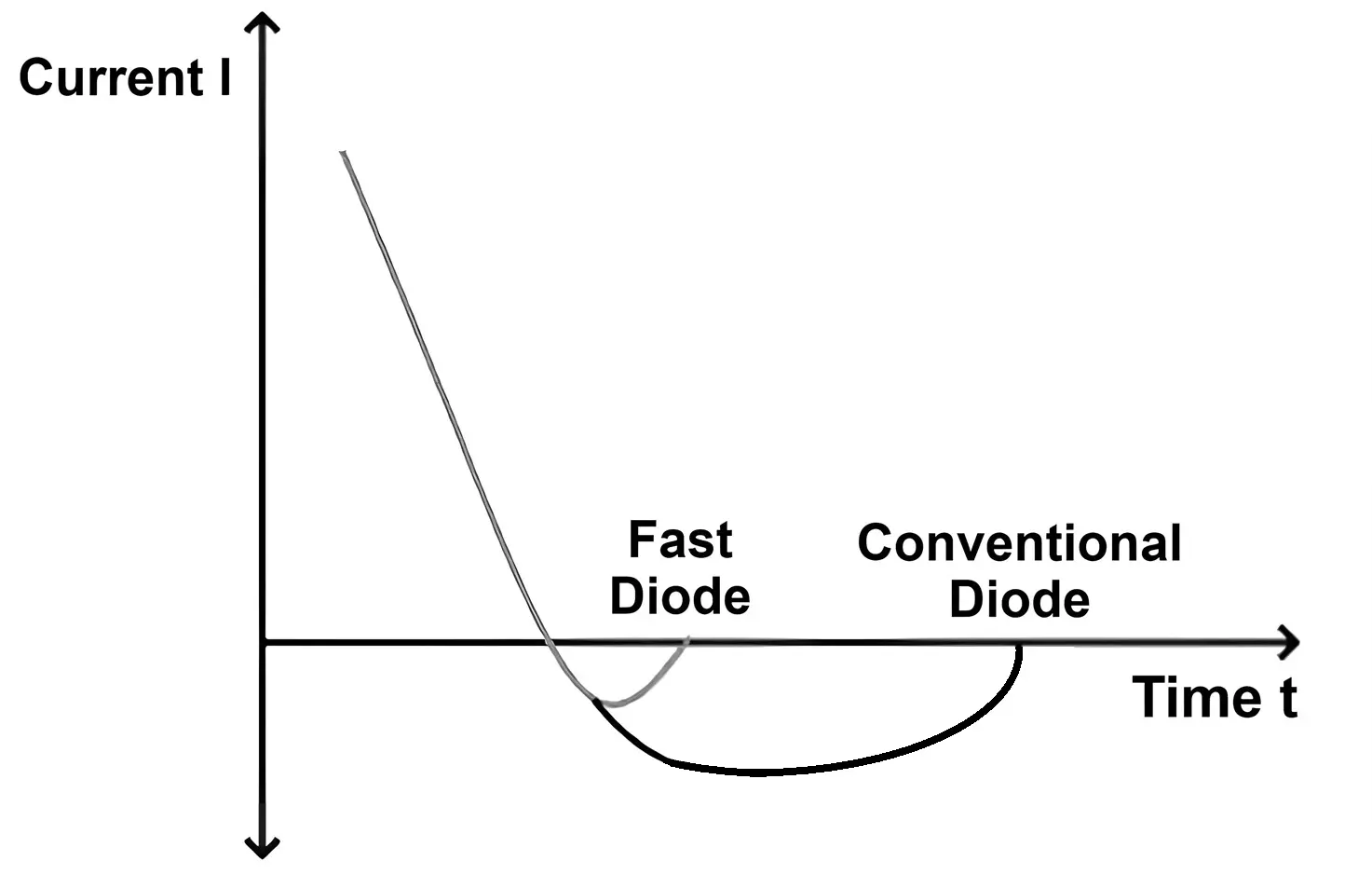
- Reverse recovery is significantly faster than conventional diodes.
Ultra High-Speed Fast Recovery Diodes
Some advanced ultra high-speed FRDs are designed for extremely fast switching, even at the cost of a higher forward voltage drop:
- Reverse Recovery Time (T_rr): Around 25 ns.
- Forward Voltage Drop: Higher, around 3V to 3.6V.
- Advantages: High switching speed with soft recovery characteristics, reducing noise and EMI.
These are used in applications requiring precise high-speed switching such as RF circuits, DC-DC converters, and high-speed rectifiers.
Comparison of Fast Recovery Diode, Schottky Diode and Conventional Silicon Diode
| Parameter | Fast Recovery Diode (FRD) | Schottky Diode | Conventional Silicon Diode |
|---|---|---|---|
| Forward Voltage Drop (V_f) | 1.3V – 3.6V | 0.2V – 0.5V | 0.7V – 1.1V |
| Reverse Recovery Time (T_rr) | 25 ns – 500 ns | 0 ns (negligible) | 2 µs – 30 µs (slow) |
| Reverse Leakage Current (I_R) | 10 µA – 500 µA | 100 µA – 10 mA (high) | 1 µA – 50 µA (low) |
| Switching Speed | Fast | Very Fast | Slow |
| Efficiency in High Frequency Circuits | High | Very High | Low |
| Voltage Rating | 100V – 1200V+ | <200V typically | 50V – 1000V+ |
| Power Losses | Moderate | Low | High |
| Temperature Stability | Good | Poor (sensitive to heat) | Very Good |
| Application | SMPS, inverters, DC-DC converters | Low-voltage, high-speed switching, RF circuits | General rectification, low-frequency applications |
Key Takeaways:
- Schottky diodes are best for low voltage, high-speed applications but have high leakage current and lower voltage tolerance.
- Fast Recovery Diodes (FRD) are optimized for high-frequency rectification with fast switching but have higher forward voltage.
- Conventional diodes are best for low-frequency applications where switching speed isn’t a concern.
Advantages of Fast Recovery Diode
- High Switching Speed – Ideal for high-frequency circuits, ensuring rapid response times.
- Low Reverse Recovery Time – Reduces switching losses and improves overall efficiency.
- Lower Power Losses – Minimizes energy dissipation, making it superior to conventional diodes in high-frequency applications.
- Better Efficiency in Rectification – Enhances the performance of DC-DC converters and switched-mode power supplies (SMPS).
- Higher Reverse Voltage Tolerance – Can withstand higher voltages compared to Schottky diodes.
- Enhanced Performance in Rectifiers – Provides superior rectification efficiency in comparison to standard diodes.
- Wide Operating Temperature Range – Suitable for industrial and power electronics applications where temperature fluctuations are significant.
- Improved Reverse Recovery Behavior – Leads to improved thermal management and energy efficiency. Reduces stress on circuit components, extending their lifespan.
Disadvantages of Fast Recovery Diode
- Higher Forward Voltage Drop: Compared to Schottky diodes, leading to slightly increased conduction losses.
- Increased Reverse Leakage Current: Due to gold doping for fast switching.
Higher Cost: More expensive than conventional diodes. - Higher Cost: More expensive than standard diodes due to advanced construction techniques.
- Limited Voltage Ratings: May not be suitable for ultra-high voltage applications.
Applications of Fast Recovery Diode
Fast recovery diodes are commonly used in high-speed circuits where fast switching is essential.
- Switch Mode Power Supplies (SMPS): Used in high-frequency rectification circuits.
- DC-DC Converters: Enhances efficiency in power conversion applications.
- Motor Drive Circuits: Reduces switching losses in high-speed motor controllers.
- Inverters for Solar Panels: Improves efficiency in photovoltaic power conversion.
- Power Factor Correction (PFC) Circuits: Helps in reducing power losses in correction circuits.
- High-Frequency Rectification: Used in applications requiring rapid polarity switching.
- RF and Communication Systems: Plays a role in high-speed signal demodulation.
Conclusion
Fast recovery diodes play a vital role in modern power electronics, providing high-speed switching with minimal losses. Their ultra-fast recovery time makes them suitable for rectifiers, converters, and switching circuits in high-frequency applications. While they have a higher cost and voltage drop compared to some alternatives, their efficiency and performance outweigh these disadvantages. UF4007 and MUR460 are some of the very popular Fast Recovery Diodes used for high frequency application.
Understanding how fast recovery diodes work and their advantages allows engineers to design more efficient and reliable power circuits for modern electronics, automotive, and renewable energy applications.
Step Recovery Diode Symbol, Construction, Working & Applications
Types of Diodes with Symbol, Definition, Working and Applications
VI Characteristics of Zener Diode, Working and its Applications
Types of Capacitors with Symbol, Classification and Applications