
Counters are fundamental digital circuits used in sequential logic for counting purposes. They are broadly classified into two types: Synchronous Counters and Asynchronous Counters. Understanding the difference between synchronous and asynchronous counters helps in choosing the right type for specific applications in digital electronics. These counters play a crucial role in modern digital systems, ranging from simple counting applications to complex microprocessor-based timing circuits.
What is a Counter?
A counter is a sequential circuit that goes through a predefined sequence of states upon receiving clock pulses. Digital systems widely use counters for counting events, generating time delays, frequency division, and more. Flip-flops (such as JK, D, or T flip flop) implement these circuits, storing and transitioning between binary states based on clock inputs. Understanding the difference between synchronous and asynchronous counters is essential for designing efficient timing and counting circuits.
What is a Synchronous Counter?
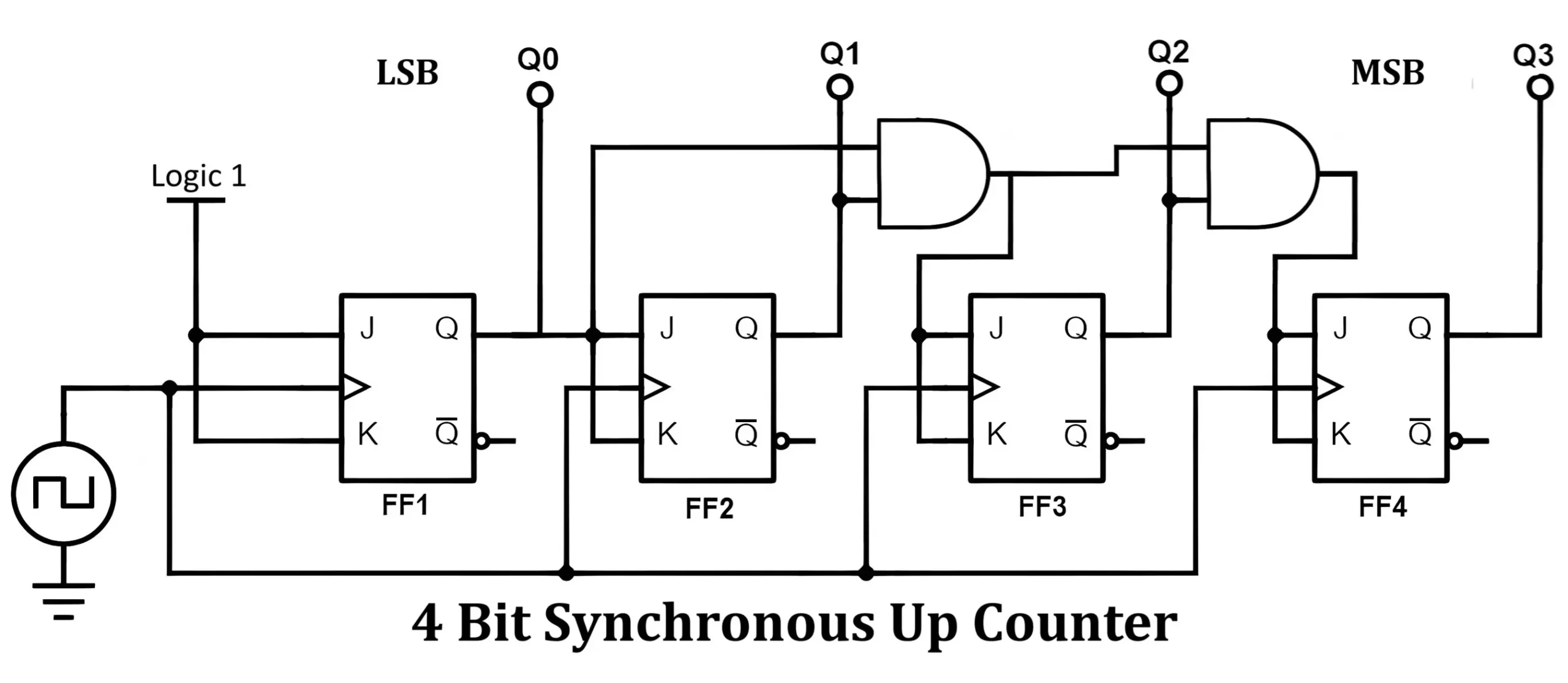
A synchronous counter is a type of counter in which all flip-flops receive the clock signal simultaneously. This ensures that every flip flop changes state at the same time, eliminating propagation delays and allowing for high-speed operation.
Working Principle of a Synchronous Counter:
- All flip-flops in a synchronous counter are connected to a common clock signal.
- Logic gates are used to control state transitions based on the current state of the counter.
- Since all flip-flops switch simultaneously, timing issues are minimal, leading to accurate counting and reduced delay.
- The counter can be designed to work in up-counting, down-counting, or bidirectional modes, depending on the application.
Types of Synchronous Counters:
- Up Counter: Increments the count with each clock pulse.
- Down Counter: Decrements the count with each clock pulse.
- Up/Down Counter: Can count both upward and downward, depending on an external control signal.
- Ring Counter: A circulating pattern of states, often used in sequence generation.
- Johnson Counter: A modified ring counter where outputs provide more unique states, used in frequency division.
Advantages of Synchronous Counters:
- Faster operation since all flip-flops are clocked simultaneously, reducing propagation delay.
- Glitch-free output by eliminating the ripple effect found in asynchronous counters.
- Better reliability with fewer errors due to timing mismatches.
- Easier to design for high-speed applications, operating at higher frequencies without significant delays.
- Stable performance ensuring accurate counting in time-sensitive applications.
Disadvantages of Synchronous Counters:
- More complex circuitry requiring additional logic gates for proper operation.
- Increased power consumption due to more components.
- Higher cost due to additional hardware requirements.
Applications of Synchronous Counters:
- High-speed digital circuits
- Frequency counters
- Digital clocks
- Computer memory addressing
- Timer circuits
- Digital signal processing
- High-performance computing systems
What is an Asynchronous Counter?
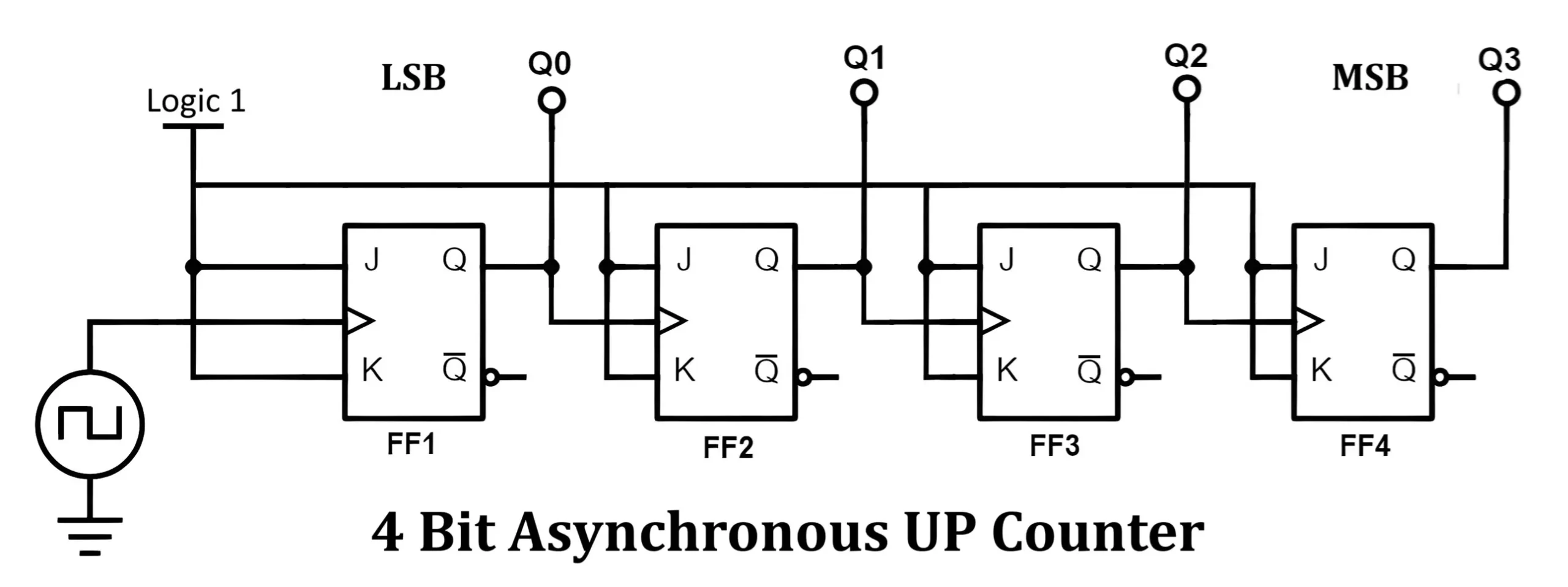
An asynchronous counter, also known as a ripple counter, connects flip-flops in a cascaded manner, with each flip-flop receiving the clock signal from the previous stage rather than from a common clock source.
Working Principle of an Asynchronous Counter:
- The first flip-flop receives an external clock signal.
- Each subsequent flip-flop gets its clock input from the output of the preceding flip-flop.
- This causes a delay as the clock signal ripples through each stage, introducing propagation delays.
- Asynchronous counters are typically used in applications where speed is not a major concern, but simplicity and low power consumption are key factors.
Types of Asynchronous Counters:
- Mod-N Counter: A counter that resets after reaching a specific count (e.g., MOD-10 counter resets after counting 10 states).
- Up Counter: Counts in an increasing binary sequence.
- Down Counter: Counts in a decreasing binary sequence.
- Up/Down Counter: Can count in both directions based on external control signals.
Advantages of Asynchronous Counters:
- Simple design requiring fewer components, making implementation easier.
- Lower power consumption due to fewer logic gates.
- Cost-effective because of reduced hardware requirements.
- Suitable for low-speed applications where high-frequency operation is not required.
Disadvantages of Asynchronous Counters:
- Propagation delay caused by the ripple effect as each flip-flop changes state sequentially.
- Limited speed, making them unsuitable for high-frequency applications.
- More prone to timing errors and glitches.
- Unsuitable for synchronous digital systems requiring precise timing.
Applications of Asynchronous Counters:
- Simple event counters
- Low-speed frequency division
- Light intensity measurement circuits
- Stepper motor control
- Basic timer circuits
- Simple pulse counting applications
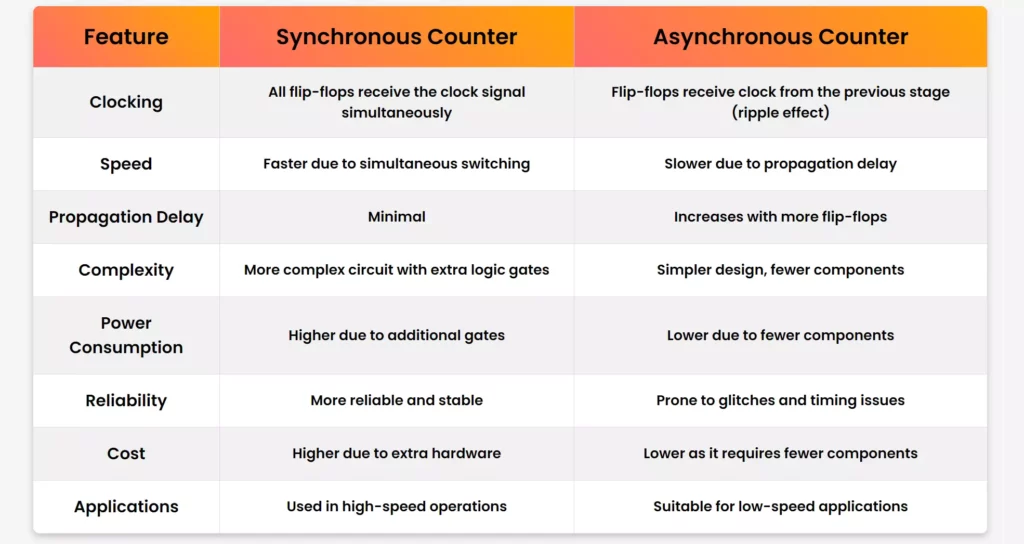
Difference Between Synchronous and Asynchronous Counters
| Feature | Synchronous Counter | Asynchronous Counter |
|---|---|---|
| Clocking | All flip-flops receive the clock signal simultaneously | Flip-flops receive clock from the previous stage (ripple effect) |
| Speed | Faster due to simultaneous switching | Slower due to propagation delay |
| Propagation Delay | Minimal | Increases with more flip-flops |
| Complexity | More complex circuit with extra logic gates | Simpler design, fewer components |
| Power Consumption | Higher due to additional gates | Lower due to fewer components |
| Reliability | More reliable and stable | Prone to glitches and timing issues |
| Cost | Higher due to extra hardware | Lower as it requires fewer components |
| Applications | Used in high-speed operations | Suitable for low-speed applications |
Conclusion
Both synchronous and asynchronous counters have their own advantages and disadvantages. Understanding the difference between synchronous and asynchronous counters is crucial in selecting the right type for your digital electronics applications. Synchronous counters are ideal for high-speed, glitch-free operations, whereas asynchronous counters are better suited for simpler, low-speed applications.
By understanding their differences, you can make an informed decision on which counter best suits your application!
FAQs Synchronous and Asynchronous Counters
1. Which counter is better for high-speed applications?
Synchronous counters are better suited for high-speed applications because all flip-flops are triggered simultaneously, reducing propagation delays.
2. Why are asynchronous counters also called ripple counters?
They are called ripple counters because the clock signal ripples through each flip-flop sequentially, causing a delay.
3. Can a synchronous counter be used in place of an asynchronous counter?
Yes, but it may be overkill for simple applications where speed is not a critical factor. Synchronous counters are more complex and costly.
4. What is the major drawback of asynchronous counters?
The major drawback is propagation delay, which limits the speed at which the counter can operate.
5. Which counter is more power-efficient?
Asynchronous counters are more power-efficient because they use fewer logic gates and components compared to synchronous counters.
6. Can both types of counters be used together?
Yes, hybrid designs sometimes use both types depending on the application requirements, such as using an asynchronous counter for a simple count and a synchronous counter for precise timing.
7. What is the main difference between synchronous and asynchronous counters?
The main difference is that synchronous counters receive a common clock signal for all flip-flops, while asynchronous counters receive clock inputs in a cascading manner, leading to propagation delays.
8. Where are synchronous and asynchronous counters used in real life?
Synchronous counters are used in high-speed computing, digital clocks, and memory addressing, while asynchronous counters are used in low-speed counters, frequency division, and simple timers.
9. How does propagation delay affect asynchronous counters?
Propagation delay accumulates in asynchronous counters, limiting their speed and making them unsuitable for high-frequency applications.
=> Popular Synchronous Counter ICs:
These counters have all flip-flops clocked simultaneously, reducing propagation delay.
- IC 74161 (74LS161) – 4-bit synchronous binary counter with clear and load features
- IC 74163 (74LS163) – 4-bit synchronous presettable binary counter
- IC 74193 (74LS193) – 4-bit synchronous up/down counter
- CD4510 – BCD up/down counter
- CD4029 – Binary/BCD up/down counter with preset
=> Popular Asynchronous (Ripple) Counter ICs:
These counters operate by passing the clock signal sequentially through flip-flops.
- IC 7490 (74LS90) – Decade counter (Divides by 10, BCD counter)
- IC 7492 (74LS92) – Divide-by-12 counter
- IC 7493 (74LS93) – 4-bit binary counter (Mod-16)
- CD4040 – 12-stage binary ripple counter
- CD4060 – 14-stage ripple binary counter with an internal oscillator
Types of Logic Gates with Symbol, Truth Table and IC Numbers