
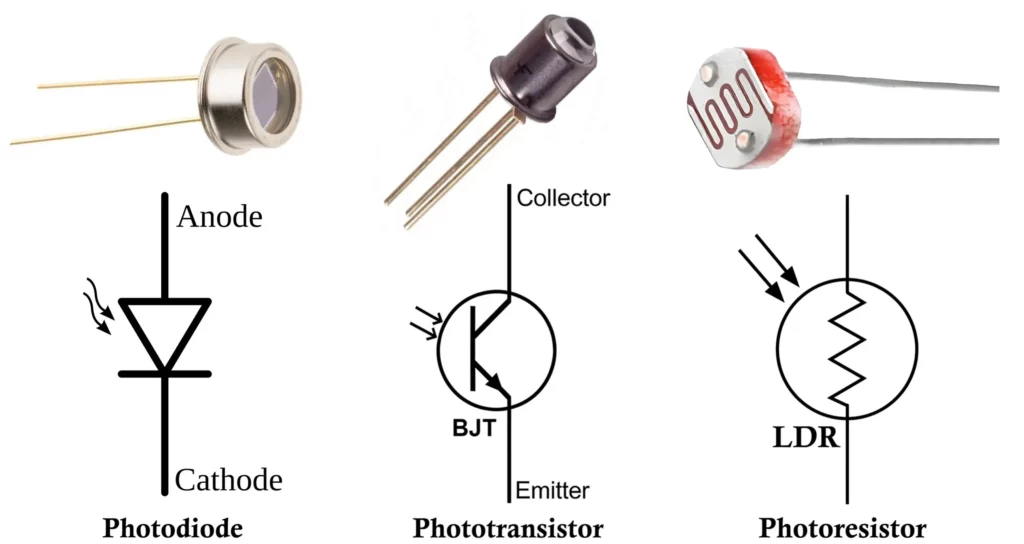
In the field of electronics and optoelectronics, light-sensitive devices play a crucial role in converting light signals into electrical signals. Among the most widely used light sensors are the Photodiode, Phototransistor, and Photoresistor (also known as Light Dependent Resistor or LDR). Though they all respond to light, their construction, working principles, advantages, disadvantages, and applications differ significantly. This article explores these differences in-depth, helping you understand which device is best suited for specific applications.
Photodiode
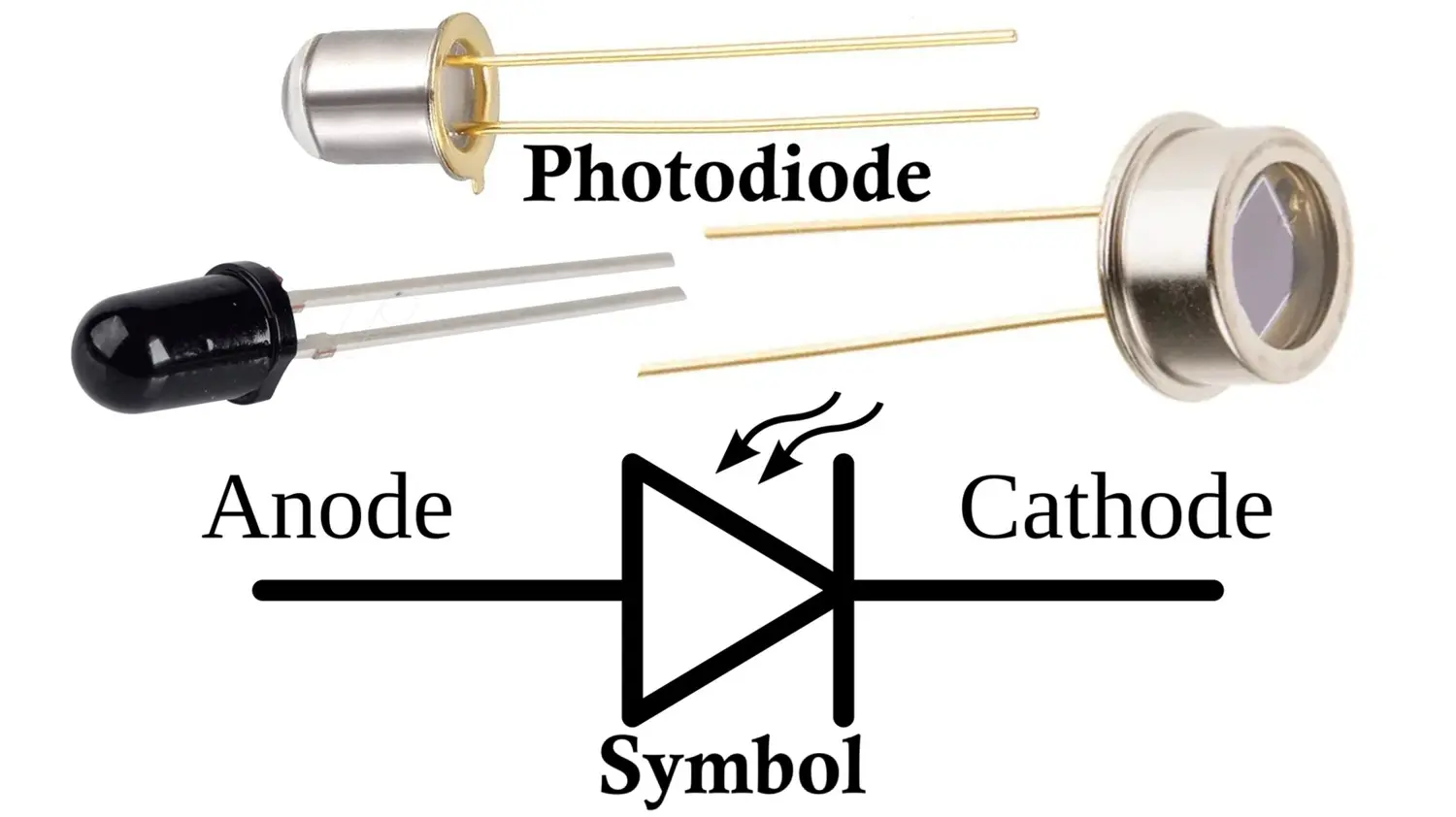
Photodiode Construction
A photodiode is a semiconductor device designed to convert light into electrical current. It operates similarly to a regular p-n junction diode but is optimized for light sensitivity.
- P-N Junction: The core structure consists of a p-type and n-type semiconductor junction.
- Transparent Window/Glass Cover: Allows light to enter and reach the junction without obstruction.
- Depletion Region: Where incident photons are absorbed to generate electron-hole pairs.
- Metal Contacts: For external electrical connections.
- Package: Usually encapsulated in a light-transparent casing to protect the photodiode while allowing light in.
Working Principle
The operation of a photodiode is based on the photoelectric effect.
- Photovoltaic Mode (Zero bias):
- Light generates electron-hole pairs.
- A small photocurrent is produced without external bias (used in solar cells).
- Photoconductive Mode (Reverse bias):
- A reverse voltage is applied across the p-n junction.
- Incident light creates electron-hole pairs in the depletion region.
- The reverse bias widens the depletion region and improves response time.
- The generated photocurrent is proportional to the light intensity.
Equation:
I = IL − ID
Where:
- I = Net current
- IL = Light-generated photocurrent
- ID = Dark saturation current (without light)
Advantages of Photodiode
- High Speed: Fast response time, ideal for high-speed applications.
- Wide Spectral Response: Can detect a broad range of wavelengths depending on the semiconductor material.
- Compact Size: Small and suitable for integration in circuits.
- High Linearity: Photocurrent is linearly proportional to light intensity over a wide range.
- Low Power Consumption: Works in reverse bias with low operating power.
Disadvantages of Photodiode
- Low Sensitivity: Compared to other photodetectors like photomultiplier tubes.
- Requires Reverse Bias: Adds complexity to the circuit.
- Temperature Dependence: Dark current increases with temperature, causing noise.
- Limited Dynamic Range: Photocurrent saturates at high light intensities.
- Need for Amplification: Often requires a preamplifier for weak signals.
Photodiode – Symbol, Construction, Working, Types and Applications
Applications of Photodiode
- Optical Communication: Used in fiber optic systems to detect light pulses.
- Solar Cells: Convert sunlight into electrical energy.
- Light Meters: In cameras and industrial sensors.
- Barcode Scanners: Detect light reflected from barcode patterns.
- Smoke Detectors: Sense light interruption due to smoke.
- Medical Instruments: In devices like pulse oximeters.
- Safety Systems: In automatic doors and alarms.
- Position Sensing: In optical encoders for robotics and machinery.
Phototransistor
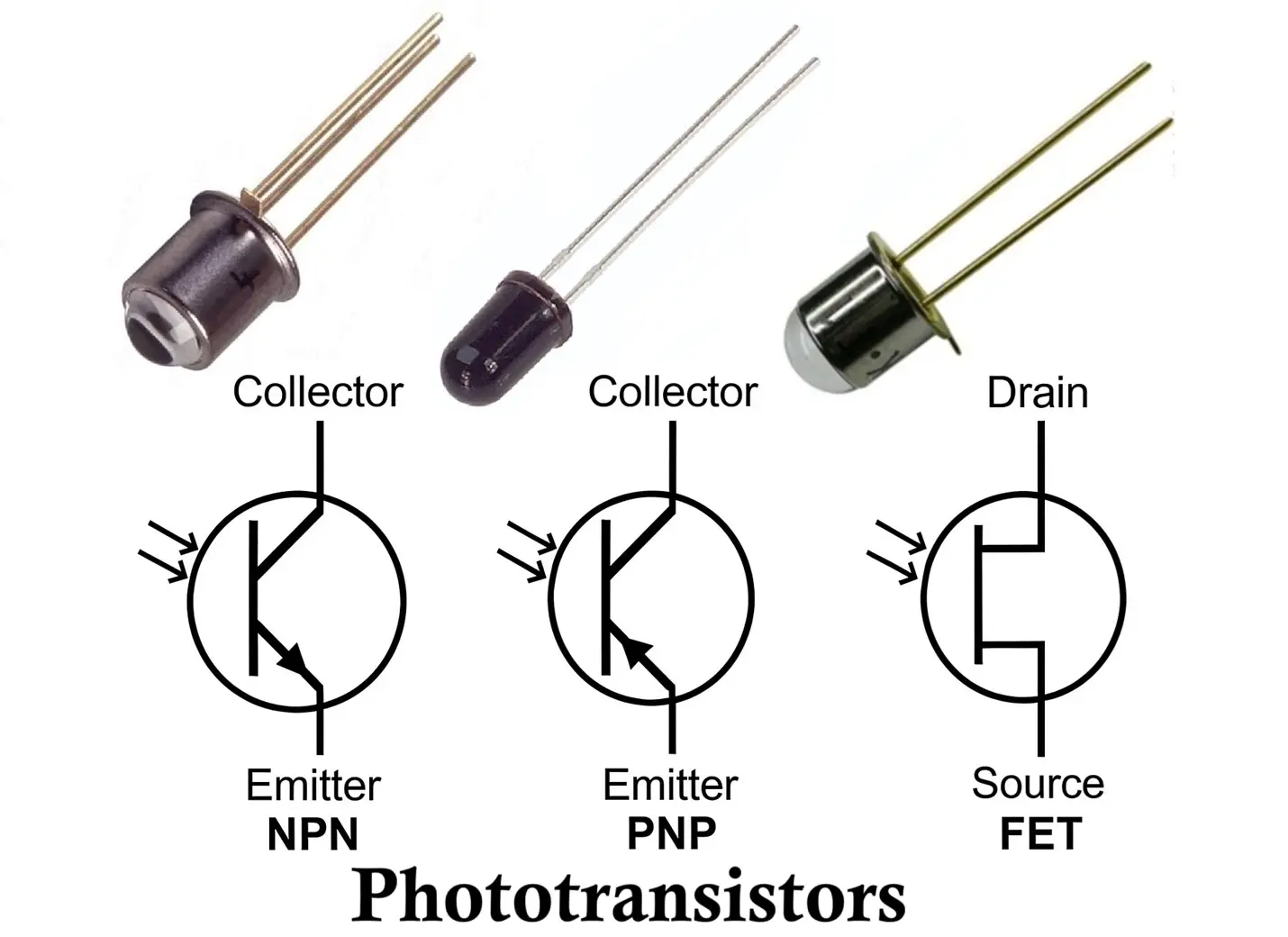
Phototransistor Construction
A phototransistor is a semiconductor device that combines the functions of a photodiode and a transistor, designed to amplify the electrical signal generated by light.
- Transistor Structure (Typically NPN or PNP): Similar to a bipolar junction transistor (BJT), consisting of Emitter (E), Base (B), and Collector (C).
- Light-Sensitive Base Region: Instead of connecting the base terminal externally, the base is exposed to light through a transparent window.
- Transparent Window/Glass Cover: Allows light to reach the base region where it generates electron-hole pairs.
- Metal Contacts: For external electrical connections (Collector and Emitter terminals).
- Package: Encapsulated in a light-transparent casing to protect the device while allowing light in.
Working Principle
The operation of a phototransistor is based on the photoelectric effect combined with transistor amplification.
- Incident Light:
- Photons strike the base region of the transistor.
- Photon energy generates electron-hole pairs in the base region.
- Amplification Effect:
- The generated carriers act as a base current, which controls a much larger current flow between the collector and emitter.
- As a result, the photocurrent is amplified by the transistor’s current gain (β\beta).
Equation:
IC = β ⋅ Iphoto
Where:
- IC = Collector current
- β = Current gain (typically 100 or more)
- Iphoto = Photogenerated current in the base region
Advantages of Phototransistor
- High Sensitivity: Due to internal amplification, can detect lower light levels compared to photodiodes.
- Simple Circuit Design: No need for external amplification in many cases.
- Compact Size: Small and easy to integrate into circuits.
- Good Linearity: Photocurrent is proportional to light intensity in a wide range.
- Cost-Effective: Low manufacturing cost.
Disadvantages of Phototransistor
- Slower Response Time: Compared to photodiodes, due to charge storage in the transistor structure.
- Limited Spectral Response: Depends on the semiconductor material used.
- Temperature Dependence: Sensitivity and dark current vary with temperature.
- Nonlinear at High Light Levels: Saturation effects limit linearity at high intensities.
- Higher Noise: Compared to photodiodes due to amplification of both signal and noise.
Phototransistor – Construction, Working, Types and Applications
Applications of Phototransistor
- Light Sensors: Detect ambient light levels in devices like automatic lighting systems.
- Optocouplers: Provide electrical isolation between circuits using light as the medium.
- Security Systems: Motion detectors and intruder alarms.
- Remote Control Receivers: Detect infrared signals from remote controls.
- Industrial Automation: Position sensing and object detection in assembly lines.
- Optical Switches: Turn circuits on/off based on light presence.
- Counting Systems: Used in optoelectronic counters for industrial applications.
Photoresistor (LDR)
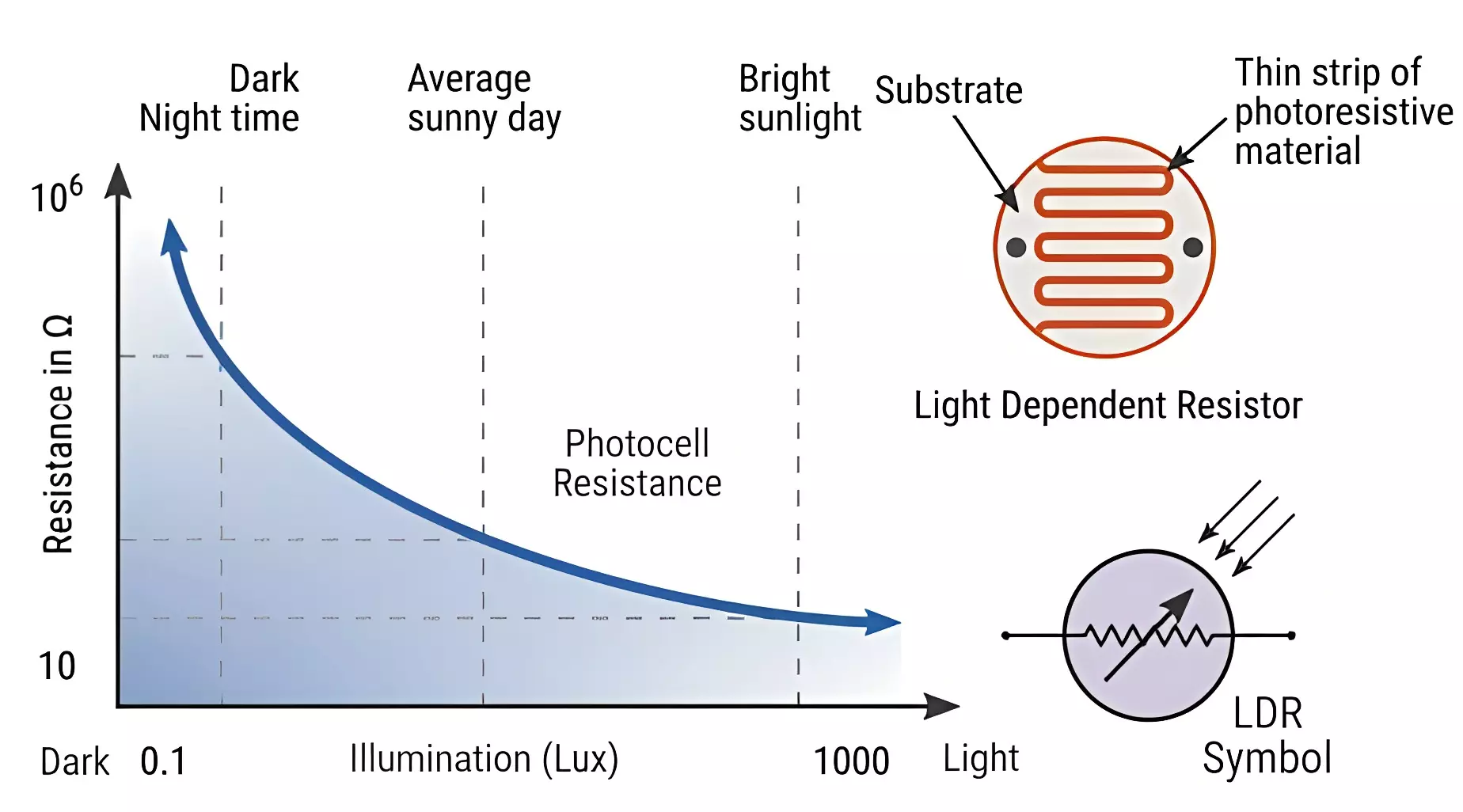
Photoresistor Construction
A photoresistor, also known as a Light Dependent Resistor (LDR), is a semiconductor device whose resistance changes based on the intensity of light falling on it.
- Semiconductor Material: Typically made from cadmium sulfide (CdS) or cadmium selenide (CdSe).
- Resistive Element: Thin film of light-sensitive semiconductor material deposited on an insulating substrate.
- Metal Contacts: Electrodes connected to the resistive layer for external electrical connections.
- Transparent Window/Glass Cover: Allows light to pass through and reach the resistive material.
- Package: Encapsulated in a protective casing with a transparent window to allow light exposure.
Working Principle
The operation of a photoresistor is based on the photoconductive effect.
- Incident Light:
- When light of sufficient energy falls on the semiconductor material, photons excite electrons from the valence band to the conduction band.
- This increases the number of free charge carriers (electrons and holes), reducing the material’s resistance.
- Resistance Variation:
- In darkness or low light, the resistance is very high (in megaohms).
- Under bright light, the resistance drops significantly (to a few hundred ohms).
Behavior Equation:
R ∝ 1/L
Where:
- R = Resistance of the LDR
- L = Light intensity
Advantages of Photoresistor (LDR)
- Simple and Easy to Use: No complex circuitry needed for basic light sensing.
- Cost-Effective: Very inexpensive compared to other light sensors.
- Wide Light Range Sensitivity: Suitable for ambient light sensing applications.
- No Power Supply Needed: Passive device, does not require power to function as a resistor.
- Compact Size: Small and easily integrable into circuits.
Disadvantages of Photoresistor (LDR)
- Slow Response Time: Typically in the range of milliseconds to seconds, unsuitable for high-speed applications.
- Poor Precision: Non-linear response makes precise light measurements difficult.
- Temperature Sensitivity: Resistance can vary with temperature, causing inaccuracies.
- Limited Spectral Response: Most LDRs are sensitive mainly to visible light, not infrared or ultraviolet.
- Aging Effect: Long-term exposure to light reduces sensitivity over time.
Light Dependent Resistor (LDR) / Photoresistor Circuit Diagram & Working
Applications of Photoresistor (LDR)
- Light Sensors: Automatic street lighting systems that turn on at dusk and off at dawn.
- Brightness Control: In devices like display screens to adjust brightness automatically.
- Alarm Systems: Detect light interruptions in security setups.
- Photography Light Meters: Measure ambient light for correct exposure settings.
- Solar Garden Lights: Turn on when ambient light is low.
- Clock Radios: Adjust display brightness based on room lighting.
- Industrial Automation: Object detection by light interruption.
Comparison of Photodiode, Phototransistor and Photoresistor
Here is a clear and concise comparison table showing the difference between Photodiode, Phototransistor, and Photoresistor:
| Feature | Photodiode | Phototransistor | Photoresistor (LDR) |
|---|---|---|---|
| Operating Principle | Converts light into current (photovoltaic or photoconductive mode) | Acts like a transistor controlled by light intensity | Changes resistance based on light intensity |
| Response Time | Very fast (nanoseconds to microseconds) | Moderate (microseconds to milliseconds) | Slow (milliseconds to seconds) |
| Sensitivity | Moderate sensitivity | Higher sensitivity than photodiode | Lower sensitivity compared to others |
| Linearity | Linear response to light intensity | Non-linear but more sensitive than photodiode | Strongly non-linear |
| Spectral Response | Wide range (depends on semiconductor material) | Similar to photodiode, but usually narrower | Broad, depending on material |
| Biasing Requirement | Requires reverse bias for photoconductive mode or works in photovoltaic mode | Requires proper biasing circuit | Passive element; no biasing needed |
| Applications | Optical communication, light meters, optical switches | Light detection in control circuits, optical sensors | Light-sensitive switches, street lighting, simple light detection |
| Cost | Moderate | Moderate to high | Low |
| Complexity | Requires external circuitry for amplification | Provides internal amplification | Very simple to use |
| Output Type | Current or voltage | Current or voltage (higher output than photodiode) | Resistance variation |
This table summarizes the key differences and typical uses of each type of light sensor component.
Conclusion
Choosing the right light-sensitive component depends on the application requirements:
- Use Photodiodes when high-speed and precise linear response are needed, especially in optical communication and sensing applications.
- Choose Phototransistors when you need higher sensitivity and built-in amplification, such as in light barriers and simple digital light detection systems.
- Opt for Photoresistors (LDRs) for simple light detection tasks where cost and ease of use are more critical than response speed or precision, like automatic lighting control.
Each of these devices serves a unique purpose, and understanding their differences enables engineers and hobbyists alike to design more efficient and purpose-driven electronic circuits.
What is a Sensor? Types of Sensors, Classification & Applications
Piezoelectric Transducer – Construction, Working and Applications