
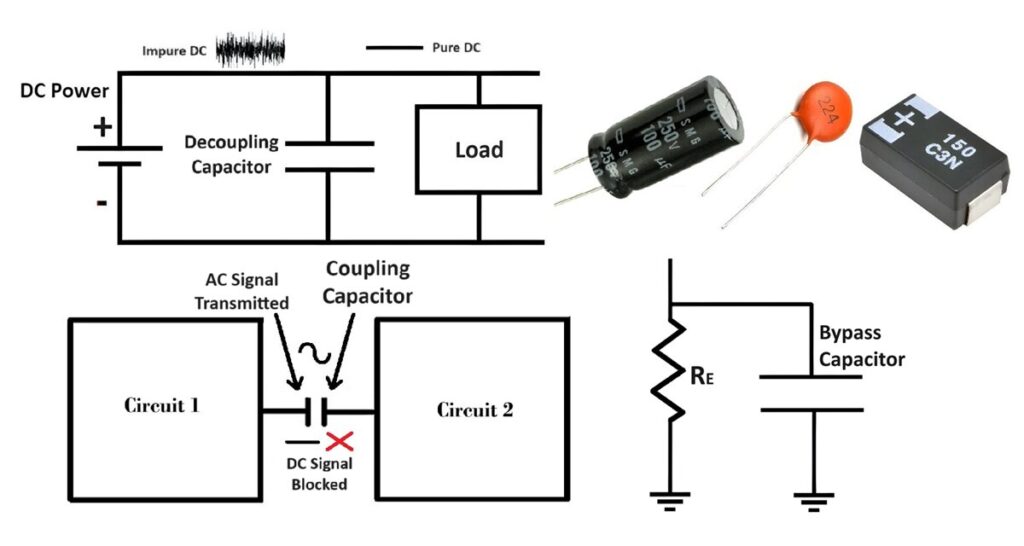
Capacitors are fundamental components in electronic circuits, performing various critical functions. Among the many types of capacitors, coupling, decoupling, and bypass capacitors are particularly important. Although they might seem similar at first glance, each serves a unique purpose in ensuring the proper functioning of electronic systems. This article explores the differences between coupling, decoupling, and bypass capacitors, shedding light on their roles and applications in electronics.
1. Coupling Capacitors:
Definition and Function: Coupling capacitors, also known as DC blocking capacitors, transmit alternating current (AC) signals from one stage of a circuit to another while blocking direct current (DC) components. Their primary function is to isolate different sections of a circuit, preventing DC biasing from one stage from affecting the other.

Applications:
- Audio Systems: Coupling capacitors are used to pass audio signals between different stages of an amplifier without transferring DC offsets.
- Signal Processing: They are essential in analog signal processing to ensure that only the AC signal passes through, maintaining the integrity of the signal.
Example: In an audio amplifier, a coupling capacitor placed between the pre-amplifier and power amplifier stages allows the AC audio signal to pass through while blocking any DC voltage that could distort the sound output.
2. Decoupling Capacitors:
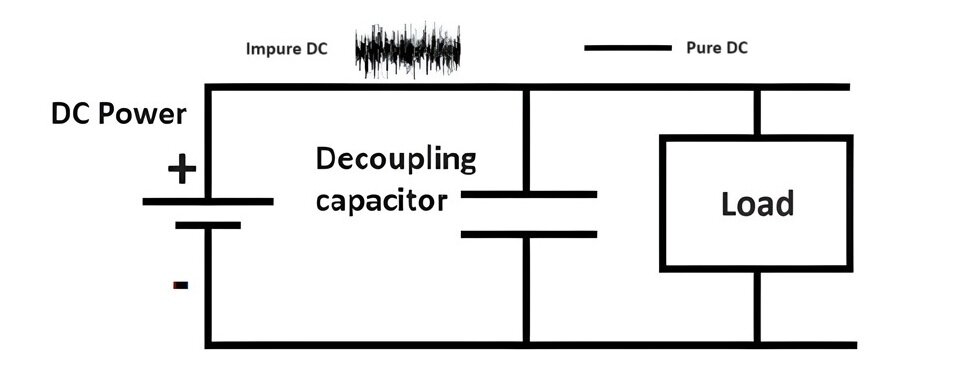
Definition and Function: Decoupling capacitors, also known as smoothing capacitors, filter out noise and stabilize voltage supply in electronic circuits. They are placed between the power supply and ground to smooth out voltage fluctuations and provide a stable DC supply to the active components.
Applications:
- Microcontroller Circuits: Decoupling capacitors are used near microcontrollers to filter out noise from the power supply, ensuring stable operation.
- Digital Circuits: In high-speed digital circuits, they are crucial for mitigating transient voltage spikes that occur due to rapid switching of digital signals.
Example: In a microcontroller circuit, a decoupling capacitor placed close to the power pins absorbs the noise generated by the microcontroller’s rapid switching, preventing it from affecting other parts of the circuit.
3. Bypass Capacitors:
Definition and Function: Bypass capacitors provide a low-impedance path for high-frequency noise, effectively bypassing it to the ground. They are placed parallel to the power supply line and the ground to divert high-frequency noise away from the sensitive components.

Applications:
- Radio Frequency (RF) Circuits: Bypass capacitors are used to filter out high-frequency noise in RF circuits, ensuring signal integrity.
- Analog Circuits: In analog circuits, they help in reducing noise and ensuring a clean power supply to sensitive components like operational amplifiers.
Example: In an RF amplifier, a bypass capacitor connected across the power supply line and ground diverts high-frequency noise away from the amplifier, ensuring a cleaner signal.
Key Differences:
Purpose:
- Coupling Capacitors: Transfer AC signals between stages while blocking DC.
- Decoupling Capacitors: Stabilize the power supply by filtering out noise and voltage fluctuations.
- Bypass Capacitors: Provide a low-impedance path for high-frequency noise to ground.
Placement:
- Coupling Capacitors: Between circuit stages.
- Decoupling Capacitors: Near power supply lines and active components.
- Bypass Capacitors: Parallel to the power supply line and ground.
Frequency Handling:
- Coupling Capacitors: Handle AC signals, typically within the audio or signal processing range.
- Decoupling Capacitors: Handle a broad range of frequencies to stabilize power supply.
- Bypass Capacitors: Specialize in high-frequency noise filtration.
Coupling, Decoupling, and Bypass Capacitors Difference:
Here is a table that outlines the differences between coupling, decoupling, and bypass capacitors:
| Aspect | Coupling Capacitor | Decoupling Capacitor | Bypass Capacitor |
|---|---|---|---|
| Primary Function | Passes AC signals between stages while blocking DC | Reduces noise by stabilizing voltage supply | Provides a low-impedance path to ground for AC signals |
| Usage | Signal processing and transmission circuits | Power supply circuits | Power supply and analog circuits |
| Location | Between stages of an amplifier or different circuit blocks | Across power supply pins of ICs or devices | Across power supply lines or close to ICs |
| Purpose | Allows AC signals to pass and blocks DC components | Filters out voltage spikes and noise | Shunts AC noise to ground, stabilizing voltage |
| Capacitance Value | Typically small (pF to µF) | Generally larger (nF to µF) | Varies depending on application (nF to µF) |
| Effect on AC | Allows AC signals to pass | Provides a stable AC environment | Short-circuits high-frequency noise |
| Effect on DC | Blocks DC signals | Maintains constant DC voltage | Stabilizes DC voltage by filtering AC noise |
| Example Application | Audio amplifiers, RF circuits | Digital circuits, power supplies | Power lines in analog and digital circuits |
This table should help you quickly compare and understand the differences between coupling, decoupling, and bypass capacitors.
Conclusion:
Understanding the roles of coupling, decoupling, and bypass capacitors is essential for designing effective and reliable electronic circuits. While they may appear similar, their distinct functions and applications highlight the nuanced requirements of electronic design. Coupling capacitors ensure proper signal transmission, decoupling capacitors stabilize power supplies, and bypass capacitors mitigate high-frequency noise, collectively contributing to the smooth operation of complex electronic systems.
3 Simple IR Proximity Sensor Circuits with Working & Applications