
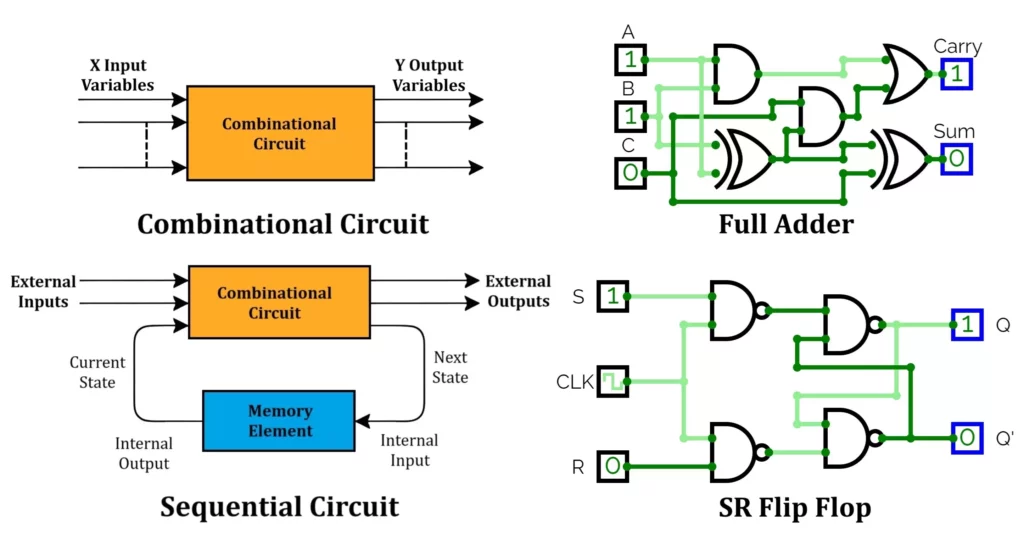
Digital circuits are broadly classified into two types: Combinational Circuits and Sequential Circuits. These circuits are fundamental building blocks in digital electronics and play a significant role in designing various digital systems. This article explores the differences between these two types of circuits in detail, discussing their characteristics, examples, advantages, disadvantages, applications along with some frequently asked questions.
What is a Combinational Circuit?
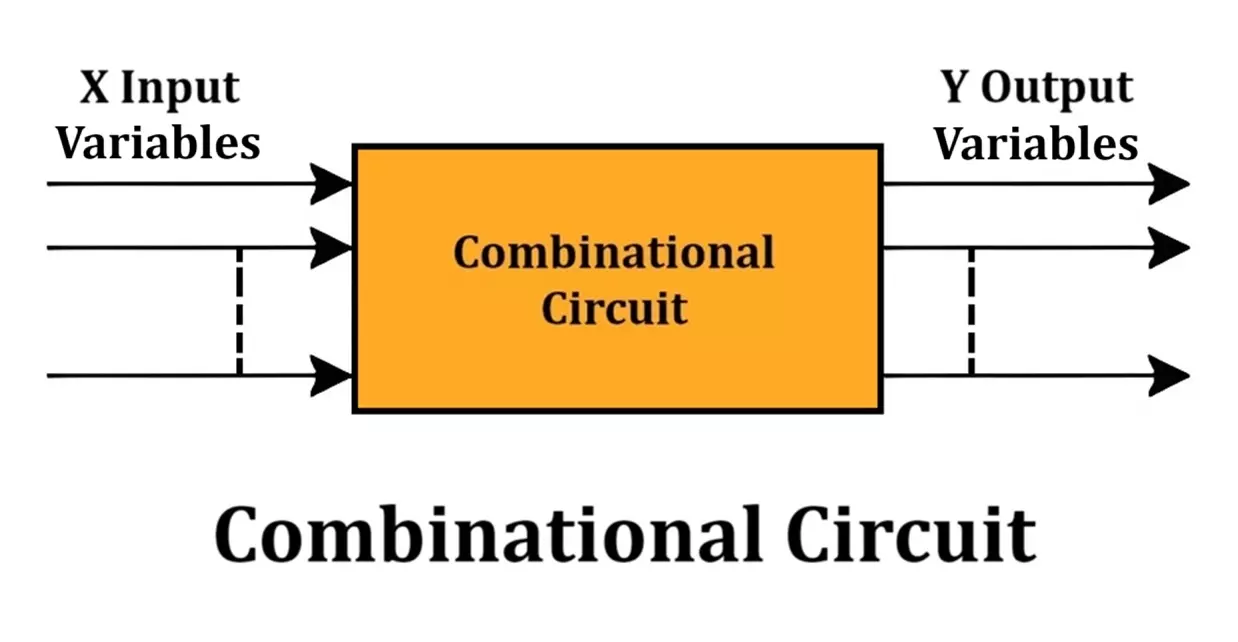
A Combinational Circuit is a type of digital circuit where the output solely depends on the current input values. These circuits do not have any memory elements, meaning that they do not store any past input information. This makes them suitable for applications where real-time processing is required without the need for storing previous states.
Characteristics of Combinational Circuits:
- Output depends only on the present input.
- No feedback paths.
- No memory elements (e.g., flip-flops or latches).
- Designed using logic gates like AND, OR, NOT, NAND, NOR, XOR, and XNOR.
- Fast processing as they do not require clock pulses.
- Used in real-time computations where history is not required.
- Simplifies the circuit design due to the absence of sequential dependencies.
Examples of Combinational Circuits:
- Multiplexers (MUX) – Used to select one input from multiple sources.
- Demultiplexers (DEMUX) – Used to distribute one input to multiple outputs.
- Encoders – Convert multiple input signals into a smaller number of outputs.
- Decoders – Convert binary information from encoded inputs to a specific output.
- Half Adder and Full Adder – Perform binary addition.
- Half Subtractor and Full Subtractor – Perform binary subtraction.
- ALU (Arithmetic Logic Unit) – Performs logical and arithmetic operations.
- Parity Generators and Checkers – Used in error detection in digital communication.
Advantages of Combinational Circuits:
- Simpler to design as they do not require memory components.
- Faster operation due to the absence of storage elements.
- Reduced complexity compared to sequential circuits.
- Used in arithmetic, logic, and data processing applications.
- No need for synchronization as it does not rely on clock pulses.
Disadvantages of Combinational Circuits:
- Cannot store past states.
- Not suitable for applications requiring memory or state retention.
- May require a large number of gates for complex logic functions.
What is a Sequential Circuit?
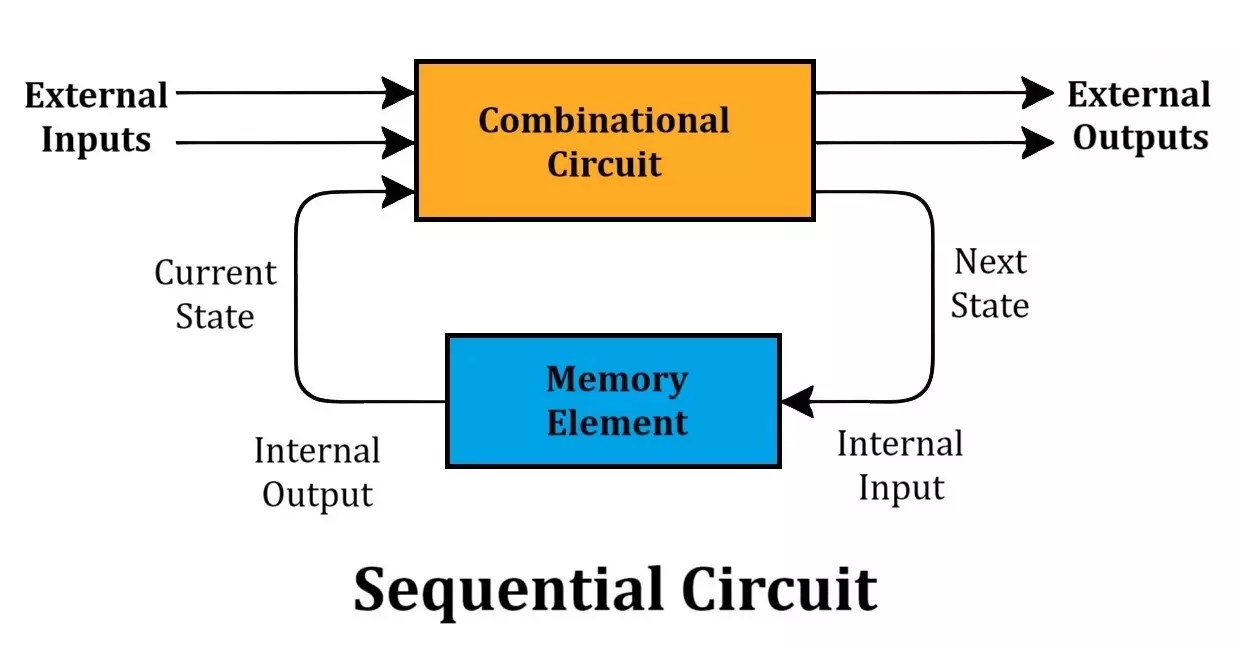
A Sequential Circuit is a type of digital circuit where the output depends not only on the present input but also on the past input history (i.e., previous states). These circuits have memory elements that store previous states, allowing them to perform operations based on past data as well as current input.
Characteristics of Sequential Circuits:
- Output depends on both present and past inputs.
- Contain memory elements like flip-flops, latches, or registers.
- Require clock signals for synchronization.
- Can store state information, making them ideal for memory and control applications.
- Used in finite state machines (FSMs) to implement control logic.
- More complex compared to combinational circuits due to feedback loops.
Examples of Sequential Circuits:
- Flip-Flops (SR, JK, D, T Flip-Flops) – Basic memory storage elements.
- Registers – Store multiple bits of data for processing.
- Counters (Synchronous & Asynchronous Counters) – Used for counting applications.
- Shift Registers – Used in data serialization and deserialization.
- Finite State Machines (FSMs) – Control units in processors and automation systems.
- Memory Units (RAM, ROM, Cache) – Store and retrieve data.
- Timers and Clocks – Generate precise time delays and clock pulses.
- Control Units in Microprocessors – Direct the operations of the processor.
Advantages of Sequential Circuits:
- Can store and retain information.
- Suitable for applications requiring state transitions.
- Used in memory units, processors, and communication systems.
- More efficient in managing complex functions requiring history or state management.
Disadvantages of Sequential Circuits:
- More complex design due to memory elements.
- Slower operation compared to combinational circuits because of the additional delay caused by memory components.
- Require synchronization using clock pulses, leading to timing constraints.
- Higher power consumption due to the continuous use of clock signals.
Comparison of Combinational and Sequential Circuits
| Feature | Combinational Circuit | Sequential Circuit |
|---|---|---|
| Definition | Output depends only on current input. | Output depends on current and past input (stored state). |
| Memory Elements | No memory elements. | Uses memory elements (flip-flops, latches). |
| Feedback Path | No feedback path. | Uses feedback to store previous states. |
| Clock Requirement | Does not require a clock. | Requires a clock for synchronization. |
| Examples | Multiplexers, Encoders, Adders. | Flip-flops, Counters, Registers. |
| Complexity | Simpler to design. | More complex due to memory components. |
| Speed | Faster as no memory elements introduce delay. | Slower due to the need for state transitions. |
| Application | Arithmetic operations, Data processing. | Memory storage, Sequence generation, State machines. |
| Power Consumption | Generally lower as it operates instantly. | Higher due to continuous clock usage. |
Applications of Combinational Circuits:
- Used in arithmetic and logic units (ALU).
- Data transmission systems (e.g., multiplexers and encoders).
- Digital signal processing (DSP) applications.
- Code converters and comparators.
- Error detection and correction systems.
Applications of Sequential Circuits:
- Used in memory units like RAM, ROM, and registers.
- Control units in microprocessors and microcontrollers.
- Digital clocks and timing applications.
- Communication protocols and data synchronization.
- Finite state machines in automation and robotics.
Conclusion
Both combinational and sequential circuits play crucial roles in digital electronics. Combinational circuits are ideal for applications requiring fast and simple logic processing, while sequential circuits are used in memory and state-dependent operations. A thorough understanding of these two circuit types is essential in designing efficient digital systems, whether for computation, control, or communication applications.
FAQs
1. Why is a sequential circuit slower than a combinational circuit?
A sequential circuit is slower because it involves memory elements and requires clock signals for synchronization, introducing additional delays.
2. Can a combinational circuit store information?
No, combinational circuits cannot store information as they lack memory elements. Only sequential circuits have the capability to store past states.
3. Which circuit is better: Combinational or Sequential?
Both have their advantages. Combinational circuits are better for fast and simple operations, whereas sequential circuits are essential for tasks requiring memory and state-dependent processing.
4. Where are combinational and sequential circuits used together?
Many digital systems, like microprocessors, use both. Combinational circuits are used for arithmetic operations, while sequential circuits manage registers and memory.
5. What is an example of a real-world sequential circuit?
A digital watch is a good example of a sequential circuit, as it stores time and updates based on past states.
Types of Logic Gates with Symbol, Truth Table and IC Numbers
What is Flip Flop Circuit? Types of Flip Flops with Truth Table