
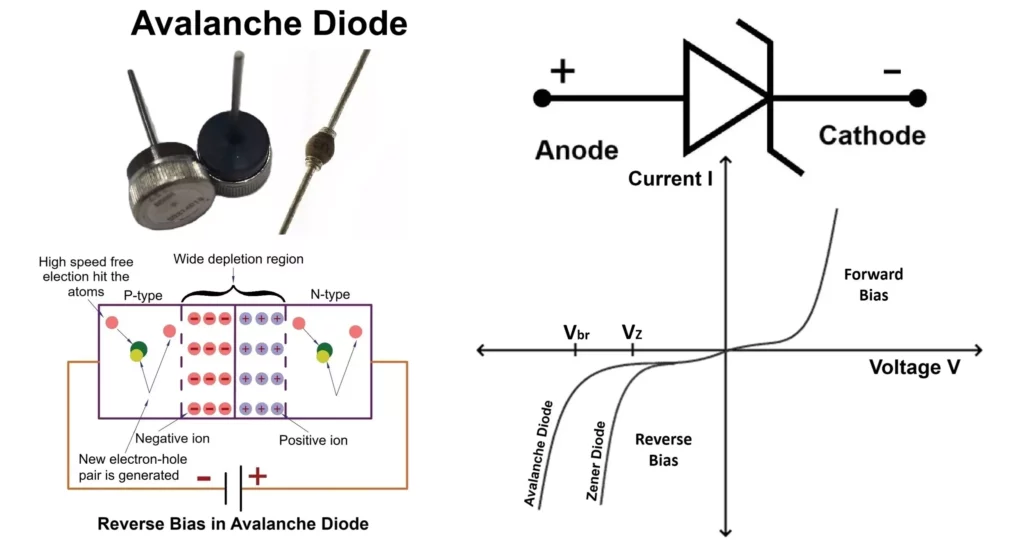
The avalanche diode is a specialized type of semiconductor diode designed to operate in the reverse breakdown region without getting damaged. It plays a critical role in protecting electronic circuits from high voltage spikes and is commonly used in voltage regulation and surge protection applications. This article explores the avalanche diode in depth, from its symbol and internal construction to its working principle, characteristics, pros and cons, and applications.
Symbol of Avalanche Diode
The circuit symbol of an avalanche diode resembles a Zener diode, with a minor distinction to reflect its avalanche breakdown capability.
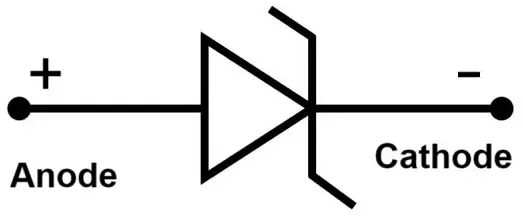
- The symbol includes a sharp, bent line on the cathode side (similar to a Zener diode), representing its ability to operate in reverse breakdown.
- Often, the avalanche diode symbol is not distinctly different from a Zener diode, but in circuit diagrams, it is labeled or denoted explicitly as “Avalanche Diode.”
Construction of Avalanche Diode
The avalanche diode is constructed using a heavily doped p-n junction, but with specific attention to doping levels and junction width to operate in reverse bias and support avalanche breakdown without permanent damage.
- P+ Region (Heavily Doped P-Type):
- This is the anode of the diode.
- It is heavily doped to ensure a high concentration of holes, facilitating efficient current flow.
- N− Region (Lightly Doped N-Type):
- Also known as the drift region, this layer is lightly doped and relatively thick.
- The light doping and increased thickness allow for a wider depletion region, which is crucial for sustaining high reverse voltages and enabling the avalanche multiplication process.
- N+ Region (Heavily Doped N-Type):
- This serves as the cathode of the diode.
- The heavy doping provides a high concentration of electrons, ensuring low resistance and efficient current flow.
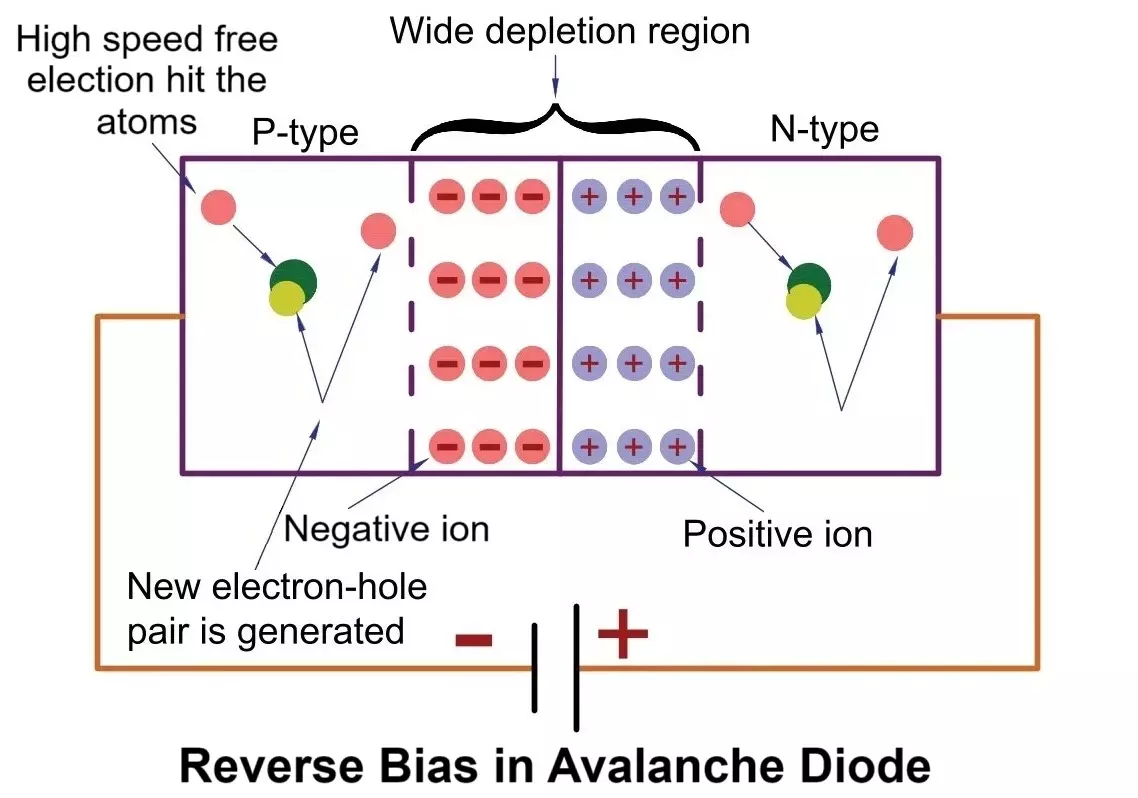
- P-N Junction: The junction is lightly doped and wide compared to that of a Zener diode.
- Breakdown Region: Designed to undergo avalanche breakdown rather than Zener breakdown.
- Material: Typically made from silicon.
- Encapsulation: Packaged in protective enclosures to dissipate heat and withstand surge voltages.
Avalanche Breakdown vs Zener Breakdown
Zener breakdown:
Zener breakdown occurs in heavily doped pn-junction diodes at low reverse voltages, typically below 5V. Due to heavy doping, the depletion region becomes very narrow, and when a reverse voltage is applied, it creates a strong electric field across this thin region. This field is strong enough to cause quantum mechanical tunneling, where electrons from the valence band of the p-side tunnel directly into the conduction band of the n-side. This sudden movement of electrons results in a sharp increase in reverse current. Zener breakdown is a controlled and reversible process, commonly used in Zener diodes for voltage regulation in circuits.
Avalanche breakdown:
Avalanche breakdown, on the other hand, occurs in lightly doped diodes with a wider depletion region and at higher reverse voltages (typically above 6V). When the reverse bias is large enough, minority carriers gain high kinetic energy due to the electric field. These energetic carriers collide with atoms in the lattice, creating more electron-hole pairs through a process called impact ionization. This leads to a chain reaction of carrier multiplication, causing a large and sudden increase in current. Unlike Zener breakdown, avalanche breakdown can damage the diode if the current is not properly limited, but it is used in devices like avalanche diodes and surge protectors.
Unlike Zener diodes (which have a breakdown voltage typically < 5V), avalanche diodes are designed for higher breakdown voltages (usually above 6V to hundreds of volts).
Working Principle of Avalanche Diode
The avalanche diode operates on the principle of avalanche breakdown. Here’s how it works:
➤ Normal Operation (Forward Bias):
- Functions like a regular diode.
- Allows current flow when anode is positive with respect to cathode.
- Forward voltage drop ~0.7V (for silicon).
➤ Reverse Bias (Key Operation Mode):
- When reverse voltage is applied, the diode blocks current up to a certain voltage (breakdown voltage).
- If the reverse voltage exceeds the breakdown voltage, the electric field across the depletion layer becomes strong enough to accelerate free electrons.
- These electrons gain enough kinetic energy to collide with the lattice atoms and release more electrons — a chain reaction called impact ionization.
- This leads to a sudden increase in reverse current — the avalanche effect.
- The diode continues to conduct in reverse without damage, provided the current is limited by external resistance.
Important: The diode must be operated within its power dissipation rating to avoid thermal runaway or permanent damage.
VI Characteristics of Avalanche Diode
1. Forward Bias Region
- When the avalanche diode is forward biased (positive voltage to the p-side), it behaves just like a normal diode.
- The current remains very small until the forward voltage crosses the threshold (~0.7V for silicon).
- After this point, current rises exponentially with voltage.
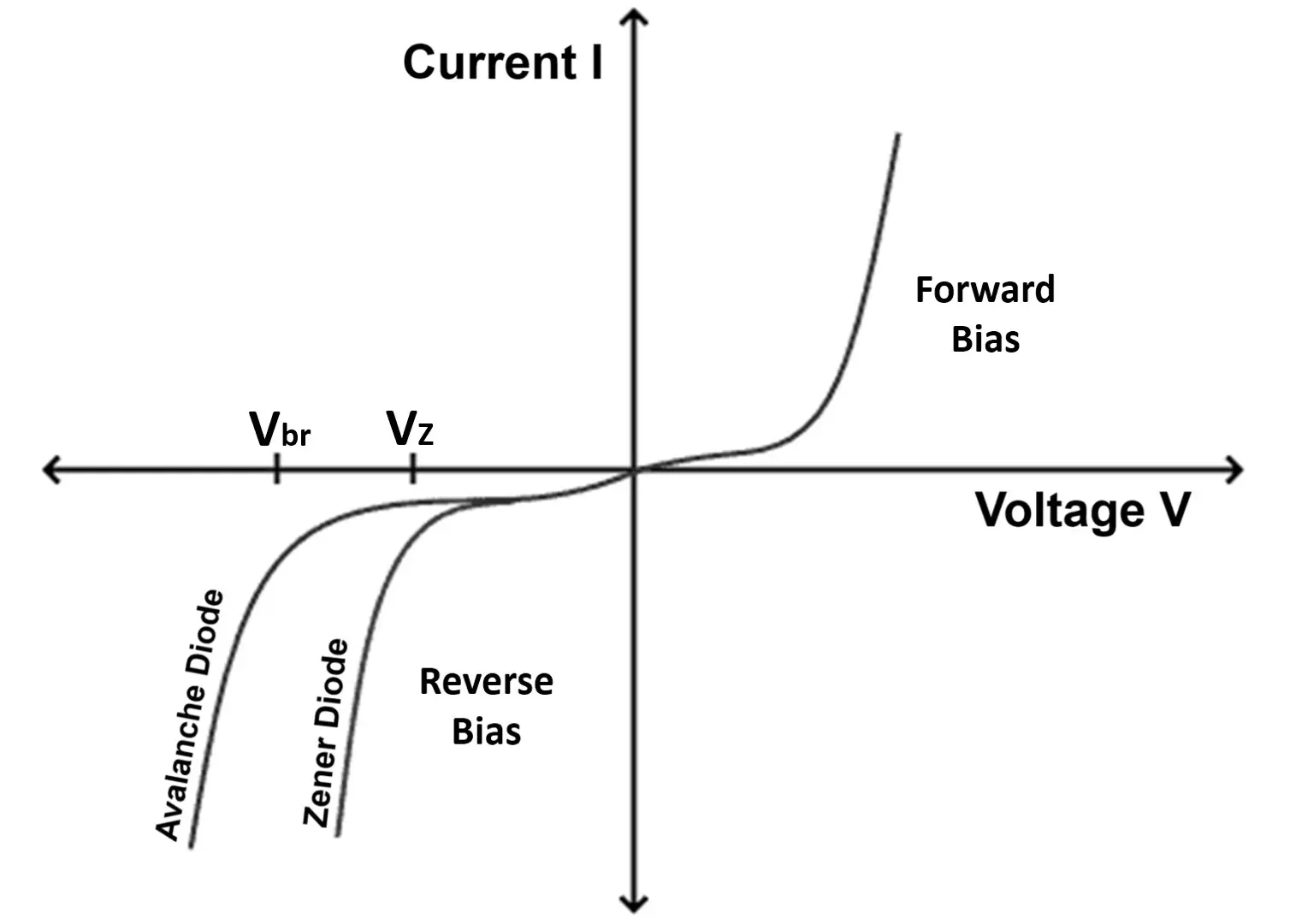
Key Terms:
- Vbr: Avalanche breakdown voltage (typically >6V)
- VZ: Zener breakdown voltage (typically <6V)
2. Reverse Bias Region (Before Breakdown)
- As reverse voltage increases, the diode blocks current, allowing only a small leakage current (reverse saturation current).
- The diode remains in its non-conductive state, and current stays minimal.
3. Avalanche Breakdown Region
- Once the reverse voltage exceeds a certain critical value (called the breakdown voltage, typically >6V), the diode enters avalanche breakdown.
- At this point, reverse current shoots up sharply, even with a small increase in voltage.
- The voltage across the diode stays nearly constant at the breakdown voltage, while current can rise significantly (depending on external circuit resistance).
Important: Avalanche diodes are designed to withstand breakdown safely, unlike regular diodes which can be damaged if this happens. However, the current must be limited using an external resistor to prevent thermal damage.
Advantages of Avalanche Diode
- High Voltage Tolerance: Can withstand high reverse voltages without breakdown damage.
- Fast Response Time: Ideal for protecting circuits against sudden voltage spikes.
- Stable Operation: Operates stably in avalanche breakdown mode with proper current limiting.
- High Reliability: Robust construction makes it suitable for industrial and power electronics.
- Surge Protection: Commonly used as a clamp to protect sensitive components.
Disadvantages of Avalanche Diode
- Requires Series Resistor: Must have external current limiting to avoid thermal damage.
- High Power Dissipation: Generates significant heat in breakdown mode.
- Higher Cost: More expensive than standard diodes or Zener diodes in many applications.
- Larger Size: Often bigger than Zener diodes due to high-voltage construction.
Applications of Avalanche Diode
- Overvoltage Protection:
- Clamps voltage spikes in power supplies, automotive electronics, etc.
- Acts like a one-shot surge protector.
- Switching Circuits:
- Used in fast switching applications due to quick response.
- Radio and RF Systems:
- Used as noise sources in communication systems.
- Avalanche noise generation used in random number generators.
- Telecommunication Circuits:
- Protects data lines and signal paths from voltage transients.
- Voltage Regulation (in some cases):
- Similar to Zener diode, but for higher voltage regulation.
- Laser Diodes (Avalanche Photodiodes):
- Modified forms are used to detect low-intensity light with internal gain.
Difference Between Zener Diode and Avalanche Diode
Here’s a clear comparison between Zener Diode and Avalanche Diode:
| Feature | Zener Diode | Avalanche Diode |
|---|---|---|
| Breakdown Mechanism | Zener breakdown (quantum tunneling) | Avalanche breakdown (impact ionization) |
| Doping Level | Heavily doped | Lightly doped |
| Depletion Region | Narrow | Wide |
| Breakdown Voltage | Typically less than 5V | Typically greater than 6V |
| Voltage Stability | Very stable at low voltages | Stable at high voltages |
| Temperature Coefficient | Negative (voltage decreases with temperature) | Positive (voltage increases with temperature) |
| Reverse Current | Sharp increase at breakdown, but lower than avalanche | Sharp and higher reverse current at breakdown |
| Application Use | Voltage regulation, reference voltage | Surge protection, high-voltage regulation |
| Damage Risk | Less prone to damage if within limits | Can be damaged if current is not limited |
| Noise | Low, known as “shot noise” | Higher noise, known as “avalanche noise” |
Conclusion
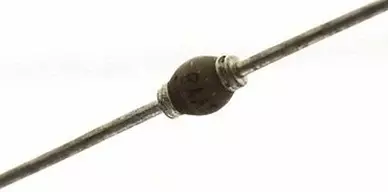
The avalanche diode is a powerful and reliable component in electronics, especially when it comes to handling high reverse voltages and protecting circuits from spikes. Unlike ordinary diodes, it safely operates in the reverse breakdown region using the avalanche effect. 1n5624, 1n5625, 1n5626, 1n5627 are some of the avalanche diodes. Whether you’re working with power supplies, automotive systems, or sensitive RF circuits, the avalanche diode proves to be an indispensable tool in ensuring durability and performance.
VI Characteristics of Zener Diode, Working and its Applications
Types of Diodes with Symbol, Definition, Working and Applications
Types of Transistors: Classification (BJT, JFET, MOSFET & IGBT)