
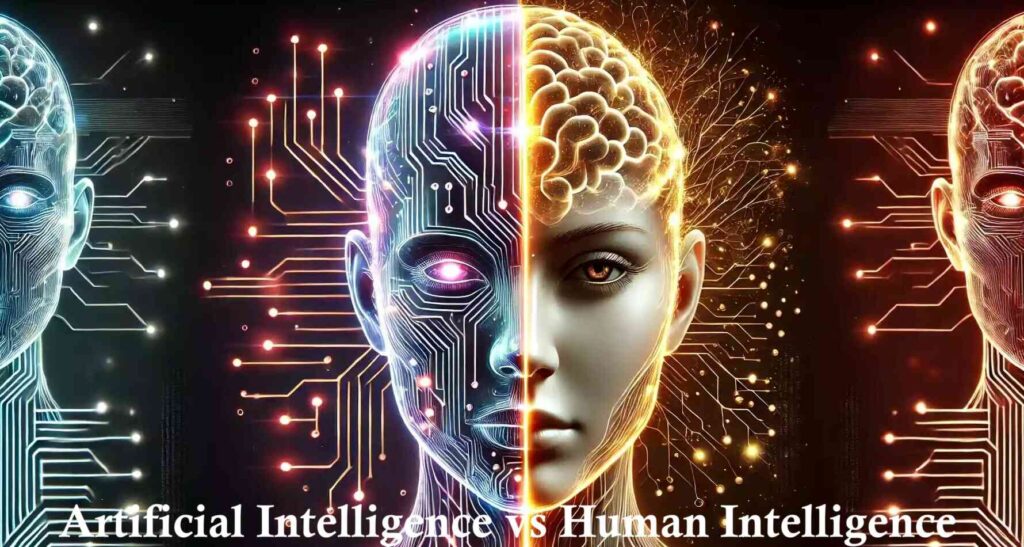
Let’s explore the difference: Artificial Intelligence vs Human Intelligence, nuances of AI and human intelligence, comparing their strengths, weaknesses, and implications for the future. In recent years, artificial intelligence (AI) has emerged as one of the most transformative technologies of our time. From self-driving cars to advanced chatbots, AI systems have demonstrated capabilities once thought to be uniquely human. However, this rapid advancement has also sparked debates about the similarities, differences, and future coexistence of AI and human intelligence.
What is Human Intelligence?
Human intelligence is a multifaceted construct encompassing cognitive abilities such as reasoning, problem-solving, learning, creativity, and emotional understanding. It is shaped by:
- Experience and Adaptability: Humans learn from past experiences and adapt their behavior to new situations. This adaptability is rooted in the brain’s neural plasticity, allowing individuals to grow intellectually and emotionally over time.
- Emotional Intelligence: Beyond logic and reasoning, humans possess the ability to perceive, understand, and manage emotions. Emotional intelligence enables empathy, social bonding, and effective communication.
- Intuition and Creativity: Human intelligence thrives on intuition and creative thinking. Unlike algorithmic processes, humans often arrive at solutions through imaginative leaps and abstract reasoning.
- Consciousness and Free Will: Humans have self-awareness and the ability to make decisions based on subjective experiences, moral values, and ethical considerations.
What is Artificial Intelligence or AI?
AI refers to the development of computer systems capable of performing tasks that typically require human intelligence. AI can be broadly categorized into:
- Narrow AI: This refers to AI systems designed to perform specific tasks, such as image recognition, language translation, or medical diagnosis. These systems excel in their defined domains but lack general cognitive abilities.
- General AI: A theoretical concept, General AI aims to replicate human-level intelligence, enabling machines to perform any intellectual task a human can. While this remains an aspiration, it underscores the ultimate goal of AI research.
- Machine Learning and Deep Learning: Machine learning enables AI systems to improve their performance over time by learning from data. Deep learning, a subset of machine learning, uses neural networks to simulate human brain processes for tasks like image and speech recognition.
Key Differences Between AI and Human Intelligence
- Learning and Adaptation:
- AI: Relies on large datasets and predefined algorithms. While AI can “learn” from data, its learning is domain-specific and lacks the generalized adaptability of humans.
- Humans: Learn through experience, observation, and social interaction. Human learning is holistic and not confined to specific datasets.
- Creativity and Innovation:
- AI: Capable of generating creative outputs (e.g., AI-generated art or music) but lacks genuine creativity. AI “creativity” is derived from patterns in training data.
- Humans: Creativity is intrinsic and often arises from intuition, imagination, and emotional depth.
- Emotional Understanding:
- AI: Can simulate emotional responses (e.g., sentiment analysis or empathetic chatbots) but lacks true emotional comprehension.
- Humans: Possess genuine emotional intelligence, enabling deep interpersonal connections and empathy.
- Speed and Efficiency:
- AI: Processes information at incredible speeds, outperforming humans in tasks like data analysis and pattern recognition.
- Humans: Slower in processing but excel in understanding context, nuance, and abstract concepts.
- Consciousness and Ethics:
- AI: Operates without consciousness or subjective experiences. Ethical decisions in AI are dictated by programming and human-defined parameters.
- Humans: Ethical reasoning is influenced by cultural, moral, and personal values, making it nuanced and context dependent.
Strengths of AI
- Data Processing: AI can analyze vast amounts of data far beyond human capacity, identifying patterns and insights with incredible precision.
- Automation: AI automates repetitive tasks, improving efficiency and reducing human error.
- 24/7 Operation: Unlike humans, AI systems do not tire, enabling continuous operation.
- Scalability: AI applications can scale across industries, from healthcare to finance to transportation.
Strengths of Human Intelligence
- Critical Thinking: Humans excel in reasoning, debating, and making judgments based on incomplete information.
- Empathy and Compassion: These uniquely human traits foster relationships, community building, and moral decision-making.
- Adaptability: Humans can navigate unpredictable situations and apply knowledge creatively across contexts.
- Ethical Considerations: Humans can evaluate the moral implications of actions, balancing logic with empathy and fairness.
Challenges and Limitations
- AI: Limited by the quality and quantity of training data, algorithmic bias, lack of creativity, and ethical concerns surrounding misuse.
- Humans: Prone to cognitive biases, emotional decision-making, and limited computational capacity compared to machines.
Artificial Intelligence (AI) vs Human Intelligence Differences
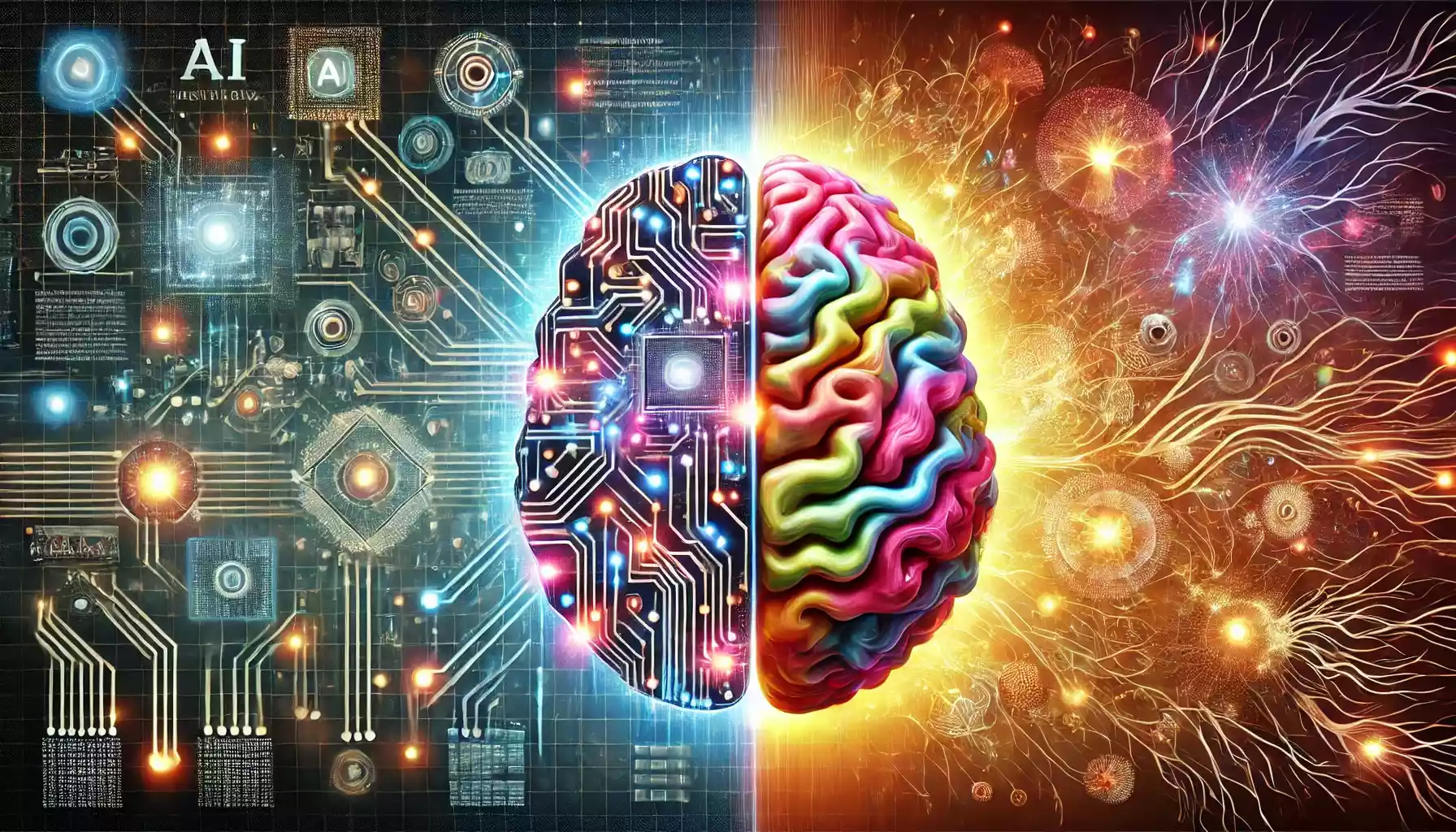
| Aspect | Artificial Intelligence (AI) | Human Intelligence |
|---|---|---|
| Definition | Machine systems designed to perform tasks requiring intelligence. | Cognitive and emotional abilities inherent to humans. |
| Learning Process | Relies on training data, algorithms, and defined rules. | Learns through experiences, intuition, and reasoning. |
| Creativity | Limited to patterns in training data; lacks true innovation. | Capable of abstract, imaginative, and original thought. |
| Adaptability | Adjusts based on programming and data; slower in unfamiliar contexts. | Adapts quickly to new, unpredictable environments. |
| Emotional Understanding | Cannot truly feel emotions; mimics emotional responses if programmed. | Naturally experiences and understands complex emotions. |
| Decision-Making | Based on logic, data patterns, and algorithms. | Balances logic, intuition, and emotional factors. |
| Speed | Processes data and computations much faster than humans. | Slower in computation but excels in contextual understanding. |
| Memory | Unlimited and precise, depending on hardware. | Limited and subject to forgetting or distortion. |
| Learning Limits | Restricted by available data and computational power. | Potentially limitless, influenced by curiosity and motivation. |
| Physical Capabilities | Depends on robotics; can work in hazardous environments. | Limited by physical endurance and biological constraints. |
| Ethics and Morality | Operates without inherent ethics unless programmed to follow guidelines. | Capable of ethical and moral reasoning. |
| Energy Efficiency | Requires significant energy to operate (e.g., servers, cooling). | Highly energy-efficient in relation to complexity of tasks. |
| Error Handling | Repeats errors unless explicitly corrected. | Learns from mistakes intuitively. |
| Contextual Awareness | Limited; struggles with subtle context and ambiguity. | Deep understanding of complex and nuanced contexts. |
| Dependency | Dependent on human input for creation, maintenance, and updates. | Independent and self-reliant for survival and growth. |
| Evolution | Evolves rapidly with technological advancements. | Evolves biologically over generations. |
AI and Human Collaboration: A Synergistic Future
The future lies in collaboration between AI and human intelligence. By leveraging their respective strengths, humans and AI can achieve extraordinary outcomes:
- Healthcare: AI-powered diagnostics can complement human doctors’ expertise, enabling faster and more accurate treatments.
- Education: AI-driven tools can personalize learning experiences, while teachers provide mentorship and emotional support.
- Workplace Efficiency: AI can handle repetitive tasks, allowing humans to focus on strategic, creative, and interpersonal roles.
- Scientific Discovery: AI accelerates research by analyzing complex data, while humans interpret findings and guide ethical applications.
Ethical Considerations and Challenges
As AI continues to advance, several ethical questions arise:
- Job Displacement: How can societies adapt to the economic shifts caused by AI automation?
- Bias and Fairness: How can we ensure AI systems are free from biases and equitable in their decisions?
- Privacy and Security: What safeguards are needed to protect data and prevent misuse of AI?
- Autonomy and Control: How do we balance AI autonomy with human oversight?
Conclusion
While AI has made remarkable strides, it remains a tool—an extension of human ingenuity. Human intelligence, with its adaptability, creativity, and emotional depth, continues to be the cornerstone of innovation and progress. By understanding the strengths and limitations of both AI and human intelligence, we can foster a future where technology augments human potential, driving progress in ways that are ethical, inclusive, and transformative.
What is a Sensor? Types of Sensors, Classification & Applications
Types of Diodes with Symbol, Definition, Working and Applications